

Motmot

Pearl-spotted Owlet vs African Barred Owlet

Glaucidium perlatum versus Glaucidium capense

Play a quiz with Pearl-spotted Owlet and African Barred Owlet
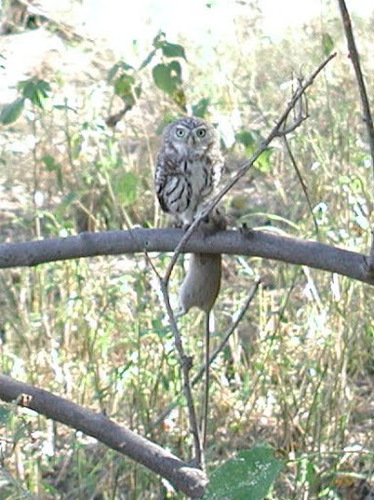
Pearl-spotted Owlet (Glaucidium perlatum) Pearl-spotted Owlet
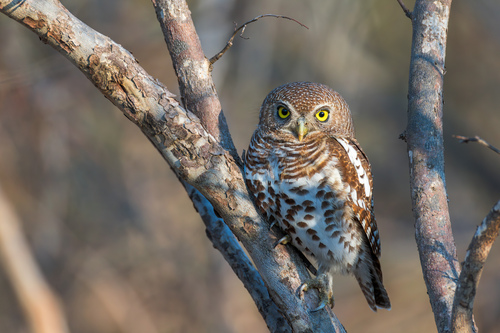
African Barred Owlet (Glaucidium capense) African Barred Owlet

Media

Loading…

In short

The most reliable way to separate Pearl-spotted Owlet from African Barred Owlet is by looking for the bold black-and-white 'false eyes' on the back of the head—present only on Pearl-spotted Owlet of all ages. Pearl-spotted shows white spots on the head and back, while African Barred Owlet is finely barred above and lacks the 'eyes.' In flight, Pearl-spotted Owlet’s upperparts and tail are boldly spotted and barred, while African Barred Owlet shows fine barring and a white shoulder stripe. Both are small, diurnal owlets, but careful attention to head pattern and upperpart markings will resolve most confusion, especially with perched or well-seen birds.

Identification tips

  1. False 'eyes' on nape: Pearl-spotted Owlet always shows two bold black spots outlined in white on the back of the head. African Barred Owlet never shows these; this is the single most reliable field mark for all ages and seasons.
  2. Head and back pattern: Pearl-spotted is heavily spotted white on the head and back, while African Barred is finely barred with buff and lacks any spots.
  3. Shoulder stripe: African Barred Owlet shows a white stripe across the shoulder (scapulars and greater coverts) when perched, which Pearl-spotted lacks.
  4. Upperwing and tail in flight: Pearl-spotted shows bold white spots forming bars on brown flight feathers and tail, visible in flight and when perched. African Barred shows fine, even barring with rufous tones and no large white spots.
  5. Facial disc and eyebrow: Pearl-spotted has an off-white facial disc and no distinct eyebrow. African Barred has a narrow white eyebrow above the eye, adding to a more 'barred' look.
  6. Breast and underparts: Pearl-spotted has a streaked breast, while African Barred has a finely barred chest and white underparts with brown spots or blotches.
  7. Tail behavior: Pearl-spotted often flicks or wags its tail when alarmed or excited, a useful behavioral clue if seen.
  8. Roosting behavior: African Barred Owlet prefers to roost in tree cavities or dense cover, while Pearl-spotted often roosts more openly under bushes or shrubs.
  9. Juvenile confusion: Even young Pearl-spotted Owlets retain the 'false eyes,' though head and back spots may be reduced. Juvenile African Barred Owlet never shows these 'eyes.'
  10. Bill and feet color: Both species have greenish-yellow bills and yellow feet, so this is not a reliable separator.
  11. Eye color: Both have yellow eyes; do not use this as a separator.
  12. Size and structure: Both are similar in size and shape; do not rely on this unless you have direct comparison.
  13. Habitat: Overlap is extensive, but Pearl-spotted is more likely in open woodland and savanna, African Barred in woodland and forest edge, sometimes deeper forest.
  14. Mobbed by small birds: Both are frequently mobbed, so this is not diagnostic.
  15. Vocalization: Not described in the notes; do not use voice for separation unless you have local knowledge.

Size

Both species are very similar in size, with Pearl-spotted Owlet averaging around 82g and 17–21 cm in length, and African Barred Owlet at about 17 cm long. Pearl-spotted Owlet females can be slightly heavier (up to 100g), but this is not a reliable field mark. Structurally, both are compact with short tails and rounded wings, and size alone is not a useful separator in the field.

Plumage

Juvenile and adult Pearl-spotted Owlets always show two prominent black 'false eyes' outlined in white on the nape, a unique and diagnostic feature. Their upperparts are cinnamon-brown with distinct white spotting, and the tail and flight feathers are brown with large white spots forming bars. Juveniles may have reduced head and back spots but the 'false eyes' remain obvious. In contrast, African Barred Owlet of all ages lacks these 'eyes' and instead has fine buff barring across the greyish-brown upperparts, with a narrow white eyebrow and a white stripe across the shoulder (formed by scapulars and greater coverts). The chest is finely barred, and the breast/flanks are white with brown spots. In flight, African Barred Owlet’s wings and tail are finely barred with rufous, and the white shoulder stripe is visible on perched birds. Underwings are white in both, but the upperwing pattern is more spotted in Pearl-spotted and barred in African Barred. Both have yellow eyes and greenish-yellow bills, but Pearl-spotted’s facial disc is more off-white.

Behaviour

Both species are partly diurnal and often seen perched in open, low positions. Pearl-spotted Owlet is especially active by day, often flicking or wagging its tail when alarmed or excited, and will change perches if disturbed. African Barred Owlet is also active during the day but tends to roost within cover, often in tree cavities, and is more likely to call at dusk and dawn. Both are frequently mobbed by small birds when discovered. Pearl-spotted Owlet may be seen bathing by day and often bobs its head or flicks its tail while hunting. African Barred Owlet is more likely to be seen perched openly scanning for prey, but both hunt from low perches and take a variety of small vertebrates and invertebrates.

Habitat

Both species occur in sub-Saharan Africa with overlapping ranges in some regions. Pearl-spotted Owlet is widespread in open woodland and savanna, typically roosting below canopies of small bushes or shrubs. African Barred Owlet is found in much of southern, central, and eastern Africa, often in woodland and forest edge, and is more likely to use tree cavities for roosting and nesting. Habitat overlap is common, so context alone is rarely diagnostic.

Submit a better description

Use the same sections as the comparison. Your text is published immediately.

The most reliable way to separate Pearl-spotted Owlet from African Barred Owlet is by looking for the bold black-and-white 'false eyes' on the back of the head—present only on Pearl-spotted Owlet of all ages. Pearl-spotted shows white spots on the head and back, while African Barred Owlet is finely barred above and lacks the 'eyes.' In flight, Pearl-spotted Owlet’s upperparts and tail are boldly spotted and barred, while African Barred Owlet shows fine barring and a white shoulder stripe. Both are small, diurnal owlets, but careful attention to head pattern and upperpart markings will resolve most confusion, especially with perched or well-seen birds.

  1. False 'eyes' on nape: Pearl-spotted Owlet always shows two bold black spots outlined in white on the back of the head. African Barred Owlet never shows these; this is the single most reliable field mark for all ages and seasons.
  2. Head and back pattern: Pearl-spotted is heavily spotted white on the head and back, while African Barred is finely barred with buff and lacks any spots.
  3. Shoulder stripe: African Barred Owlet shows a white stripe across the shoulder (scapulars and greater coverts) when perched, which Pearl-spotted lacks.
  4. Upperwing and tail in flight: Pearl-spotted shows bold white spots forming bars on brown flight feathers and tail, visible in flight and when perched. African Barred shows fine, even barring with rufous tones and no large white spots.
  5. Facial disc and eyebrow: Pearl-spotted has an off-white facial disc and no distinct eyebrow. African Barred has a narrow white eyebrow above the eye, adding to a more 'barred' look.
  6. Breast and underparts: Pearl-spotted has a streaked breast, while African Barred has a finely barred chest and white underparts with brown spots or blotches.
  7. Tail behavior: Pearl-spotted often flicks or wags its tail when alarmed or excited, a useful behavioral clue if seen.
  8. Roosting behavior: African Barred Owlet prefers to roost in tree cavities or dense cover, while Pearl-spotted often roosts more openly under bushes or shrubs.
  9. Juvenile confusion: Even young Pearl-spotted Owlets retain the 'false eyes,' though head and back spots may be reduced. Juvenile African Barred Owlet never shows these 'eyes.'
  10. Bill and feet color: Both species have greenish-yellow bills and yellow feet, so this is not a reliable separator.
  11. Eye color: Both have yellow eyes; do not use this as a separator.
  12. Size and structure: Both are similar in size and shape; do not rely on this unless you have direct comparison.
  13. Habitat: Overlap is extensive, but Pearl-spotted is more likely in open woodland and savanna, African Barred in woodland and forest edge, sometimes deeper forest.
  14. Mobbed by small birds: Both are frequently mobbed, so this is not diagnostic.
  15. Vocalization: Not described in the notes; do not use voice for separation unless you have local knowledge.

Both species are very similar in size, with Pearl-spotted Owlet averaging around 82g and 17–21 cm in length, and African Barred Owlet at about 17 cm long. Pearl-spotted Owlet females can be slightly heavier (up to 100g), but this is not a reliable field mark. Structurally, both are compact with short tails and rounded wings, and size alone is not a useful separator in the field.

Juvenile and adult Pearl-spotted Owlets always show two prominent black 'false eyes' outlined in white on the nape, a unique and diagnostic feature. Their upperparts are cinnamon-brown with distinct white spotting, and the tail and flight feathers are brown with large white spots forming bars. Juveniles may have reduced head and back spots but the 'false eyes' remain obvious. In contrast, African Barred Owlet of all ages lacks these 'eyes' and instead has fine buff barring across the greyish-brown upperparts, with a narrow white eyebrow and a white stripe across the shoulder (formed by scapulars and greater coverts). The chest is finely barred, and the breast/flanks are white with brown spots. In flight, African Barred Owlet’s wings and tail are finely barred with rufous, and the white shoulder stripe is visible on perched birds. Underwings are white in both, but the upperwing pattern is more spotted in Pearl-spotted and barred in African Barred. Both have yellow eyes and greenish-yellow bills, but Pearl-spotted’s facial disc is more off-white.

Both species are partly diurnal and often seen perched in open, low positions. Pearl-spotted Owlet is especially active by day, often flicking or wagging its tail when alarmed or excited, and will change perches if disturbed. African Barred Owlet is also active during the day but tends to roost within cover, often in tree cavities, and is more likely to call at dusk and dawn. Both are frequently mobbed by small birds when discovered. Pearl-spotted Owlet may be seen bathing by day and often bobs its head or flicks its tail while hunting. African Barred Owlet is more likely to be seen perched openly scanning for prey, but both hunt from low perches and take a variety of small vertebrates and invertebrates.

Both species occur in sub-Saharan Africa with overlapping ranges in some regions. Pearl-spotted Owlet is widespread in open woodland and savanna, typically roosting below canopies of small bushes or shrubs. African Barred Owlet is found in much of southern, central, and eastern Africa, often in woodland and forest edge, and is more likely to use tree cavities for roosting and nesting. Habitat overlap is common, so context alone is rarely diagnostic.

Discard your changes?

You have unsaved edits. If you leave now, those changes will be lost.

Pearl-spotted Owlet · African Barred Owlet · My Tricky Birds