

Peaceful Dove vs Bar-shouldered Dove
Geopelia placida versus Geopelia humeralis
Play a quiz with Peaceful Dove and Bar-shouldered Dove
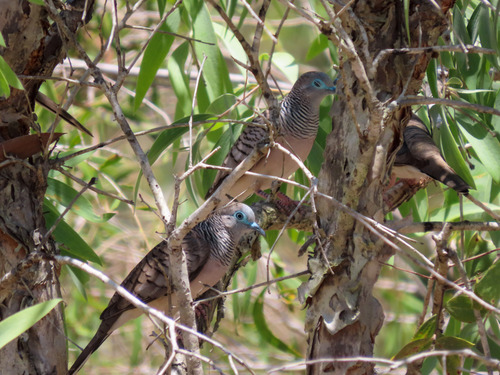 Peaceful Dove
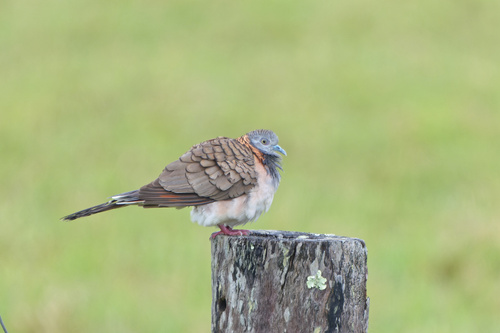 Bar-shouldered Dove
In short
To separate Peaceful Dove from Bar-shouldered Dove, focus on the patterning of the neck and throat: Peaceful Dove has fine striations (narrow black-and-white bars) extending from the nape onto the throat, while Bar-shouldered Dove shows coppery, striated nape feathers but a plain, unbarred throat. In all ages, Bar-shouldered Dove’s nape is copper-colored and lacks throat barring, which is a key difference. Bar-shouldered Dove is also noticeably larger and bulkier, with a slightly longer tail. Both species can show similar long-tailed, ground-dove jizz, but careful attention to neck and throat pattern is the most reliable field mark, especially at close range or with good binocular views.
Identification tips
- Neck and throat pattern (all ages): Peaceful Dove shows fine black-and-white striations (bars) extending from the nape down onto the throat and sides of the neck. Bar-shouldered Dove has a coppery, striated nape but a plain, unbarred throat. This is the single most reliable mark at any age.
- Nape color (all ages): Bar-shouldered Dove’s nape is coppery or rufous with striations; Peaceful Dove’s nape is greyish with fine black-and-white bars.
- Breast and belly: Both species have blue-grey breasts, but Peaceful Dove’s is often paler and more uniform, while Bar-shouldered Dove’s may appear slightly darker and bulkier.
- Wing pattern: Bar-shouldered Dove has chequered brown-bronze wings, which can look scaly or patterned in good light. Peaceful Dove’s wings are less distinctly chequered and more uniform.
- Eye ring: Bar-shouldered Dove has a grey eye ring, which can turn red-brown in breeding season. Peaceful Dove’s eye ring is less prominent and not described as changing color.
- Size and structure: Bar-shouldered Dove is significantly larger (26–30 cm) and more robust, with a longer tail. Peaceful Dove is smaller and more delicate. Size is best judged with direct comparison or in mixed flocks.
- Tail: Both have long tails, but Bar-shouldered Dove’s is proportionally longer and the bird appears bulkier overall.
- Flight style: Both species fly directly and swiftly, but Bar-shouldered Dove’s wings are noted to whistle in flight. Listen for this sound when birds flush.
- Voice: Bar-shouldered Dove’s call is a distinctive, melodious "cook-a-wook" or "coolicoo." If you hear this, you are likely hearing Bar-shouldered Dove.
- Juvenile birds: Even in duller juveniles, the throat pattern remains diagnostic: Peaceful Dove juveniles retain throat striations, Bar-shouldered Dove juveniles do not.
- Context: Both species can occur together, but check for size and throat pattern before relying on habitat or behavior.
- Common pitfalls: Do not confuse the coppery nape of Bar-shouldered Dove for throat barring—always check if the barring extends onto the throat (Peaceful Dove) or stops at the nape (Bar-shouldered Dove).
- Lighting: In poor light, the coppery nape of Bar-shouldered Dove may appear duller, so always double-check the throat for striations.
- Mixed flocks: When both species are present, direct comparison of size and throat pattern is easiest.
- Spotted Turtle Dove confusion: Both species can be confused with the introduced Spotted Turtle Dove, but that species has a spotted rather than barred neck and is not covered in this comparison.
Size
Bar-shouldered Dove is distinctly larger, measuring 26–30 cm in length, compared to the smaller Peaceful Dove (not specified here, but always smaller than Bar-shouldered Dove in direct comparison) [wikipedia]. Bar-shouldered Dove appears more robust and longer-tailed, while Peaceful Dove is more petite and delicate overall. In mixed flocks or side-by-side, the size difference is usually obvious, but beware lone birds or poor views, as posture can sometimes mislead.
Plumage
- Juvenile/immature birds: Both species are duller when young, but the key difference remains: Peaceful Dove juveniles still show fine black-and-white striations on both nape and throat, while Bar-shouldered Dove juveniles have a duller, coppery nape but the throat remains plain and unbarred [wikipedia].
- Adults: Peaceful Dove has a blue-grey breast and belly, with fine black-and-white barring (striations) extending from the nape down onto the sides of the neck and throat. Bar-shouldered Dove has a blue-grey breast as well, but the nape is coppery with striations, and the throat is unbarred and plain. The wings of Bar-shouldered Dove are chequered brown-bronze, while Peaceful Dove’s wings are less distinctly chequered. Eye ring color in Bar-shouldered Dove is usually grey but can turn red-brown in breeding season; this is less conspicuous in Peaceful Dove.
- In flight: No distinctive upperwing pattern differences are described for these two species, so flight separation relies mainly on overall size and tail length, with Bar-shouldered Dove appearing larger and longer-tailed.
Behaviour
Both doves are often seen feeding on the ground, singly, in pairs, or in loose flocks. Flight is direct and swift in both species, but Bar-shouldered Dove’s wings are noted to whistle in flight. Both are generally approachable and not particularly shy, but Bar-shouldered Dove may be more likely to be found in larger loose groups. No major behavioral differences are diagnostic in the field.
Voice
Bar-shouldered Dove has a distinctive, melodious call described as "cook-a-wook" or "coolicoo." No vocal description is provided for Peaceful Dove here, but the Bar-shouldered Dove’s call is considered distinctive and may help in separation if heard well.