

Motmot

オーストラリアチョウショウバト 対 ベニカノコバト

Geopelia placida 対 Geopelia humeralis

オーストラリアチョウショウバトとベニカノコバトのクイズ
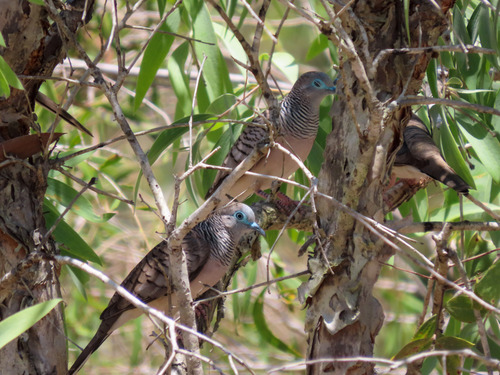
オーストラリアチョウショウバト (Geopelia placida) オーストラリアチョウショウバト
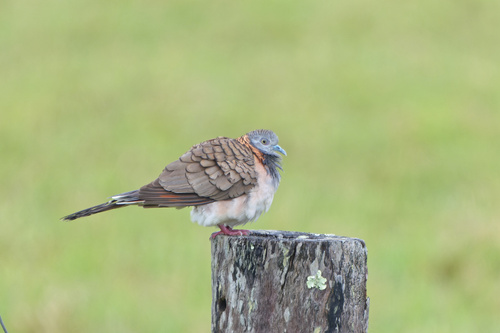
ベニカノコバト (Geopelia humeralis) ベニカノコバト

メディア

読み込み中…

要点

平和なハトとベニカノコバトを区別するには、首と喉の模様に注目してください:平和なハトは、後頭部から喉にかけて細い縞模様(狭い黒と白のバー)が伸びていますが、ベニカノコバトは銅色の縞模様の後頭羽を持ちますが、喉は無地でバーがありません。すべての年齢において、ベニカノコバトの後頭部は銅色で、喉にバーがないことが重要な違いです。ベニカノコバトはまた、明らかに大きく、がっしりとしており、尾も少し長いです。両種は似たような長い尾を持つ地面のハトの特徴を示すことがありますが、首と喉の模様に注意を払うことが最も信頼できるフィールドマークであり、特に近距離や良好な双眼鏡での観察時に重要です。

識別のコツ

  1. 首と喉の模様(すべての年齢): 平和なハトは、後頭部から喉と首の側面にかけて細い黒と白の縞模様(バー)を示します。ベニカノコバトは銅色の縞模様の後頭部を持ちますが、喉は無地でバーがありません。これはすべての年齢で最も信頼できるマークです。
  2. 後頭部の色(すべての年齢): ベニカノコバトの後頭部は銅色または赤褐色で縞模様があります;平和なハトの後頭部は灰色がかっており、細い黒と白のバーがあります。
  3. 胸と腹: 両種は青灰色の胸を持っていますが、平和なハトの胸はしばしばより淡く、均一であるのに対し、ベニカノコバトの胸はやや暗く、がっしりしているように見えることがあります。
  4. 翼の模様: ベニカノコバトは、良い光の下で鱗状または模様のように見えるチェック模様の茶色と青銅色の翼を持っています。平和なハトの翼は、あまり明確にチェック模様ではなく、より均一です。
  5. 目の輪: ベニカノコバトは灰色の目の輪を持ち、繁殖期には赤褐色に変わることがあります。平和なハトの目の輪はあまり目立たず、色が変わるとは記載されていません。
  6. サイズと構造: ベニカノコバトは明らかに大きく(26–30 cm)より頑丈で、尾が長いです。平和なハトは小さく、より繊細です。サイズは直接比較または混合群で判断するのが最良です。
  7. 尾: 両は長い尾を持っていますが、ベニカノコバトの尾は相対的に長く、全体的にがっしりとした印象を与えます。
  8. 飛行スタイル: 両種は直接的かつ迅速に飛びますが、ベニカノコバトの翼は飛行中に口笛のような音を出すことが知られています。この音を聞くために、鳥が飛び立つときに注意してください。
  9. 声: ベニカノコバトの鳴き声は、独特でメロディックな「クック・ア・ウック」または「クーリクー」です。これを聞いた場合、あなたはおそらくベニカノコバトを聞いています。
  10. 幼鳥: 幼い個体でも、喉の模様は診断的です:平和なハトの幼鳥は喉の縞模様を保持し、ベニカノコバトの幼鳥は保持しません。
  11. 文脈: 両種は一緒に出現することがありますが、生息地や行動に頼る前にサイズと喉の模様を確認してください。
  12. 一般的な落とし穴: ベニカノコバトの銅色の後頭部を喉のバーと混同しないでください—常にバーが喉にまで伸びているか(平和なハト)または後頭部で止まっているか(ベニカノコバト)を確認してください。
  13. 照明: 照明が悪い場合、ベニカノコバトの銅色の後頭部は鈍く見えることがあるため、喉の縞模様を常に再確認してください。
  14. 混合群: 両種が存在する場合、サイズと喉の模様の直接比較が最も簡単です。
  15. スパイテッド・タートル・ダブの混同: 両種は導入されたスパイテッド・タートル・ダブと混同されることがありますが、その種はバーではなく斑点のある首を持ち、この比較には含まれていません。

大きさ

ベニカノコバトは明らかに大きく、長さは26–30 cmで、より小さい平和なハトと比較されます(ここでは指定されていませんが、直接比較では常にベニカノコバトより小さいです)[wikipedia]。ベニカノコバトはより頑丈で尾が長いように見えますが、平和なハトは全体的により小柄で繊細です。混合群や並んでいる場合、サイズの違いは通常明らかですが、孤立した鳥や視界が悪い場合は注意が必要です。姿勢が時には誤解を招くことがあります。

羽色

行動

両種のハトは、地面で単独、ペア、または緩い群れで餌を食べているのがよく見られます。両種の飛行は直接的かつ迅速ですが、ベニカノコバトの翼は飛行中に口笛のような音を出すことが知られています。両者は一般的に近づきやすく、特に恥ずかしがり屋ではありませんが、ベニカノコバトはより大きな緩い群れで見つかる可能性が高いです。フィールドで診断的な主要な行動の違いはありません。

声

ベニカノコバトは、「クック・ア・ウック」または「クーリクー」と表現される独特でメロディックな鳴き声を持っています。ここでは平和なハトの鳴き声の記述は提供されていませんが、ベニカノコバトの鳴き声は独特であり、よく聞こえれば区別に役立つかもしれません。

より良い説明を送る

比較と同じ項目を使ってください。文章はすぐに公開されます。

To separate Peaceful Dove from Bar-shouldered Dove, focus on the patterning of the neck and throat: Peaceful Dove has fine striations (narrow black-and-white bars) extending from the nape onto the throat, while Bar-shouldered Dove shows coppery, striated nape feathers but a plain, unbarred throat. In all ages, Bar-shouldered Dove’s nape is copper-colored and lacks throat barring, which is a key difference. Bar-shouldered Dove is also noticeably larger and bulkier, with a slightly longer tail. Both species can show similar long-tailed, ground-dove jizz, but careful attention to neck and throat pattern is the most reliable field mark, especially at close range or with good binocular views.

  1. Neck and throat pattern (all ages): Peaceful Dove shows fine black-and-white striations (bars) extending from the nape down onto the throat and sides of the neck. Bar-shouldered Dove has a coppery, striated nape but a plain, unbarred throat. This is the single most reliable mark at any age.
  2. Nape color (all ages): Bar-shouldered Dove’s nape is coppery or rufous with striations; Peaceful Dove’s nape is greyish with fine black-and-white bars.
  3. Breast and belly: Both species have blue-grey breasts, but Peaceful Dove’s is often paler and more uniform, while Bar-shouldered Dove’s may appear slightly darker and bulkier.
  4. Wing pattern: Bar-shouldered Dove has chequered brown-bronze wings, which can look scaly or patterned in good light. Peaceful Dove’s wings are less distinctly chequered and more uniform.
  5. Eye ring: Bar-shouldered Dove has a grey eye ring, which can turn red-brown in breeding season. Peaceful Dove’s eye ring is less prominent and not described as changing color.
  6. Size and structure: Bar-shouldered Dove is significantly larger (26–30 cm) and more robust, with a longer tail. Peaceful Dove is smaller and more delicate. Size is best judged with direct comparison or in mixed flocks.
  7. Tail: Both have long tails, but Bar-shouldered Dove’s is proportionally longer and the bird appears bulkier overall.
  8. Flight style: Both species fly directly and swiftly, but Bar-shouldered Dove’s wings are noted to whistle in flight. Listen for this sound when birds flush.
  9. Voice: Bar-shouldered Dove’s call is a distinctive, melodious "cook-a-wook" or "coolicoo." If you hear this, you are likely hearing Bar-shouldered Dove.
  10. Juvenile birds: Even in duller juveniles, the throat pattern remains diagnostic: Peaceful Dove juveniles retain throat striations, Bar-shouldered Dove juveniles do not.
  11. Context: Both species can occur together, but check for size and throat pattern before relying on habitat or behavior.
  12. Common pitfalls: Do not confuse the coppery nape of Bar-shouldered Dove for throat barring—always check if the barring extends onto the throat (Peaceful Dove) or stops at the nape (Bar-shouldered Dove).
  13. Lighting: In poor light, the coppery nape of Bar-shouldered Dove may appear duller, so always double-check the throat for striations.
  14. Mixed flocks: When both species are present, direct comparison of size and throat pattern is easiest.
  15. Spotted Turtle Dove confusion: Both species can be confused with the introduced Spotted Turtle Dove, but that species has a spotted rather than barred neck and is not covered in this comparison.

Bar-shouldered Dove is distinctly larger, measuring 26–30 cm in length, compared to the smaller Peaceful Dove (not specified here, but always smaller than Bar-shouldered Dove in direct comparison) [wikipedia]. Bar-shouldered Dove appears more robust and longer-tailed, while Peaceful Dove is more petite and delicate overall. In mixed flocks or side-by-side, the size difference is usually obvious, but beware lone birds or poor views, as posture can sometimes mislead.

  • Juvenile/immature birds: Both species are duller when young, but the key difference remains: Peaceful Dove juveniles still show fine black-and-white striations on both nape and throat, while Bar-shouldered Dove juveniles have a duller, coppery nape but the throat remains plain and unbarred [wikipedia].
  • Adults: Peaceful Dove has a blue-grey breast and belly, with fine black-and-white barring (striations) extending from the nape down onto the sides of the neck and throat. Bar-shouldered Dove has a blue-grey breast as well, but the nape is coppery with striations, and the throat is unbarred and plain. The wings of Bar-shouldered Dove are chequered brown-bronze, while Peaceful Dove’s wings are less distinctly chequered. Eye ring color in Bar-shouldered Dove is usually grey but can turn red-brown in breeding season; this is less conspicuous in Peaceful Dove.
  • In flight: No distinctive upperwing pattern differences are described for these two species, so flight separation relies mainly on overall size and tail length, with Bar-shouldered Dove appearing larger and longer-tailed.

Both doves are often seen feeding on the ground, singly, in pairs, or in loose flocks. Flight is direct and swift in both species, but Bar-shouldered Dove’s wings are noted to whistle in flight. Both are generally approachable and not particularly shy, but Bar-shouldered Dove may be more likely to be found in larger loose groups. No major behavioral differences are diagnostic in the field.

Bar-shouldered Dove has a distinctive, melodious call described as "cook-a-wook" or "coolicoo." No vocal description is provided for Peaceful Dove here, but the Bar-shouldered Dove’s call is considered distinctive and may help in separation if heard well.

変更を破棄しますか?

保存していない編集があります。今離れると失われます。

オーストラリアチョウショウバト · ベニカノコバト · 苦手な鳥