

Pallas's Sandgrouse vs Pin-tailed Sandgrouse
Syrrhaptes paradoxus versus Pterocles alchata
Play a quiz with Pallas's Sandgrouse and Pin-tailed Sandgrouse
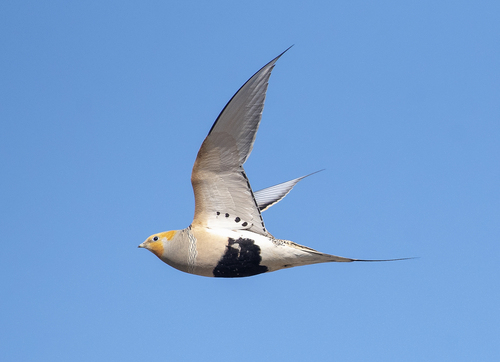 Pallas's Sandgrouse
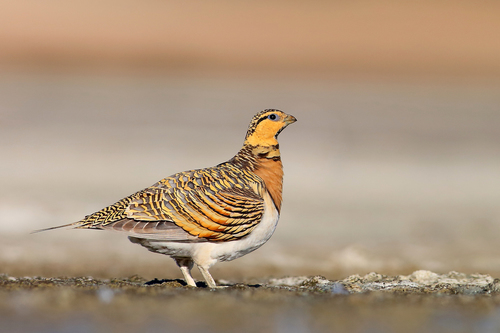 Pin-tailed Sandgrouse
In short
The most reliable field mark to separate Pallas's Sandgrouse from Pin-tailed Sandgrouse is the underwing and belly pattern in flight: Pallas's shows a distinctive black belly patch and pale underwings, while Pin-tailed has bright white underparts and underwings without a black belly. Adult males of Pallas's have a grey head and breast with an orange face, whereas Pin-tailed males show a yellowish-green head and neck with a reddish-brown breast band. Both species have long pointed wings and tails, but Pin-tailed males have especially long central tail streamers. Females of both are duller, but Pallas's females have more upperpart barring and lack the breast band. In all ages, focus on the underwing and belly pattern in flight for the quickest separation.
Identification tips
- Flight underwing and belly pattern (all ages): Pallas's Sandgrouse always shows a bold black belly patch and pale underwings; Pin-tailed Sandgrouse has white underparts and underwings with no black belly.
- Tail shape and length (males): Pin-tailed males have very long, slate-grey central tail streamers, giving a pin-tailed look; Pallas's has a long, pointed tail but lacks such pronounced streamers.
- Head and face (adult males): Pallas's male has a grey head and breast with an orange face and grey breast band; Pin-tailed male has a yellowish-green head and neck, yellow cheeks, and a reddish-brown breast band with thin black borders.
- Breast band (adult males): Pallas's male breast band is grey; Pin-tailed male's is reddish-brown with black borders.
- Upperpart barring (females and non-breeding): Pallas's female is more heavily barred above and lacks a breast band; Pin-tailed female is duller, golden-buff on cheeks and neck, and has multiple black breast stripes.
- Underwing coverts in flight: Pin-tailed shows bright white underwing coverts and white underparts; Pallas's underwings are pale but not as bright, and always with a black belly patch.
- Wing pattern in flight: Pin-tailed has black primaries with pale edges, creating a black rim to the wing's leading and trailing edges; this is not described for Pallas's.
- Bill and feet: Pallas's has small feet lacking a hind toe, with fused front toes and a paw-like appearance, but this is rarely visible in the field.
- Jizz in flight: Both species have fast, direct flight with long pointed wings, but Pin-tailed may appear more elongated due to the tail streamers in males.
- Voice: If you hear a loud "kattar-kattar" or "ga-ga-ga" call, it's Pin-tailed; Pallas's is less vocal or not described.
- Habitat: Both use open, dry plains, so do not rely on habitat alone unless you are outside the normal range of one species.
- Seasonal changes: Pin-tailed males lose the black throat patch and become more barred above outside the breeding season; Pallas's males retain the black belly and pale underwing year-round.
- Sex differences: Both species' females are duller, but Pallas's female lacks the breast band and is more barred above; Pin-tailed female has a shorter tail and multiple breast stripes.
- Flock size: Pallas's can form exceptionally large flocks (thousands), which may be a clue in irruption years.
- Pitfalls: Immature and female Pin-tailed may be confused with Pallas's due to overall dullness, but the underwing and belly pattern in flight remains diagnostic.
Size
Both species are medium-large sandgrouse with a compact, sturdy body and small pigeon-like head. Pin-tailed Sandgrouse has a recorded average mass of about 237.5 g [wikidata], and a typical length of around 35 cm. Pallas's Sandgrouse is similar in length (30–41 cm), but no direct mass figure is available. Overall, size is not a strong separator in the field, as both overlap considerably and have similar proportions.
Plumage
- Juvenile/Immature/Non-breeding (flight views):
- Pallas's Sandgrouse of all ages shows a bold black belly patch and pale underwings in flight. The upperparts are buff with barring, and the tail is long and pointed. Females and immatures are duller, with more upperpart barring and lacking the male's breast band.
- Pin-tailed Sandgrouse of all ages shows bright white underparts and underwings in flight, with no black belly patch. The tail is long, with especially long central streamers in males. The upperparts are barred black and brownish-yellow outside breeding season; females are duller and better camouflaged, with a shorter tail than males.
- Adult breeding males:
- Pallas's: Grey head and breast, orange face, grey breast band, black belly patch, pale underwings.
- Pin-tailed: Yellowish-green head and neck, yellow cheeks, reddish-brown breast band with thin black borders, white underparts, white underwing coverts, black primaries with pale edges creating black leading/trailing edge in flight, chestnut-edged outer wing coverts, long slate-grey central tail feathers.
- Adult females:
- Pallas's: Duller overall, more upperpart barring, lacks breast band, retains black belly patch and pale underwings.
- Pin-tailed: Duller, golden-buff cheeks and neck, black eye-stripe, white chin, multiple black breast stripes, back and wings grey barred with black, shorter central tail feathers than male, white underparts and underwings.
Behaviour
Both species are gregarious and often seen in flocks, especially when flying to watering holes at dawn or dusk. Pallas's Sandgrouse is known for exceptionally large flocks (sometimes thousands) and can make long round trips (up to 121 km) to water. Both species have fast, direct flight with long pointed wings. Males of Pallas's Sandgrouse are noted for soaking their breast feathers to carry water to chicks, a behavior not specifically described for Pin-tailed. Both species nest in ground scrapes and are partial migrants, with some irruptive movements in Pallas's.
Habitat
Both species breed on dry, open, treeless plains or steppes. Pallas's Sandgrouse is more associated with the central Asian steppes, while Pin-tailed Sandgrouse occurs in southern Europe, northwestern Africa, the Middle East, and parts of Asia. Both prefer open, arid habitats with little vegetation. Habitat alone is not a reliable separator where ranges overlap or for vagrants.
Voice
Pin-tailed Sandgrouse is described as usually silent on the ground but gives a loud "kattar-kattar", nasal "ga-ga-ga", and low-pitched "gang gang" in flight. Pallas's Sandgrouse's vocalizations are not described in detail in the sources provided. Thus, voice is only a reliable separator if Pin-tailed's distinctive calls are heard.
Pallas's Sandgrouse · Pin-tailed Sandgrouse · My Tricky Birds