

Pallas's Grasshopper Warbler vs Common Grasshopper Warbler
Helopsaltes certhiola versus Locustella naevia
Play a quiz with Pallas's Grasshopper Warbler and Common Grasshopper Warbler
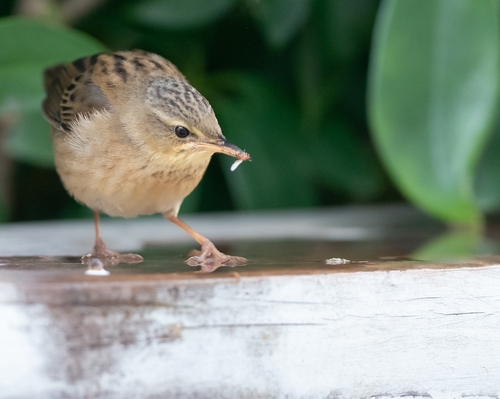 Pallas's Grasshopper Warbler
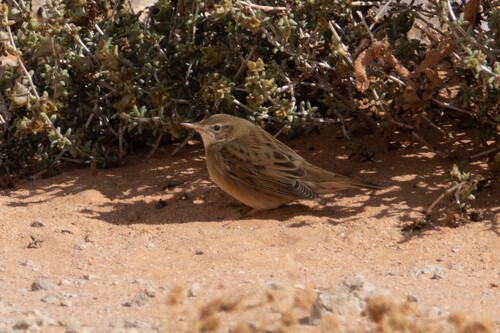 Common Grasshopper Warbler
In short
The most reliable field mark to separate Pallas's Grasshopper Warbler from Common Grasshopper Warbler is the presence of white tips to the tail and tertial feathers on Pallas's, which are absent in Common. Pallas's also shows a warmer, rusty-brown rump and unstreaked, whitish-grey underparts, while Common has a paler olive-brown back, streaked underparts, and a more uniform tail. Juvenile Pallas's are yellower below, but both species can be secretive and hard to see. The song is a key difference: Pallas's gives a varied, melodic song, while Common produces a mechanical, insect-like reeling.
Identification tips
- White tail and tertial tips (Pallas's only): Look for white tips on the tail and tertials in any view, especially if the bird fans its tail or is seen in flight. This is the single most reliable mark for Pallas's of all ages.
- Rump color: Pallas's shows a warmer, rusty-brown rump, while Common's is more uniformly reddish-brown, sometimes with faint bars. This is subtle but can be seen in good light or flight.
- Underpart streaking: Pallas's has whitish-grey, mostly unstreaked underparts (except for some undertail streaks). Common has cream or yellowish-buff underparts with clear dark streaks or spots on the breast and flanks, and streaked undertail coverts. If you see heavy streaking below, it's likely Common.
- Juvenile coloration: Young Pallas's are yellower below than adults, but still lack the heavy underpart streaking of Common. Juvenile Common can be buffy but should show at least some streaks below.
- Tail pattern in flight: In flight, Pallas's may flash white tail tips; Common's tail is more uniform and lacks white.
- Cheek and face: Common has greyish cheeks and a faint eye-stripe; Pallas's facial pattern is less marked and more uniform.
- Song: If singing, Pallas's gives a varied, melodic warble; Common produces a long, mechanical reeling trill. Song is often the easiest separator if heard well.
- Behavior: Both are very skulking, but Common often flares its tail to show streaked undertail coverts. Pallas's is less likely to do so, and the undertail is less streaked.
- Habitat and range: If in Europe or western Palearctic, it's almost certainly Common. In far eastern Asia, Pallas's is more likely. In India, both may occur in migration or winter, so use plumage and song.
- Size: Pallas's is slightly larger, but this is rarely useful unless both are side by side.
- Leg color: Both have pale yellowish-brown legs; not a useful separator.
- Flight style: Both fly low and briefly, soon diving back into cover. If you see a white flash in the tail, favor Pallas's.
- Sex and age: Both sexes are similar in both species; age differences are mainly in underpart color (Pallas's juveniles yellower, Common juveniles buffy and streaked).
- Upperpart streaking: Both have streaked brown backs, but Common's is paler olive-brown with each feather centrally streaked. Pallas's is darker and more uniform.
- Pitfall: Do not rely on general brownish color or secretive behavior; focus on tail and tertial pattern, underpart streaking, and song for confident ID.
Size
Pallas's Grasshopper Warbler is slightly larger than Common Grasshopper Warbler, but the difference is subtle and rarely diagnostic in the field. Both are medium-sized warblers, and unless seen side by side, size is not a reliable separator. Adult Common Grasshopper Warbler measures about 12.5 cm in length and weighs 11.5–16 grams [wikipedia]. Pallas's is described as 'slightly larger' but no precise figures are given in the sources.
Plumage
The most diagnostic plumage feature is the white tips to the tail and tertials in Pallas's Grasshopper Warbler (all ages), which are lacking in Common. Pallas's also has a warmer, rusty-brown rump, while Common's tail is more uniformly reddish-brown with faint bars. The upperparts of both are streaked brown, but Common's are paler olive-brown with each feather centrally streaked, and its cheeks are greyish. Underparts differ: Pallas's has whitish-grey, largely unstreaked underparts (except for the undertail), while Common shows cream or yellowish-buff underparts with distinct dark streaks or spots on the breast and flanks, and streaked undertail coverts. Juvenile Pallas's are yellower below, which can overlap with the buff tones of young Common, but the white tail tips and unstreaked belly remain useful. In flight, look for the white in Pallas's tail and tertials; Common lacks these contrasts.
Behaviour
Both species are extremely skulking and prefer to creep through dense grass or low vegetation, rarely showing themselves except when singing. Both may scurry or run along stems. Common Grasshopper Warbler is noted for its high-stepping gait and tendency to flare its tail, showing off its streaked undertail coverts. Pallas's is similarly secretive but may be seen more easily when singing. Flight is brief and low in both, but Pallas's may show white tail tips if flushed.
Habitat
Pallas's Grasshopper Warbler breeds in the eastern Palearctic (from the Altai Mountains through Mongolia, NE China, Korea, and nearby islands) and winters from India to Indonesia. Common Grasshopper Warbler breeds across temperate Europe and the western Palearctic, wintering in northern tropical Africa and locally in India. Both favor dense, rough grass or bushy areas, but their ranges overlap only in parts of central Asia and India. Habitat structure is similar: damp or dry grass with cover, edges of fens, clearings, or young plantations.
Voice
Pallas's Grasshopper Warbler has a melodic, inventive song reminiscent of Acrocephalus warblers, not the mechanical reeling of Locustella. Common Grasshopper Warbler gives a long, high-pitched reeling trill (like an angler's reel or distant mower), which is continuous, ventriloquial, and very difficult to pinpoint. This song is diagnostic where heard well: Pallas's never reels, Common never gives a melodic warble.
Pallas's Grasshopper Warbler · Common Grasshopper Warbler · My Tricky Birds