

Pale-vented Pigeon vs Red-billed Pigeon
Patagioenas cayennensis versus Patagioenas flavirostris
Play a quiz with Pale-vented Pigeon and Red-billed Pigeon
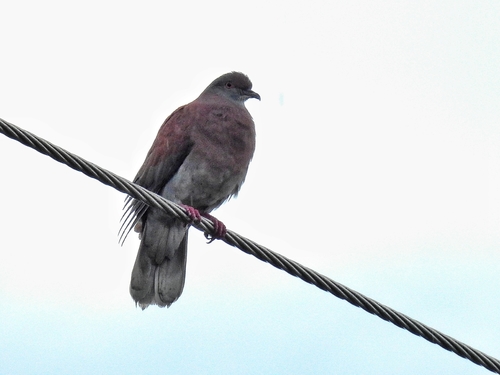 Pale-vented Pigeon
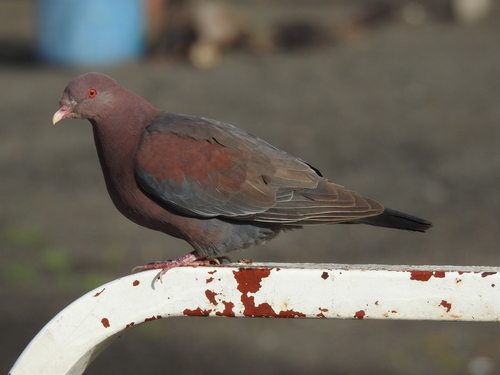 Red-billed Pigeon
In short
The most reliable field mark between Pale-vented Pigeon and Red-billed Pigeon is the bill color: Pale-vented always has a black bill, while Red-billed shows a distinctive red bill with a yellow tip in all ages. Adult Pale-vented Pigeons also have a paler, often whitish or pale grey lower belly and vent, contrasting with the blue-gray belly of Red-billed. Juvenile and immature birds of both species are duller, but Red-billed immatures tend to show browner wings and mantle, and their bill color is still diagnostic. Both species are large, robust pigeons of similar size, but their head and underpart coloration, as well as subtle differences in eye and leg color, can help in close views. Flight jizz and habitat overlap, but Pale-vented is more likely in humid or semi-open areas, while Red-billed prefers drier woodlands and riversides.
Identification tips
- Bill color is diagnostic: Pale-vented Pigeon always has a black bill; Red-billed Pigeon has a red bill with a yellow tip, even in immatures. This is the most reliable mark at any age or season.
- Underparts color: Adult Pale-vented Pigeon shows pale grey to white lower belly and vent (especially in southern birds), contrasting with the blue-gray belly and tail coverts of Red-billed Pigeon.
- Head and neck tones: Pale-vented males have a dull purple head and breast with copper gloss on the nape; Red-billed has a maroon to purple head and neck, often richer in tone, but lacks iridescent collar plumage.
- Juvenile/immature coloration: Immature Red-billed Pigeons are browner on the mantle and wings, with dusky shoulders; Pale-vented immatures are more uniformly greyish-brown and lack reddish or maroon hues.
- Throat color: Pale-vented has a whitish throat, which can contrast with the purple breast; Red-billed's throat is not distinctly pale.
- Back color: Red-billed Pigeon has a less brown back than most other pigeons, but this is subtle compared to Pale-vented.
- Eye and orbital ring: Both have pale red eyes, but Red-billed's orbital ring is orange, while Pale-vented's is red. This can be hard to see in the field.
- Leg color: Both have red legs, not a strong separator.
- Flight jizz: Both species fly high and fast with direct wingbeats, but Pale-vented may show a semi-circular glide in display. Not a strong field mark for separation.
- Wing noise: Red-billed Pigeon produces a clapping sound with its wings on takeoff, which is not noted for Pale-vented.
- Voice: Pale-vented gives a soft 'kuk kuk croo-ooos' with a distinctive initial 'kuk'; Red-billed's call is a long, high 'coooo' with three 'cuk-c'-c'-coo' notes. Use call if birds are vocalizing.
- Habitat: In drier, open woodlands or riversides, suspect Red-billed; in humid, forest-edge or semi-open tropical areas, Pale-vented is more likely. There is overlap, so use with caution.
- Sex differences: Females of both species are duller than males, but the bill color remains diagnostic.
- Size: Both are large pigeons with overlapping size ranges; do not use size for separation.
- Subspecies variation: Southern Pale-vented (P. c. andersoni) can be especially pale below, which may help in the far south of the range.
Size
Both species are large pigeons, with overlapping size ranges. Pale-vented Pigeon is typically 30–32 cm long and weighs 230–250 g [wikipedia], while Red-billed Pigeon is 30–37 cm and 230–425 g [wikipedia]. In the field, size alone is not a reliable separator, as both can appear similarly robust and mid-to-large among pigeons.
Plumage
- Juvenile/immature birds: Both are duller than adults, but Red-billed Pigeon immatures are especially brown on the mantle and wings, with dusky shoulders. Pale-vented immatures are greyish-brown overall, lacking any reddish or maroon tones, and their bill remains black.
- Adults: Pale-vented Pigeon males have a dull purple head, breast, and upperparts with copper glossing on the nape, a whitish throat, and pale grey to white lower underparts (especially in southern subspecies). Red-billed Pigeon adults have a maroon to purple head, neck, and wing coverts, but their belly and tail coverts are blue-gray, and their back is less brown than other pigeons. The bill is always red with a yellow tip in Red-billed, black in Pale-vented. Both sexes of each species are similar, but females are duller. Eye color is pale red in both, but the orbital ring is orange in Red-billed and red in Pale-vented.
Behaviour
Both species are often seen flying high and fast with direct, powerful wingbeats, typical of large pigeons. Pale-vented Pigeon may perform a semi-circular glide as part of its display flight. Both can be seen away from dense forests, sometimes in small flocks at water sources. Red-billed Pigeon wings make a clapping sound on takeoff, which is not noted for Pale-vented. Both species are fairly solitary but may gather at feeding or drinking sites.
Habitat
Pale-vented Pigeon favors forest edges, riverbanks, and partially open areas with scattered trees, mostly in humid or semi-humid tropical regions. Red-billed Pigeon is more typical of dry forests, riverside woodlands, and lowland areas, especially in coastal Mexico and Central America. There is some overlap in riverine or edge habitats, but Red-billed is more likely in drier, open woodlands, while Pale-vented is common in moister, more forested regions.
Voice
Pale-vented Pigeon's call is a series of soft 'kuk kuk croo-ooos,' with the initial 'kuk' being distinctive for the species group. Red-billed Pigeon gives a long, high-pitched 'coooo' followed by three 'cuk-c'-c'-coo' notes, with an ascending pattern. The calls are quite different in rhythm and pitch, and Red-billed's is more drawn-out and higher. Red-billed also produces a wing-clap on takeoff, which Pale-vented does not.