

Pale Rockfinch vs Sinai Rosefinch
Carpospiza brachydactyla versus Carpodacus synoicus
Play a quiz with Pale Rockfinch and Sinai Rosefinch
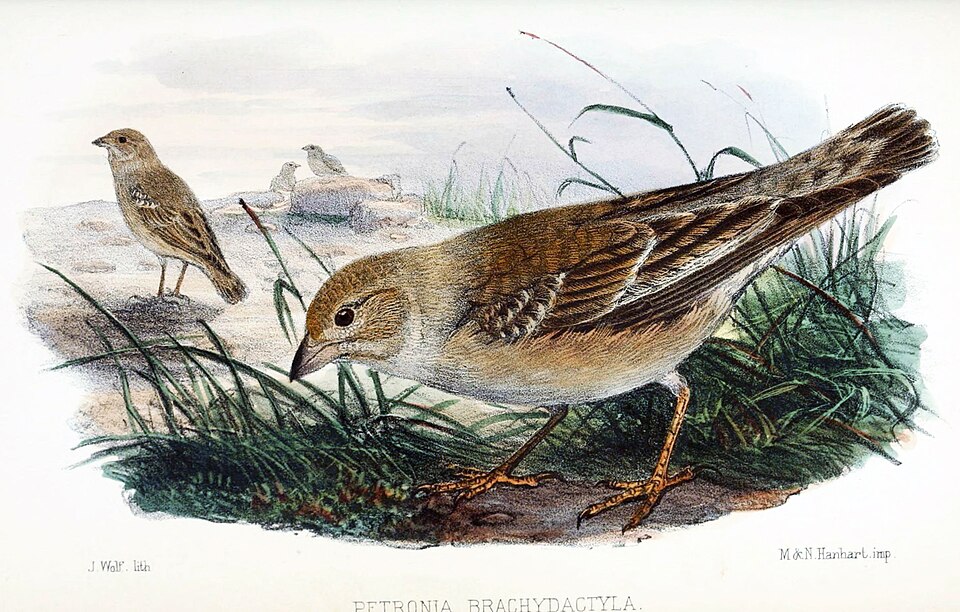 Pale Rockfinch
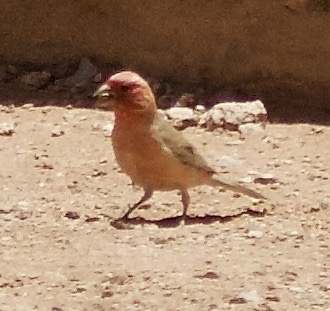 Sinai Rosefinch
In short
The most reliable field mark is the presence of pink coloration in male Sinai Rosefinch, which is never shown by Pale Rockfinch of any age or sex. Female Sinai Rosefinch is much plainer, but still differs from Pale Rockfinch by its overall colder gray-brown tones and whiter belly, while Pale Rockfinch is sandy-gray and more uniform. Both species can appear drab and sparrow-like, especially females and immatures, but careful attention to subtle plumage tones and structure—especially bill shape and body proportions—will separate them. Habitat overlap is possible in arid, rocky regions, but Sinai Rosefinch is much more localized and often associated with rocky wadis and cliffs. Beware of confusing dull female/immature Sinai Rosefinch with Pale Rockfinch in poor light or at a distance.
Identification tips
- Pink coloration: Any pink on the face, breast, or rump immediately identifies Sinai Rosefinch (adult male); Pale Rockfinch is always plain sandy-gray.
- Overall tone: Pale Rockfinch is sandy or buff-gray and very uniform; Sinai Rosefinch (female/immature) is colder gray-brown above with a distinctly paler, whitish belly.
- Bill shape: Sinai Rosefinch has a thick, conical finch bill; Pale Rockfinch's bill is thinner, more pointed, and sparrow-like. This is subtle but diagnostic at close range.
- Body shape: Pale Rockfinch is slimmer and more elongated, with a proportionally longer tail; Sinai Rosefinch is chunkier and more compact.
- Habitat context: In open grassland or steppe, especially with scattered shrubs, Pale Rockfinch is more likely. In rocky wadis, cliffs, or boulder fields, especially in the Sinai or Negev, expect Sinai Rosefinch.
- Foraging behavior: Pale Rockfinch is often seen actively feeding on the ground in flocks; Sinai Rosefinch is more likely to be perched on rocks or shrubs.
- Sex/age confusion: Female and immature Sinai Rosefinch lack pink and can be confused with Pale Rockfinch, but look for colder gray tones and a paler belly versus the uniform sandy-gray of Pale Rockfinch.
- Flight views: No strong wing pattern differences are described for immatures or adults, so rely on overall color and structure.
- Range: Sinai Rosefinch is highly localized to the Sinai, Negev, and adjacent areas; Pale Rockfinch has a wider range from the Middle East to Central Asia and is a rare but increasing winter visitor to India.
- Season: Pale Rockfinch may appear in large migratory flocks in winter, especially in India; Sinai Rosefinch is more sedentary and rarely forms large flocks.
- Confusion risk: In poor light or at a distance, female/immature Sinai Rosefinch can appear very plain; always check for subtle color differences and bill shape.
- No yellow throat: If you see a yellow throat, you are likely looking at Yellow-throated Sparrow, not either of these species.
- No strong streaking: Neither species is strongly streaked above or below, helping separate them from many other sparrows and finches in the region.
- No wing panels: Neither species shows strong wing panels or contrasting edges in any age, so do not rely on this feature.
- Check for flock composition: Mixed flocks are unlikely; if you see both pink and sandy-gray birds together, check for misidentification or the presence of other species.
Size
Both species are small, sparrow-sized birds, and there is no strong size difference in the field. However, Pale Rockfinch may appear slightly slimmer and more elongated, with a proportionally longer tail and a more slender, pointed bill, while Sinai Rosefinch is a bit chunkier and has a thicker, conical finch bill. These differences are subtle and best appreciated with direct comparison or good views.
Plumage
- Adult male Sinai Rosefinch is unmistakable with its pink face, breast, and rump, and a whitish crown and forehead; Pale Rockfinch never shows any pink or red tones.
- Female and immature Sinai Rosefinch are pale gray-brown above with a distinctly whitish belly, lacking any pink, but still colder and grayer than Pale Rockfinch. Their upperparts are less sandy and more ashy, and the contrast with the belly is more pronounced.
- Pale Rockfinch of all ages and sexes is sandy-gray overall, with a plain, uniform appearance and no strong contrast between upperparts and underparts. It lacks any pink, red, or strong patterning.
- Wing pattern: No distinctive juvenile or immature upperwing marks are described for either species, so flight views rely on overall color and structure rather than wing panels or edges.
- Bill color and shape: Sinai Rosefinch has a thicker, more conical finch bill, while Pale Rockfinch's bill is thinner and more pointed, resembling a sparrow's.
Behaviour
Pale Rockfinch is often seen foraging actively on the ground, especially in open grassland or semi-desert, sometimes in flocks during migration. It can appear restless and quick-moving. Sinai Rosefinch is more likely to be seen perched on rocks or low shrubs, often in pairs or small groups, and is somewhat less terrestrial in its habits, favoring rocky slopes and cliffs. Both can be shy and difficult to approach, but Pale Rockfinch is more likely to be overlooked due to its inconspicuous plumage and ground-foraging behavior.
Habitat
Both species inhabit arid, open landscapes, but with subtle differences. Pale Rockfinch favors subtropical or temperate dry shrubland and grassland, often in more open, sandy, or grassy areas, and is sometimes found in cultivated or semi-cultivated land. Sinai Rosefinch is much more localized, preferring rocky wadis, cliffs, and boulder-strewn slopes in the Sinai, Negev, and adjacent regions. If seen in grassy plains or open steppe, Pale Rockfinch is far more likely; in rocky gorges or cliffs, especially in the core range, Sinai Rosefinch is the default.