

Pale-billed Hornbill vs Southern Yellow-billed Hornbill
Lophoceros pallidirostris versus Tockus leucomelas
Play a quiz with Pale-billed Hornbill and Southern Yellow-billed Hornbill
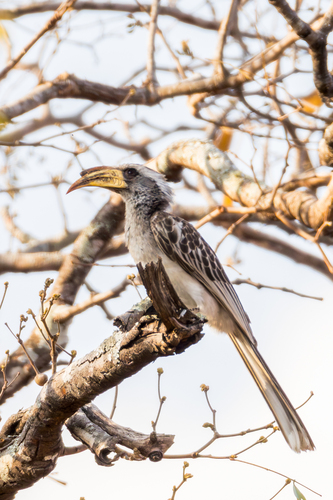 Pale-billed Hornbill
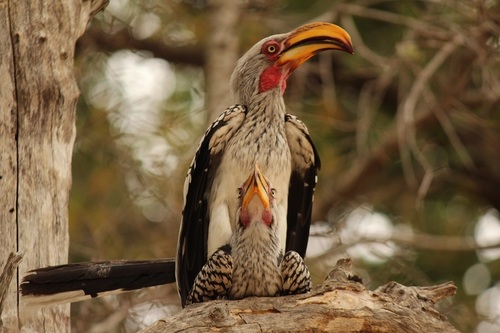 Southern Yellow-billed Hornbill
In short
The most reliable field mark between Pale-billed Hornbill and Southern Yellow-billed Hornbill is the color and structure of the bill: Pale-billed has a pale (ivory to horn-colored) bill, while Southern Yellow-billed has a strikingly bright yellow, long, and strongly down-curved bill. Both species are medium-sized hornbills with similar overall shape, but Southern Yellow-billed is generally heavier and has a more robust bill with a small casque. Plumage differences are subtle, so bill color and structure are the best field clues, especially at a distance or in poor light. Habitat can also help: Southern Yellow-billed is typical of dry thornveld and broad-leafed woodlands in southern Africa, while Pale-billed occurs more to the north and east, often in miombo woodland.
Identification tips
- Bill color is the single most useful field mark: Pale-billed Hornbill has a pale (ivory or horn-colored) bill, while Southern Yellow-billed Hornbill has a bright yellow bill. This is reliable for all ages and sexes.
- Bill structure: Southern Yellow-billed's bill is long, strongly down-curved, and robust, with a small but noticeable casque (especially in males, where it covers almost the entire bill length). Pale-billed's bill is also long but lacks the bright yellow color and may appear slimmer or less robust.
- Casque presence: Southern Yellow-billed Hornbill shows a small casque, best seen in males. Casque is less prominent or absent in Pale-billed.
- Plumage pattern: Both species are black and white overall, with white belly and spotted or streaked upperparts. Southern Yellow-billed shows a gray neck with spots and a lightly striated chest, but these are subtle and not always visible in the field.
- Eye and facial skin: Southern Yellow-billed usually has yellow eyes and pinkish skin around the eyes and malar stripe. Pale-billed's facial skin color is not specified here, so do not rely on this mark unless seen well and confirmed with a regional guide.
- Flight style: Southern Yellow-billed Hornbill alternates glides with heavy wingbeats and lacks underwing coverts, which may give a slightly different flight profile, but this is not a strong field mark without direct comparison.
- Foraging behavior: Southern Yellow-billed is often seen foraging on the ground in open areas, sometimes in groups. Pale-billed may be less terrestrial, but this is not a reliable separator without more behavioral detail.
- Habitat and range: If you are in southern Africa's dry thornveld or broad-leafed woodland, Southern Yellow-billed is expected. In miombo woodland further north (Angola, DRC, Zambia, Malawi, etc.), Pale-billed is more likely.
- Size: Southern Yellow-billed is slightly heavier and may appear bulkier, especially in the bill, but size overlap is significant and not a primary field mark.
- Sex differences: In Southern Yellow-billed, males have a longer bill and more extensive casque than females, but both sexes share the yellow bill. Sex differences are less relevant for Pale-billed in the field.
- Juvenile/immature plumage: No distinctive juvenile or immature wing or flight marks are described for either species; bill color is still the best clue.
- Voice: No vocal differences are described in the notes; do not rely on calls for separation unless you have local experience.
- Pitfalls: Do not rely on subtle plumage differences or size alone; always check bill color first. In poor light, bill color may appear washed out, so use range and habitat as supporting clues.
- Seasonal context: Both species are resident; season does not affect plumage or bill color in a way that aids identification.
- When in doubt: If the bill is not clearly yellow, consider Pale-billed, especially outside the core range of Southern Yellow-billed.
Size
Southern Yellow-billed Hornbill is slightly larger and heavier on average (body mass about 189.5 g [wikidata]), with a length of 48–60 cm. Pale-billed Hornbill's mass is not specified, but both are medium-sized hornbills and overlap in size. In the field, size alone is not a reliable separator, but Southern Yellow-billed may appear bulkier, especially in the bill.
Plumage
No distinctive age-specific wing or flight pattern differences are described for either species in the available notes. Both have predominantly black and white plumage: Southern Yellow-billed Hornbill shows a white belly, gray neck with spots, black back with white spots and stripes, and a lightly striated chest. The Pale-billed Hornbill's plumage is not detailed here, but it is generally similar in pattern, with no strong color contrasts or unique markings noted. Thus, plumage is not a reliable separator except for the bill color, which is diagnostic in all ages and sexes.
Behaviour
Southern Yellow-billed Hornbill is often seen foraging on the ground for seeds, insects, spiders, and scorpions, and is described as a powerful flier alternating glides and heavy wingbeats. It is a common and conspicuous resident in its range, often seen in pairs or small groups. Pale-billed Hornbill's behavior is not detailed, but as a member of the same genus, it likely shares similar habits, though it may be less conspicuous or less terrestrial depending on local context.
Habitat
Southern Yellow-billed Hornbill is typical of dry thornveld and broad-leafed woodlands in southern Africa, often in arid or semi-arid regions. Pale-billed Hornbill occurs further north and east, in countries like Angola, DRC, Kenya, Malawi, Mozambique, Tanzania, and Zambia, and is associated with miombo woodland. Range and habitat can help: if you are in southern Africa's dry thornveld, Southern Yellow-billed is far more likely; further north in miombo, Pale-billed is expected.
Pale-billed Hornbill · Southern Yellow-billed Hornbill · My Tricky Birds