

Pale-bellied Hermit vs Stripe-throated Hermit
Phaethornis anthophilus versus Phaethornis striigularis
Play a quiz with Pale-bellied Hermit and Stripe-throated Hermit
 Pale-bellied Hermit
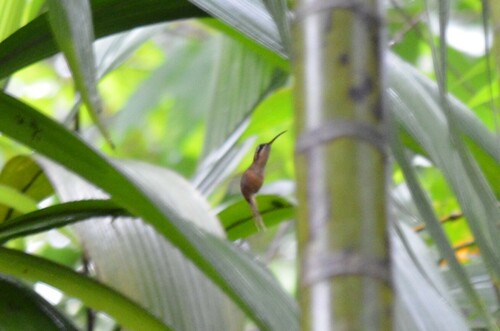 Stripe-throated Hermit
In short
The most reliable field mark between Pale-bellied Hermit and Stripe-throated Hermit is size: Pale-bellied is distinctly larger and heavier, with a noticeably longer body and more robust jizz. In close views, the underparts are also diagnostic—Pale-bellied Hermit shows pale gray underparts, while Stripe-throated Hermit has buff flanks and belly with a grayish-brown, often faintly streaked throat. Bill shape and color provide further clues: Pale-bellied Hermit males have a nearly straight bill, while Stripe-throated Hermit has a long, decurved bill with a yellowish base to the lower mandible. Juvenile Stripe-throated Hermits are unique in having an entirely pale rufous back, a feature not seen in Pale-bellied. Both species share a black mask and buffy supercilium, but overall impression and subtle plumage differences are key for confident separation.
Identification tips
- Size is the first clue: If the bird appears large and robust for a hermit, favor Pale-bellied; if small and dainty, Stripe-throated is more likely.
- Juvenile back color: Any hermit with an entirely pale rufous back is a juvenile Stripe-throated Hermit—Pale-bellied never shows this.
- Underparts color: Pale-bellied Hermit has pale gray underparts, while Stripe-throated Hermit shows buff flanks and belly with a grayish-brown throat.
- Throat streaking: Look for small, dark streaks on the throat of Stripe-throated Hermit (though these can be faint); Pale-bellied Hermit's throat is mostly white and unstreaked.
- Face pattern: Both have a black mask and buffy supercilium, but Stripe-throated's malar and supercilium are whitish-buff, and the mask may appear more 'bandit-like.'
- Bill shape: Male Pale-bellied Hermits have an almost straight bill; Stripe-throated Hermit always has a long, decurved bill. Female Pale-bellied also has a decurved bill, so this is most useful for males.
- Bill color: Stripe-throated Hermit shows a yellow base to the lower mandible (otherwise black); Pale-bellied's bill is not described as bicolored.
- Tail pattern: Stripe-throated Hermit has a blackish tail with whitish to ochraceous tips; Pale-bellied's tail pattern is not highlighted as distinctive.
- Rump color: Stripe-throated Hermit has a pale rufous rump, which can be a useful field mark in good light; Pale-bellied Hermit does not.
- Jizz in flight: Pale-bellied Hermit appears heavier and more elongated in flight; Stripe-throated is quicker and more agile.
- Lekking and song: If you observe a hermit singing a high-pitched, squeaky, monotonous song at a lek, it's Stripe-throated Hermit.
- Geographic context: In Central America north of Panama, only Stripe-throated is expected; in Colombia and Panama, both occur but Stripe-throated is more widespread and common.
- Sex differences: Both species are sexually similar in plumage, but bill shape differences (straighter in male Pale-bellied) can help with sexed individuals.
- Subspecies variation: Some Pale-bellied Hermit subspecies (P. a. hyalinus) are more bluish green above and paler below, but this does not overlap with Stripe-throated's rufous and buff tones.
- When in doubt: Focus on overall size, underparts color, and bill shape/color for the most reliable separation in the field.
Size
Pale-bellied Hermit is significantly larger and heavier: about 13 cm in length and 5.9 g in mass (males 4.5–5.5 g, females 4–5 g). Stripe-throated Hermit is much smaller, at 9–10 cm and only 2–3 g. In the field, Pale-bellied appears more robust and elongated, while Stripe-throated is noticeably petite and delicate. This size gap is often apparent even without direct comparison, especially if you are familiar with the typical size range of local hermits.
Plumage
- Juvenile/immature birds: Stripe-throated Hermit juveniles have an entirely pale rufous back, which is unique and not matched by Pale-bellied Hermit at any age. If you see a small hermit with a rufous back, it's Stripe-throated.
- Adults: Pale-bellied Hermit has dark green to olive upperparts and light gray underparts. The face shows a black mask, buffy supercilium, and mostly white throat. Stripe-throated Hermit adults have dull iridescent green upperparts, a pale rufous rump, buff flanks and belly, and a pale grayish-brown throat with small, often faint dark streaks. The face pattern is similar (black mask, whitish-buff supercilium and malar), but the throat streaking (even if faint) and buffy underparts help separate Stripe-throated from the cleaner, paler Pale-bellied.
- Tail: Stripe-throated Hermit has a blackish tail with whitish to ochraceous tips (depending on subspecies), while Pale-bellied Hermit's tail pattern is not described as distinctive in the sources.
- Bill: Pale-bellied Hermit males have a nearly straight bill; Stripe-throated Hermit has a long, decurved bill with a yellow base to the lower mandible (otherwise black).
Behaviour
Both species are typical hermits in behavior, often solitary and feeding by trap-lining between flowers. Stripe-throated Hermit males form leks and sing to attract females, a behavior not specifically noted for Pale-bellied Hermit in the sources. In flight, Pale-bellied Hermit may appear heavier and more direct due to its size, while Stripe-throated is likely to seem more agile and quick, matching its smaller build.
Habitat
Both species occur in overlapping regions of Colombia and Panama, but Stripe-throated Hermit ranges farther north into Central America and is generally more widespread. Pale-bellied Hermit is found in Colombia, Panama, and Venezuela. Both inhabit humid forested areas, but local abundance and microhabitat preferences may differ—Stripe-throated is described as generally fairly common.
Voice
Stripe-throated Hermit males have a high-pitched, squeaky, monotonous song, which is easily overheard and varies geographically. No vocal description is provided for Pale-bellied Hermit in the sources, so voice is not a reliable separator unless you are familiar with Stripe-throated's distinctive song.
Pale-bellied Hermit · Stripe-throated Hermit · My Tricky Birds