

Pale-bellied Hermit vs Sand Martin
Phaethornis anthophilus versus Riparia riparia
Play a quiz with Pale-bellied Hermit and Sand Martin
 Pale-bellied Hermit
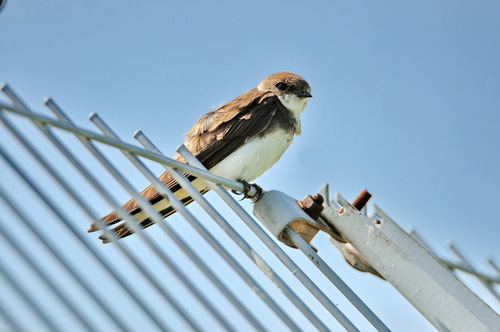 Sand Martin
In short
The most reliable way to separate Pale-bellied Hermit from Sand Martin is by structure: the hermit is a medium-sized hummingbird with a long, nearly straight or decurved bill and greenish upperparts, while the sand martin is a small swallow with a short, black bill, brown upperparts, and a distinctive brown breast band. Juvenile sand martins show rufous tips to their wing coverts and secondaries, which are never present on hermits. In flight, the sand martin's quick, jerky swallow flight and long, pointed wings contrast strongly with the hovering or darting flight of the hermit. Both species are similar in length, but the sand martin is heavier and bulkier. Habitat is also a strong clue: sand martins are found over open water or sandy banks, while pale-bellied hermits frequent forest edges and understory.
Identification tips
- Bill shape: Pale-bellied hermit always has a long, nearly straight (male) or decurved (female) bill; sand martin has a short, black, conical bill. Bill shape is visible even at a distance and is diagnostic.
- Upperparts color: Hermit is dark green to olive green above; sand martin is plain brown above. No sand martin shows greenish upperparts at any age.
- Underparts color: Hermit has light gray underparts; sand martin is white below with a narrow brown breast band. The breast band is never present on hermit.
- Facial pattern: Hermit has a bold black mask with a buffy supercilium and mostly white throat; sand martin has a plain face with a white throat and no mask or supercilium.
- Juvenile wing pattern: Juvenile sand martins have rufous tips to wing coverts and secondaries; hermits never show rufous in the wing.
- Flight style: Sand martin flies with quick, jerky wingbeats and glides, often in groups; hermit hovers at flowers or darts through vegetation, usually alone or in pairs.
- Perched posture: Sand martin perches upright on wires or exposed branches; hermit perches low in vegetation, often with bill angled down.
- Size and bulk: Sand martin is heavier (11–16 g) and broader-winged; hermit is slimmer and lighter (about 5.9 g).
- Tail shape: Not described in detail, but sand martin typically has a short, square tail; hermit’s tail is longer and may be graduated, typical of hermits.
- Habitat: Sand martin is found over open water, sand banks, or fields; hermit is in forest edge, clearings, or understory.
- Group size: Sand martins are often in flocks, especially in flight; hermits are solitary or in pairs.
- Vocalization: Sand martin gives a gravelly twitter in flight and a harsh alarm; hermit’s voice is not described, so use sand martin’s call as a positive clue.
- Sex differences: Hermit females have a more decurved bill; no strong sexual dimorphism in sand martin visible in the field.
- Seasonal context: Sand martins are migratory and may be seen in large numbers during migration; hermits are resident in their range.
- Common pitfalls: Do not confuse the sand martin’s brown back and breast band for a hermit’s mask; the hermit’s greenish upperparts and facial pattern are never matched by sand martin at any age.
Size
Both species are similar in length (about 13 cm), but the sand martin is much heavier (11–16 g, sometimes up to 19.5 g before migration) compared to the pale-bellied hermit (about 5.9 g). The sand martin also has a much longer wingspan (26.5–29 cm) versus the hermit's more compact build. In the hand or with a good view, the sand martin will appear stockier and broader-winged, while the hermit is slimmer and more delicate.
Plumage
Juvenile sand martins have rufous tips to their wing coverts and margins to the secondaries, a feature never seen on pale-bellied hermit of any age. Adult sand martins are brown above and white below, with a narrow brown breast band and a white throat; their back is plain brown. Pale-bellied hermits have dark green to olive upperparts and light gray underparts, with a black facial mask, buffy supercilium, and mostly white throat. The hermit’s upperparts are always greenish, never brown, and the underparts are gray rather than pure white. The sand martin’s brown breast band is a key mark, while the hermit’s face pattern (black mask, buffy supercilium) is unique. No age or sex of sand martin shows a facial mask or greenish upperparts. Subspecies of hermit may show slightly different tones (e.g., more bluish green or paler underparts), but always within the green/gray spectrum.
Behaviour
Sand martins are highly aerial, often seen in groups, flying rapidly and with quick, jerky wingbeats over water or open ground. Their flight is direct and swallow-like, with long glides and rapid turns. Pale-bellied hermits are typically solitary or in loose pairs, hovering at flowers or darting through forest edges and understory. Their flight is more fluttery and involves frequent hovering. Perched, the sand martin sits upright on wires or branches, while the hermit perches low in vegetation, often with the bill angled downward.
Habitat
Sand martins breed in colonies in sandy banks near rivers, lakes, or coasts, and are often seen flying over open water or fields. They are rarely found in dense forest or deep understory. Pale-bellied hermits are found in forest edges, clearings, and understory in Colombia, Panama, and Venezuela, and are not associated with open water or sand banks. If you see the bird in a dense, shady area with lots of flowers, it is almost certainly a hermit; if over open water or in a colony on a sandy bank, it is a sand martin.
Voice
Sand martins give a continuous gravelly twittering in flight and a conversational undertone when perched, with a harsh alarm call when alarmed. Pale-bellied hermit vocalizations are not described in the provided notes, so voice is only diagnostic if you hear the sand martin’s twittering or alarm.