

Motmot

Pacific Swift vs Asian Palm Swift

Apus pacificus versus Cypsiurus balasiensis

Play a quiz with Pacific Swift and Asian Palm Swift
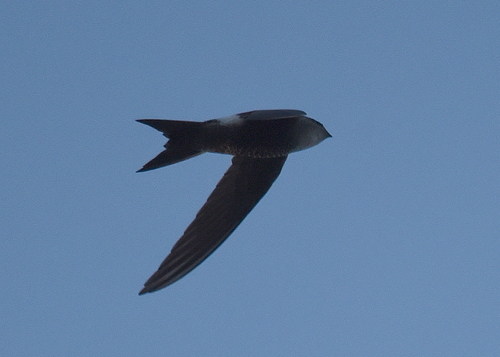
Pacific Swift (Apus pacificus) Pacific Swift
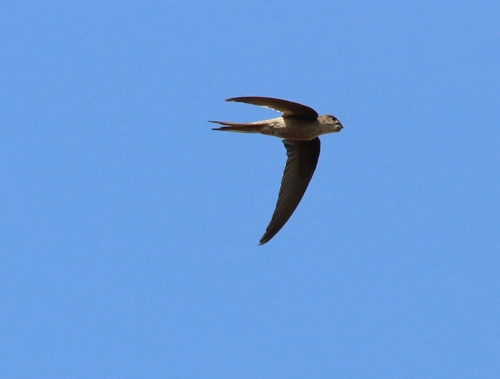
Asian Palm Swift (Cypsiurus balasiensis) Asian Palm Swift

Media

Loading…

In short

The most reliable field mark between Pacific Swift and Asian Palm Swift is size: Pacific Swift is much larger and bulkier, with a broad white rump band and a deeper tail fork, while Asian Palm Swift is tiny, slender, and pale brown, with a long, thin, deeply forked tail usually held closed. Juvenile Pacific Swifts show pale feather fringes, especially on the wings, but Asian Palm Swift immatures are mainly distinguished by shorter tails. In flight, Pacific Swift appears powerful and broad-winged, whereas Asian Palm Swift is delicate, crescent-winged, and almost bat-like. Both species have similar swift-like silhouettes, but their proportions and flight style are strikingly different.

Identification tips

  1. Size is the fastest separator: Pacific Swift is much larger and bulkier than Asian Palm Swift. If you see a swift that looks almost as big as a swallow or martin, it's not an Asian Palm Swift.
  2. White rump band: Pacific Swift has a broad, contrasting white rump band visible in all plumages (narrower in southern subspecies), while Asian Palm Swift lacks any white on the rump—its back is uniformly pale brown.
  3. Overall color: Pacific Swift is blackish above and below, with a greyer head and scaly pale fringes on the belly; Asian Palm Swift is pale brown overall, lacking any strong contrast or scaly effect.
  4. Tail shape and use: Both species have deeply forked tails, but Pacific Swift's fork is obvious in flight, while Asian Palm Swift usually holds its tail closed, making it look pointed or only slightly notched except when fanned.
  5. Wing shape: Pacific Swift has long, sickle-shaped wings that look broad and powerful; Asian Palm Swift's wings are long and swept back, giving a crescent or boomerang look—much narrower and more delicate than Pacific Swift.
  6. Flight style: Pacific Swift flies with strong, direct wingbeats and glides, often high in the sky; Asian Palm Swift is fluttery, rapid, and bat-like, often low over fields or palms.
  7. Juvenile marks: Juvenile Pacific Swifts show pale fringes on wing feathers and a scaly belly; Asian Palm Swift juveniles are best told by their shorter tails, not by wing or body pattern.
  8. Head and throat: Pacific Swift has a slightly protruding head and, in some subspecies, a larger white throat patch. Asian Palm Swift's head is less prominent and lacks any throat patch.
  9. Context and habitat: If the bird is flying low over palms or cultivated fields, especially in South or Southeast Asia, Asian Palm Swift is more likely. Pacific Swift is more often seen in open skies, sometimes far from vegetation.
  10. Vocalization: A persistent, shrill scream from a small, fast-flying swift is typical of Asian Palm Swift. Pacific Swift is generally quieter or calls less frequently at close range.
  11. Perched behavior: Both species rarely perch except to cling vertically, but Asian Palm Swift may be seen clinging to the underside of palm leaves near nests.
  12. Flock composition: Pacific Swift may be seen in mixed swift flocks during migration, but its size and white rump stand out. Asian Palm Swift often forms loose, low-flying groups near palms.
  13. Sex and age: Both species are sexually monomorphic in plumage. Only juvenile Pacific Swift shows obvious pale feather fringes; Asian Palm Swift juveniles are mainly shorter-tailed.
  14. Potential confusion: A leucistic Common Swift with a white rump could be mistaken for Pacific Swift, but Asian Palm Swift's structure and color are never close to Pacific Swift.
  15. When in doubt: Focus on size, rump color, and flight style. If the bird is small, pale, and crescent-winged, it's Asian Palm Swift; if it's large, black, with a white rump and broad wings, it's Pacific Swift.

Size

Pacific Swift is the largest Apus swift, measuring 17–18 cm in length with a 43–54 cm wingspan and a body mass around 43–45 g. In contrast, Asian Palm Swift is much smaller at about 13 cm long and only 9.2 g in mass. This size difference is dramatic in the field: Pacific Swift looks robust and heavy, while Asian Palm Swift is tiny, slender, and almost swallow-sized. Even at a distance, the bulk and wingspan of Pacific Swift stand out against the dainty, rapid-flying Asian Palm Swift.

Plumage

Juvenile Pacific Swifts are best identified by pale fringes to the wing feathers, giving a scaly look to the underparts and a slightly paler wing edge; this is most visible before their first complete moult. Asian Palm Swift juveniles differ from adults mainly in having shorter tails, not in wing pattern or feather edging. Adult Pacific Swifts are glossy black above with a broad white rump band (narrower in some southern subspecies), a greyer head, and black underparts with pale feather fringes creating a scaly effect below. Their tail is deeply forked and the wings are long and sickle-shaped. Asian Palm Swift adults are pale brown overall, with no white rump, and have long, swept-back wings that look crescent-shaped in flight. Their tail is also deeply forked but is usually held closed, making it appear pointed rather than obviously forked. Both species have similar dark eyes and very short legs, but only Pacific Swift shows a contrasting white rump and scaly underparts.

Behaviour

Pacific Swift is a powerful, long-distance migrant, often seen high in the sky, flying with strong, direct wingbeats and glides. It rarely feeds low and tends to move in purposeful, fast-moving flocks. Asian Palm Swift, on the other hand, is a resident or short-distance migrant, strongly associated with palms and open country. It spends most of its time flying low over fields or near palms, with rapid, fluttery, bat-like flight. Asian Palm Swifts often feed near the ground and are much more likely to be seen close to vegetation or buildings. Both species are almost always airborne, rarely perching except to cling vertically to surfaces.

Habitat

Pacific Swift breeds in eastern Asia and migrates to Southeast Asia and Australia, passing through a wide range of habitats but usually seen in open skies, often far from trees or buildings. It is a passage migrant in some parts of Southeast Asia. Asian Palm Swift is a common resident breeder in tropical Asia from India to the Philippines, almost always found in open country, cultivation, or near oil palms. It is rarely seen away from palms or open lowland habitats, and its strong association with palms is a good contextual clue.

Voice

Asian Palm Swift gives a loud, shrill scream, often heard as it flies low over fields or palms. Pacific Swift's call is not described in the notes, but it is generally less shrill and less likely to be heard at close range, as the species tends to fly higher and is less vocal near the ground. In a mixed swift flock, a persistent, piercing scream is more likely to be Asian Palm Swift.

Submit a better description

Use the same sections as the comparison. Your text is published immediately.

The most reliable field mark between Pacific Swift and Asian Palm Swift is size: Pacific Swift is much larger and bulkier, with a broad white rump band and a deeper tail fork, while Asian Palm Swift is tiny, slender, and pale brown, with a long, thin, deeply forked tail usually held closed. Juvenile Pacific Swifts show pale feather fringes, especially on the wings, but Asian Palm Swift immatures are mainly distinguished by shorter tails. In flight, Pacific Swift appears powerful and broad-winged, whereas Asian Palm Swift is delicate, crescent-winged, and almost bat-like. Both species have similar swift-like silhouettes, but their proportions and flight style are strikingly different.

  1. Size is the fastest separator: Pacific Swift is much larger and bulkier than Asian Palm Swift. If you see a swift that looks almost as big as a swallow or martin, it's not an Asian Palm Swift.
  2. White rump band: Pacific Swift has a broad, contrasting white rump band visible in all plumages (narrower in southern subspecies), while Asian Palm Swift lacks any white on the rump—its back is uniformly pale brown.
  3. Overall color: Pacific Swift is blackish above and below, with a greyer head and scaly pale fringes on the belly; Asian Palm Swift is pale brown overall, lacking any strong contrast or scaly effect.
  4. Tail shape and use: Both species have deeply forked tails, but Pacific Swift's fork is obvious in flight, while Asian Palm Swift usually holds its tail closed, making it look pointed or only slightly notched except when fanned.
  5. Wing shape: Pacific Swift has long, sickle-shaped wings that look broad and powerful; Asian Palm Swift's wings are long and swept back, giving a crescent or boomerang look—much narrower and more delicate than Pacific Swift.
  6. Flight style: Pacific Swift flies with strong, direct wingbeats and glides, often high in the sky; Asian Palm Swift is fluttery, rapid, and bat-like, often low over fields or palms.
  7. Juvenile marks: Juvenile Pacific Swifts show pale fringes on wing feathers and a scaly belly; Asian Palm Swift juveniles are best told by their shorter tails, not by wing or body pattern.
  8. Head and throat: Pacific Swift has a slightly protruding head and, in some subspecies, a larger white throat patch. Asian Palm Swift's head is less prominent and lacks any throat patch.
  9. Context and habitat: If the bird is flying low over palms or cultivated fields, especially in South or Southeast Asia, Asian Palm Swift is more likely. Pacific Swift is more often seen in open skies, sometimes far from vegetation.
  10. Vocalization: A persistent, shrill scream from a small, fast-flying swift is typical of Asian Palm Swift. Pacific Swift is generally quieter or calls less frequently at close range.
  11. Perched behavior: Both species rarely perch except to cling vertically, but Asian Palm Swift may be seen clinging to the underside of palm leaves near nests.
  12. Flock composition: Pacific Swift may be seen in mixed swift flocks during migration, but its size and white rump stand out. Asian Palm Swift often forms loose, low-flying groups near palms.
  13. Sex and age: Both species are sexually monomorphic in plumage. Only juvenile Pacific Swift shows obvious pale feather fringes; Asian Palm Swift juveniles are mainly shorter-tailed.
  14. Potential confusion: A leucistic Common Swift with a white rump could be mistaken for Pacific Swift, but Asian Palm Swift's structure and color are never close to Pacific Swift.
  15. When in doubt: Focus on size, rump color, and flight style. If the bird is small, pale, and crescent-winged, it's Asian Palm Swift; if it's large, black, with a white rump and broad wings, it's Pacific Swift.

Pacific Swift is the largest Apus swift, measuring 17–18 cm in length with a 43–54 cm wingspan and a body mass around 43–45 g. In contrast, Asian Palm Swift is much smaller at about 13 cm long and only 9.2 g in mass. This size difference is dramatic in the field: Pacific Swift looks robust and heavy, while Asian Palm Swift is tiny, slender, and almost swallow-sized. Even at a distance, the bulk and wingspan of Pacific Swift stand out against the dainty, rapid-flying Asian Palm Swift.

Juvenile Pacific Swifts are best identified by pale fringes to the wing feathers, giving a scaly look to the underparts and a slightly paler wing edge; this is most visible before their first complete moult. Asian Palm Swift juveniles differ from adults mainly in having shorter tails, not in wing pattern or feather edging. Adult Pacific Swifts are glossy black above with a broad white rump band (narrower in some southern subspecies), a greyer head, and black underparts with pale feather fringes creating a scaly effect below. Their tail is deeply forked and the wings are long and sickle-shaped. Asian Palm Swift adults are pale brown overall, with no white rump, and have long, swept-back wings that look crescent-shaped in flight. Their tail is also deeply forked but is usually held closed, making it appear pointed rather than obviously forked. Both species have similar dark eyes and very short legs, but only Pacific Swift shows a contrasting white rump and scaly underparts.

Pacific Swift is a powerful, long-distance migrant, often seen high in the sky, flying with strong, direct wingbeats and glides. It rarely feeds low and tends to move in purposeful, fast-moving flocks. Asian Palm Swift, on the other hand, is a resident or short-distance migrant, strongly associated with palms and open country. It spends most of its time flying low over fields or near palms, with rapid, fluttery, bat-like flight. Asian Palm Swifts often feed near the ground and are much more likely to be seen close to vegetation or buildings. Both species are almost always airborne, rarely perching except to cling vertically to surfaces.

Pacific Swift breeds in eastern Asia and migrates to Southeast Asia and Australia, passing through a wide range of habitats but usually seen in open skies, often far from trees or buildings. It is a passage migrant in some parts of Southeast Asia. Asian Palm Swift is a common resident breeder in tropical Asia from India to the Philippines, almost always found in open country, cultivation, or near oil palms. It is rarely seen away from palms or open lowland habitats, and its strong association with palms is a good contextual clue.

Asian Palm Swift gives a loud, shrill scream, often heard as it flies low over fields or palms. Pacific Swift's call is not described in the notes, but it is generally less shrill and less likely to be heard at close range, as the species tends to fly higher and is less vocal near the ground. In a mixed swift flock, a persistent, piercing scream is more likely to be Asian Palm Swift.

Discard your changes?

You have unsaved edits. If you leave now, those changes will be lost.

Pacific Swift · Asian Palm Swift · My Tricky Birds