

Oriental Magpie-Robin vs White-rumped Shama
Copsychus saularis versus Copsychus malabaricus
Play a quiz with Oriental Magpie-Robin and White-rumped Shama
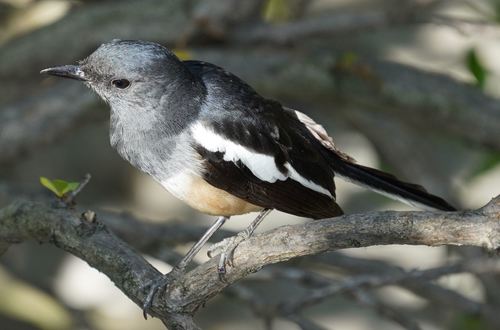 Oriental Magpie-Robin
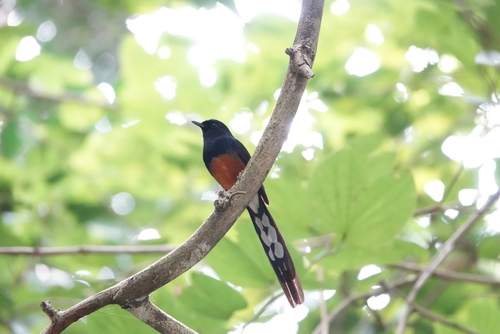 White-rumped Shama
In short
The most reliable way to separate Oriental Magpie-Robin from White-rumped Shama is by the male plumage: male magpie-robins are sharply black and white, while male shamas are glossy black above with a rich chestnut belly and a distinctive white rump and outer tail. Females and juveniles are trickier, but magpie-robins are generally paler and more contrasting, while shamas are browner and more uniform. Structure and behavior also help: magpie-robins are shorter and stockier with a cocked tail, often seen in open or urban areas, while shamas are longer, slimmer, and more secretive, preferring dense undergrowth. Juvenile and female confusion is common, so look for the shama’s longer tail and chestnut underparts versus the magpie-robin’s paler, more scaly young and upright tail posture.
Identification tips
- Male plumage: Male magpie-robin is black above and white below with a white shoulder patch; male shama is glossy black above, chestnut below, with a white rump and outer tail. This is the most reliable mark for adult males.
- Female and juvenile confusion: Female magpie-robins are paler and more contrasting (greyish-black above, greyish-white below), while female shamas are more uniformly greyish-brown and lack sharp contrast. Juvenile magpie-robins are scaly brown above and pale below; juvenile shamas are more uniformly dusky with a blotchy chest.
- Tail shape and length: Shama has a much longer tail, often more than half its body length, and the tail is fanned or flicked but not usually cocked upright. Magpie-robin’s tail is shorter and often held cocked at a steep angle, especially when foraging.
- White in tail: Magpie-robin shows white on the sides of the tail and a white shoulder patch; shama shows white on the rump and outer tail feathers, especially obvious from behind or in flight.
- Underpart color: Magpie-robin is white below (male) or greyish-white (female); shama is rich chestnut below (male) or brownish (female).
- Bill and feet: Both have dark bills and pale legs, not a strong separator.
- Perched posture: Magpie-robin often perches upright with tail cocked; shama perches more horizontally, tail trailing or gently fanned.
- Habitat: Magpie-robin is common in open, urban, or garden habitats; shama prefers dense forest undergrowth and is rarely seen in open spaces.
- Behavior: Magpie-robin is bold and conspicuous, often foraging on lawns or walls; shama is shy, skulking in dense cover, and more likely to be heard than seen.
- Song: Both are excellent mimics, but magpie-robin sings from exposed perches, shama from hidden spots. Shama’s song is richer and more flute-like, but overlap can occur.
- Flight: In flight, the shama’s long tail and white rump are diagnostic; magpie-robin’s flight is less showy, with white limited to tail sides and shoulder.
- Size and structure: Shama is longer and slimmer, magpie-robin is shorter and stockier.
- Seasonal variation: Female magpie-robins can be darker in some southern races, but never show the shama’s chestnut belly or white rump.
- Geographic overlap: Both species occur in South and Southeast Asia, but magpie-robin is more likely in urban or open settings, shama in dense forest.
- Pitfalls: Beware of juvenile and female confusion; always check tail length, underpart color, and habitat context before deciding.
Size
Oriental Magpie-Robin is smaller and stockier, with a typical mass of about 36 g and a length around 19 cm (including the tail). White-rumped Shama is noticeably longer and slimmer, at 23–28 cm in length and a mass of 28–34 g. The shama’s tail is proportionally much longer, giving it a more elongated appearance, especially when perched or in flight.
Plumage
-
Juveniles: Young magpie-robins show scaly brown upperparts and head, with a pale belly and some contrast between upper and lower parts. Juvenile shamas are more uniformly greyish-brown, with a blotchy or spotted chest but lacking the scaly pattern. Both can look drab, but magpie-robin juveniles are paler and more patterned, while shamas are duskier overall.
-
Adult males: Magpie-robin males are sharply black above (head, back, throat), white below, and have a white shoulder patch and white sides to the long tail. Shama males are glossy black above, with a rich chestnut belly, and a bold white rump and outer tail feathers (the white is not on the sides of the tail as in magpie-robin). The shama’s underparts are much darker and more colorful than the magpie-robin’s plain white.
-
Adult females: Female magpie-robins are greyish-black above and greyish-white below, generally paler and more contrasting than shama females. Female shamas are more uniformly greyish-brown, lacking the sharp contrast of the magpie-robin, and are typically shorter-tailed than males but still longer-tailed than magpie-robins. Geographic variation in female magpie-robins can make some nearly as dark as males, but they never show the chestnut belly or white rump of the shama.
-
In flight: The shama’s white rump and outer tail are obvious if seen from behind or above, while the magpie-robin shows white in the sides of the tail and a white shoulder patch.
Behaviour
Oriental Magpie-Robin is often seen openly, hopping on the ground or perching conspicuously with its tail cocked upright. It forages in leaf litter and frequently sings from high, exposed perches, especially during breeding season. White-rumped Shama is much shyer and prefers dense undergrowth or bamboo thickets, often staying hidden and moving low in the vegetation. Shamas are more likely to be heard than seen, and their long tails are often flicked or fanned during display flights. Magpie-robins are more tolerant of human presence and common in gardens and urban parks, while shamas avoid open spaces.
Habitat
Magpie-robins are adaptable and common in urban gardens, parks, and open forests, often close to human habitation. White-rumped Shamas prefer dense, tangled undergrowth in forests, secondary growth, and bamboo thickets, and are much less likely to be found in open or urban areas. If you see a Copsychus in a city park or hopping on a wall, it is far more likely to be a magpie-robin; if it is deep in tangled forest, especially in Southeast Asia, shama is more likely.
Voice
Both species are celebrated songsters, but their songs differ. Magpie-robins sing loudly from exposed perches, with a varied, melodious song. Shamas are also highly musical but are more often heard from dense cover, and their song is described as richer and more flute-like. Both can mimic other birds, so song alone is not always diagnostic, but context (open perch vs. hidden in undergrowth) can help.
Oriental Magpie-Robin · White-rumped Shama · My Tricky Birds