

Orchard Oriole vs Hooded Oriole
Icterus spurius versus Icterus cucullatus
Play a quiz with Orchard Oriole and Hooded Oriole
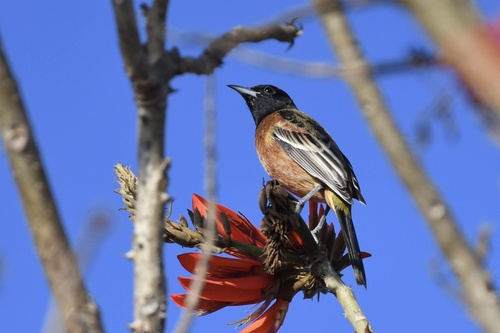 Orchard Oriole
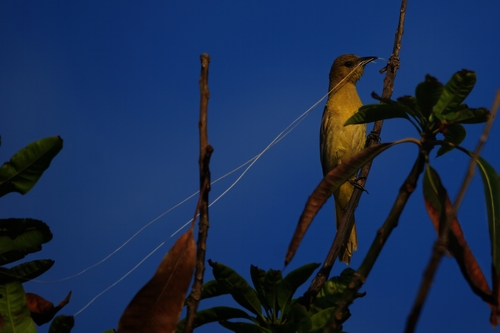 Hooded Oriole
In short
The most reliable field mark between Orchard Oriole and Hooded Oriole is the adult male's underpart color: Orchard Oriole males show deep chestnut (or ochre in the Mexican subspecies), while Hooded Oriole males are bright orange to yellow-orange below. Females and immatures of both are olive-green above and yellowish below, but Orchard Oriole is smaller and more compact, with a shorter, less slender bill. Both species have white wing bars and blackish bills, but Hooded Oriole's bill is longer and more decurved, especially in western populations. In flight or perched, look for the Orchard Oriole's smaller size and chestnut (not orange/yellow) tones on adult males, and use bill shape and overall jizz for trickier female/immature birds.
Identification tips
- Adult male underparts color: Orchard Oriole males are deep chestnut (or ochre in I. s. fuertesi), never orange or bright yellow; Hooded Oriole males are orange to yellow-orange below. This is the single most reliable mark for adult males.
- Female and immature confusion: Both species' females and immatures are olive-green above and yellowish below. Orchard Oriole is smaller and more compact, with a shorter, less decurved bill; Hooded Oriole is longer, slimmer, and has a more slender, curved bill (especially in western birds).
- One-year-old male Orchard Oriole: These birds are yellow-greenish like females but have a black bib and lores, a feature not shown by Hooded Oriole of any age.
- Bill color: Orchard Oriole's bill is black with some blue-gray at the base of the lower mandible; Hooded Oriole's bill is entirely black. This is subtle and best seen at close range.
- Wing bars: Both have two white wing bars, so this is not a useful separator.
- Size and jizz: Orchard Oriole is the smallest North American oriole, appearing compact with a short tail and bill. Hooded Oriole is medium-sized, longer, and more slender, with a proportionally longer tail and bill.
- Bill shape: Hooded Oriole's bill is longer and more decurved, especially in western subspecies (nelsoni, trochiloides). Orchard Oriole's bill is shorter and straighter.
- Subspecies variation in Hooded Oriole: Some Hooded Orioles are more orange (Texas and Mexico), others more yellow (western US), but none have the chestnut tone of Orchard Oriole.
- Flight style: Orchard Oriole often flies low, swooping close to the ground or below treetop level. Hooded Oriole's flight is less described but is not noted for this behavior.
- Foraging behavior: Hooded Oriole is acrobatic, often hanging upside down to feed, and visits feeders (including hummingbird feeders) frequently. Orchard Oriole is less acrobatic and less likely to visit feeders.
- Nest placement: Hooded Oriole often nests in palms, Orchard Oriole in horizontal branches of deciduous trees. This is useful if you see nesting behavior.
- Habitat: In the east, Orchard Oriole is expected in riparian or park-like habitats with deciduous trees. Hooded Oriole is more likely in the southwest, especially where palms are present, including urban areas.
- Song: Hooded Oriole's song is short, abrupt, and nasal/whiny; Orchard Oriole's is more musical and whistled (if heard).
- Season: Orchard Oriole is a nocturnal migrant, present in the US only in the breeding season (spring/summer). Hooded Oriole may be resident or a migrant depending on location, but is rare in the US in winter except in southern California.
- Pitfalls: Female and immature Orchard and Hooded Orioles are very similar; use size, bill shape, and subtle plumage cues. Avoid relying solely on yellowish underparts or olive upperparts for ID.
Size
Orchard Oriole is distinctly smaller and lighter than Hooded Oriole. Orchard Oriole measures 5.9–7.1 in (15–18 cm) in length and weighs 16–28 g, while Hooded Oriole is heavier (mean mass 24.3 g) and described as medium-sized among New World orioles. In the field, Hooded Oriole appears longer, more slender, and with a proportionally longer bill and wings, especially in western subspecies. Orchard Oriole is the smallest North American oriole and looks noticeably more compact.
Plumage
Adult male Orchard Orioles are unique among North American orioles for their deep chestnut underparts, shoulder, and rump (ochre in I. s. fuertesi), contrasting with a black head and upperparts. Hooded Oriole adult males are orange to yellow-orange on the head and underparts, with black restricted to the face, throat, back, wings, and tail. Both species have two white wing bars. Females and juveniles of both are olive-green above and yellowish below, making them easily confused. However, Orchard Oriole females and immatures are generally duller and more uniform, lacking any orange or bright yellow tones. One-year-old male Orchard Orioles resemble females but show a black bib and lores, while young Hooded Orioles do not. Bill color is subtly different: Orchard Oriole's bill is black with some blue-gray at the base of the lower mandible; Hooded Oriole's is entirely black. Subspecies variation in Hooded Oriole can make some birds more orange or more yellow, but none show the chestnut tones of Orchard Oriole. No distinctive juvenile or first-year upperwing patterns are described for either species, so focus on overall coloration and bill structure.
Behaviour
Orchard Orioles tend to fly low, swooping close to the ground or below treetop level, and are less acrobatic in their foraging. Hooded Orioles are more acrobatic, often hanging upside down to feed on nectar and insects, and are frequent visitors to feeders, including hummingbird feeders. Both species build tightly woven pouch nests, but Hooded Oriole often attaches its nest to palm leaves, while Orchard Oriole prefers horizontal tree branches. Courtship displays differ: Orchard Oriole females bow, seesaw, and beg with fluttering wings, while Hooded Oriole's displays are less described.
Habitat
Orchard Oriole breeds in semi-open areas with deciduous trees, often near lakes and streams in eastern North America and parts of Mexico. Hooded Oriole favors open areas with trees, especially palms, across the southwestern US and northern Mexico, and is a familiar bird in urban and suburban settings with palms. In winter, Orchard Oriole migrates to Central America and northern South America, while Hooded Oriole is resident in parts of Mexico and Belize, and migrates from the US to Mexico. Habitat overlap is limited, but both can occur in riparian or park-like settings in Texas and northeastern Mexico.
Voice
Hooded Oriole's song is short, abrupt, rapid, and often nasal or whiny, lacking the whistling quality of some other orioles. Calls include whistling and 'wheet' notes. Orchard Oriole's vocalizations are not detailed in the notes, but are generally described elsewhere as whistled and more melodic. In the field, Hooded Oriole's song may sound less musical and more chattery compared to Orchard Oriole.