

Orange-backed Woodpecker vs Buff-necked Woodpecker
Chrysocolaptes validus versus Meiglyptes tukki
Play a quiz with Orange-backed Woodpecker and Buff-necked Woodpecker
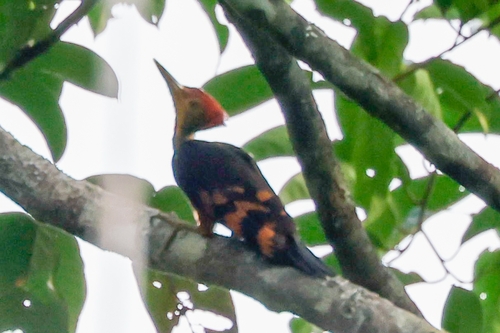 Orange-backed Woodpecker
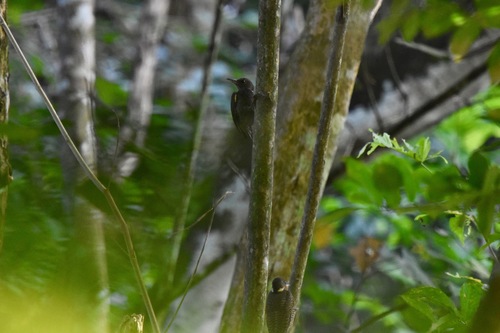 Buff-necked Woodpecker
In short
The most reliable field mark to separate Orange-backed Woodpecker from Buff-necked Woodpecker is overall coloration: Orange-backed is much brighter and more striking, while Buff-necked is small, dark brown, and subtly barred. Orange-backed is a forest canopy specialist, often seen higher up, whereas Buff-necked is darker, with a pale neck stripe and distinct wing barring. Structural differences also help: Buff-necked has a longer tail and a pointed, curved bill, while Orange-backed is more compact. Immature or in-flight birds are best separated by the Buff-necked's distinctive pale wing barring and dirty-cream neck stripe, which Orange-backed lacks.
Identification tips
- Pale wing barring (Buff-necked): Look for clear pale barring on the wings of Buff-necked Woodpecker, visible both perched and in flight. Orange-backed lacks this feature at all ages.
- Dirty-cream neck stripe (Buff-necked): Buff-necked shows a dirty-cream colored stripe on the side of the neck, a key mark in all plumages. Orange-backed does not have this stripe.
- Overall coloration: Orange-backed is much brighter, with a striking orange back, while Buff-necked is uniformly dark brown with subtle pale barring.
- Tail length: Buff-necked has a significantly longer tail than Orange-backed, giving it a more elongated appearance when perched or in flight.
- Bill shape: Buff-necked's bill is pointed and noticeably curved along the culmen, while Orange-backed's bill is less curved and appears more typical for a woodpecker.
- Nuchal crest: Buff-necked lacks a nuchal crest, which can be a subtle structural difference if visible.
- Body size: Buff-necked is much heavier and bulkier (mean 53g) compared to Orange-backed (14.9g). Use this when both species are seen together or with known size references.
- Habitat context: If the bird is seen high in the forest canopy, Orange-backed is more likely. Buff-necked may be found at various heights.
- Perched vs. in flight: In flight, Buff-necked's pale wing barring and neck stripe are especially useful. Orange-backed will appear more uniform and bright.
- Juvenile confusion: No specific juvenile marks are noted for Orange-backed, but Buff-necked's wing barring and neck stripe are present in all ages, making them reliable for separating young birds.
- Sex/season: No sex- or season-specific differences are noted in the available sources for either species, so rely on the structural and plumage marks above.
- Common pitfalls: Do not confuse Buff-necked's pale neck stripe with a pale throat or malar; it is a stripe on the side of the neck, not under the bill. Orange-backed's brightness is unique among these two.
- Bill and head jizz: Buff-necked's bill is both pointed and curved, which can be a subtle but useful mark if seen well.
- Absence of nuchal crest: While not always obvious, the lack of a nuchal crest in Buff-necked can help rule out confusion with similar species, but is less useful against Orange-backed.
- Wing pattern in flight: Always check for pale barring on the upperwing and underwing in Buff-necked, especially in poor light or fast-moving birds.
Size
Buff-necked Woodpecker is significantly heavier and larger than Orange-backed Woodpecker. The mean body mass for Buff-necked is about 53g (from a 1978 survey), while Orange-backed is much lighter at 14.9g [wikidata]. Buff-necked also has a notably longer tail and a more robust bill. In the field, Buff-necked will appear bulkier and longer-tailed, while Orange-backed is more compact and lighter-bodied.
Plumage
-
Juvenile/Immature/Flight views: Buff-necked Woodpecker of all ages shows dark brown plumage with clear pale barring on the wings and a dirty-cream stripe on the neck. These features are visible both perched and in flight, and the pale wing barring is especially diagnostic for Buff-necked when seen from below or in motion. Orange-backed Woodpecker, in contrast, is much brighter overall and lacks the combination of dark brown base color and pale barring. No distinctive juvenile or immature upperwing pattern is described for Orange-backed.
-
Adult plumage: Orange-backed Woodpecker is strikingly colored, with a bright orange back, and does not show the pale neck stripe or wing barring of Buff-necked. Buff-necked adults retain the same dark brown and barred appearance, with the pale neck stripe and no nuchal crest. The nuchal crest is absent in Buff-necked but may be present in other similar species, not Orange-backed.
Behaviour
Orange-backed Woodpecker is a forest canopy specialist, typically seen higher in the trees, moving actively in the upper levels. Buff-necked Woodpecker does not have a noted canopy preference and may be encountered at a wider range of forest levels. Both are woodpeckers and may show similar foraging behavior, but Orange-backed's tendency to stay in the canopy can be a behavioral clue.
Habitat
Orange-backed Woodpecker is a strict forest specialist, found primarily in the canopy of mature forests in southern Thailand, Malaya, Borneo, Sumatra, and Java. Buff-necked Woodpecker is also a forest species, but the notes do not specify a strong canopy association. If you see a woodpecker high in the canopy, Orange-backed is more likely; Buff-necked may be found lower as well as higher up.
Orange-backed Woodpecker · Buff-necked Woodpecker · My Tricky Birds