

Okarito Brown Kiwi vs Great Spotted Kiwi
Apteryx rowi versus Apteryx maxima
Play a quiz with Okarito Brown Kiwi and Great Spotted Kiwi
 Okarito Brown Kiwi
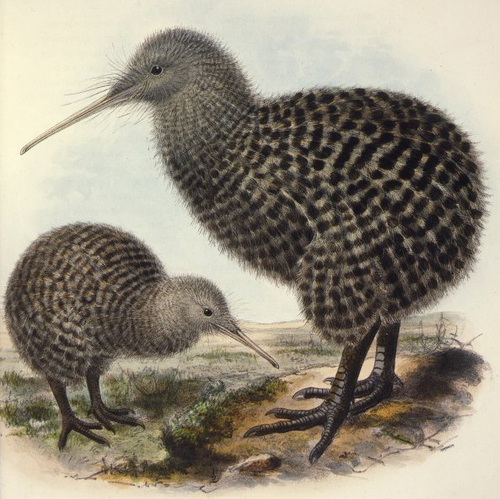 Great Spotted Kiwi
In short
The most reliable field mark to separate Okarito Brown Kiwi (Rowi) from Great Spotted Kiwi (Roroa) is the plumage pattern: Great Spotted Kiwi always shows distinct black spots on its otherwise grey to brown feathers, while Okarito Brown Kiwi lacks these spots and appears more uniformly brown. Both species are flightless, nocturnal, and structurally similar, but Great Spotted Kiwi is noticeably larger and bulkier. In the field, habitat and range are also strong clues: Okarito Brown Kiwi is restricted to the Ōkārito forest area, while Great Spotted Kiwi is more widespread in upland South Island forests. If you see a spotted, large kiwi in the South Island outside Ōkārito, it's almost certainly Great Spotted Kiwi.
Identification tips
- Spotted vs. Uniform Plumage: Great Spotted Kiwi always shows black spots on grey-brown feathers; Okarito Brown Kiwi is plain brown with no spots. This is the most reliable field mark at all ages.
- Size and Bulk: Great Spotted Kiwi is the largest kiwi, appearing noticeably bigger and bulkier than Okarito Brown Kiwi. If you have a sense of scale, use it, but beware of lone birds or poor views.
- Bill Length: Great Spotted Kiwi has a long, slender, ivory bill (9–12 cm), which may appear proportionally longer than in Okarito Brown Kiwi, but this is subtle and hard to judge without direct comparison.
- Habitat and Range: Okarito Brown Kiwi is only found in the Ōkārito forest; any kiwi seen elsewhere in the South Island uplands is almost certainly Great Spotted Kiwi.
- Territorial Behavior: Great Spotted Kiwi may be seen defending territory or in pairs over large areas; Okarito Brown Kiwi is less often described as territorial in the notes.
- No Tail: Both species lack a tail, so tail shape is not helpful for separation.
- Flightless Structure: Both are flightless with vestigial wings, so wing formula and flight patterns are not useful for ID.
- Feather Texture: Both have hair-like, soft feathers lacking aftershafts; this is not helpful for separation.
- Legs and Feet: Both have short legs with three toes per foot; not diagnostic between these two.
- No Visible Sexual Dimorphism: Both species show little to no difference between sexes in the field.
- Juvenile vs. Adult: Juveniles look similar to adults in both species; the presence or absence of spots is reliable for all ages.
- Nocturnal Activity: Both are nocturnal, but Great Spotted Kiwi may be active in daylight in predator-free areas—rarely useful for field separation.
- Vocalization: No diagnostic vocal differences are described in the notes; do not use voice for separation.
- Conservation Context: Okarito Brown Kiwi is much rarer (about 600 birds) and only seen in conservation areas or nocturnal walkthroughs; Great Spotted Kiwi is more numerous and widespread, though still vulnerable.
- Community Context: If birding with local guides or at a wildlife center, ask about the local species—Okarito Brown Kiwi is only at Ōkārito and specific centers.
Size
Great Spotted Kiwi is the largest kiwi species, with males reaching about 45 cm tall and females up to 50 cm, and weights ranging from 1.2–2.6 kg (males) and 1.5–3.3 kg (females). Okarito Brown Kiwi is smaller and less robust, though exact measurements are not given in the notes, it is consistently described as smaller than Great Spotted Kiwi. In direct comparison, Great Spotted Kiwi will look bulkier and taller, with a longer bill.
Plumage
Plumage is the most diagnostic feature: Great Spotted Kiwi of all ages shows black spots on the feathers, giving a speckled or mottled appearance over a charcoal grey to light brown background. Okarito Brown Kiwi lacks these spots entirely, presenting a uniform brown plumage. Both have hair-like, soft feathers without aftershafts, and neither has a tail. There are no described age-specific upperwing or flight marks for either species, as both are flightless and their wings are vestigial and not visible in the field. Juvenile and adult plumages are similar within each species, so the presence or absence of spots is reliable at all ages.
Behaviour
Both species are nocturnal and secretive, foraging at night and relying on their sense of smell. Great Spotted Kiwi is noted for being fiercely territorial, with pairs defending large territories (up to 25 hectares). Both species are flightless and move with a shuffling gait. In areas without predators, Great Spotted Kiwi may be active during the day, but this is rare. Okarito Brown Kiwi is not described as being particularly aggressive or territorial in the notes.
Habitat
Okarito Brown Kiwi is restricted to the Ōkārito forest on the West Coast of New Zealand's South Island, making its location highly diagnostic. Great Spotted Kiwi is more widespread in the South Island, especially in upland and high-altitude forests, and is absent from the Ōkārito area. If you encounter a kiwi outside the Ōkārito forest, especially in upland or mountainous terrain, it is almost certainly Great Spotted Kiwi.