

Ochre-breasted Foliage-gleaner vs Buff-browed Foliage-gleaner
Anabacerthia lichtensteini versus Syndactyla rufosuperciliata
Play a quiz with Ochre-breasted Foliage-gleaner and Buff-browed Foliage-gleaner
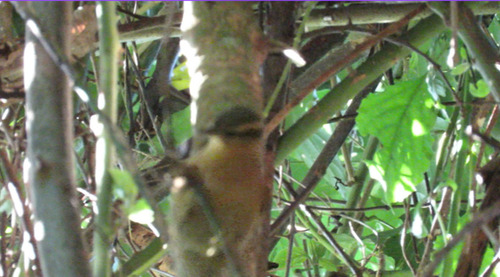 Ochre-breasted Foliage-gleaner
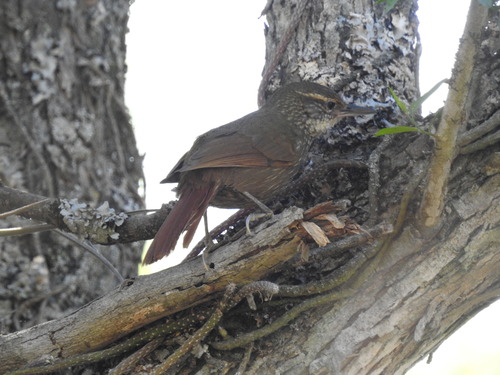 Buff-browed Foliage-gleaner
In short
To separate Ochre-breasted Foliage-gleaner from Buff-browed Foliage-gleaner, focus on the face pattern and underpart coloration. Ochre-breasted shows a sharply defined ochraceous supercilium and eye ring with a bright ochraceous throat and uniform buffy underparts, while Buff-browed has a paler, more extended supercilium, a whitish throat with brownish tips, and heavily streaked or scalloped, olive-brownish underparts. Bill structure also differs: Ochre-breasted has a shorter, wedge-shaped bill, while Buff-browed's is thicker and slightly upcurved. Juvenile underparts differ: Ochre-breasted juveniles have grayish-tipped, less uniform buff, while Buff-browed juveniles show spotted underparts. Both species overlap in range and habitat, so careful attention to these details is essential.
Identification tips
- Supercilium and Eye Ring: Ochre-breasted shows a sharply defined, ochraceous supercilium and eye ring, contrasting with a dark post-ocular band and rufous-ochre ear coverts. Buff-browed's supercilium is paler, more tawny-buff, and extends farther back (sometimes to the nape), with a less contrasting face overall.
- Throat and Malar: Ochre-breasted has a bright ochraceous buff throat and malar area, standing out against the rest of the face. Buff-browed's throat is whitish with brownish feather tips, often appearing scalloped or dirty, and lacks the rich ochraceous tone.
- Underparts: Ochre-breasted's underparts are uniform ochraceous buff (richer on the upper breast, duller below), with little or no streaking. Buff-browed's underparts are buffy whitish with strong olive-brown scalloping or streaks, especially on the breast and belly, fading toward the rear. This streaking is a key mark for Buff-browed.
- Juvenile Underparts: Juvenile Ochre-breasted shows grayish-tipped, less uniform buff underparts; Buff-browed juveniles have spotted (not streaked) underparts. If you see clear spots below, favor Buff-browed.
- Bill Structure: Ochre-breasted has the shortest, wedge-shaped bill in its genus, appearing compact and straight. Buff-browed's bill is thicker, longer, and slightly upcurved, giving a heavier-headed look.
- Crown and Back: Ochre-breasted has a dull gray-brown crown with vague pale streaks and a rufescent brown back. Buff-browed's crown is dull olive-brown with vague whitish streaks at the rear, and the back is plain olive-brown (sometimes browner or more chestnut in subspecies).
- Tail Color: Ochre-breasted's tail is mostly rufous with rufescent brown outer webs on the innermost feathers. Buff-browed's tail is dull rufous, sometimes with a chestnut wash in some subspecies, but generally less bright than Ochre-breasted.
- Wing Color: Ochre-breasted's wings are rufous brown with duskier tips on the flight feathers. Buff-browed's wings are rich olivaceous brown, matching the back more closely.
- Face Pattern: Ochre-breasted's face is more sharply marked, with a dark brownish band behind the eye and dull rufous-ochre ear coverts. Buff-browed's face is browner with small buff markings and less contrast overall.
- Leg and Bill Color: Both have similar leg colors (greenish gray to olive), but Ochre-breasted's bill is brownish gray above, light gray below; Buff-browed's is darker above, paler below, sometimes blue-gray.
- Size and Structure: Buff-browed is noticeably larger and heavier, with a bulkier body and longer tail. In direct comparison, Ochre-breasted looks more compact.
- Plumage Pitfalls: Subspecies of Buff-browed may show more ochraceous or chestnut tones, but always with more streaking or scalloping below than Ochre-breasted. Do not rely on overall color tone alone.
- Habitat/Range: Both species overlap in much of their range and habitat, so do not use location or forest type as a primary separator where both occur.
- Flight and Perched Views: In flight, focus on underpart streaking (Buff-browed) versus uniform ochraceous (Ochre-breasted). Perched, check the face pattern and bill shape.
- Sex and Season: Both species are sexually monomorphic and show little seasonal change in adult plumage. Age-related underpart pattern is the main seasonal/age clue.
Size
Buff-browed Foliage-gleaner is consistently larger and heavier (17–18 cm, 22–33 g; mean mass 25.6 g) than Ochre-breasted (15–17 cm, 18–24 g; mean mass 21.0 g) [wikidata]. In the field, this difference may be subtle, but Buff-browed often appears bulkier and longer-tailed. Bill size is also a clue: Buff-browed's bill is noticeably thicker and longer, with a slight upcurve, compared to the shorter, wedge-shaped bill of Ochre-breasted.
Plumage
- Juveniles: Ochre-breasted juveniles have less uniformly colored underparts with grayish tips, while Buff-browed juveniles show spotted (not streaked) underparts. This difference is subtle but can be useful if seen well.
- Adults: Ochre-breasted has a sharply defined ochraceous supercilium and eye ring, a bright ochraceous throat and malar, and uniform ochraceous-buff underparts. Its back and wings are rufescent brown, and the tail is mostly rufous. Buff-browed, in contrast, has a paler, longer supercilium (tawny-buff to pale, sometimes extending to the nape), a whitish throat with brownish tips, and underparts that are buffy whitish with olive-brown feather edges, creating a scalloped or streaked effect. The back and wings are olive-brown, and the tail is dull rufous. Subspecies of Buff-browed may show more chestnut or ochraceous tones, but always with more streaking or scalloping below than Ochre-breasted.
Behaviour
Both species are active foliage-gleaners, typically foraging in the midstory to canopy. No major behavioral differences are noted in the sources. Both may join mixed-species flocks and move methodically through dense foliage, rarely perching in the open for long.
Habitat
Both species overlap in much of their range (Argentina, Brazil, Paraguay) and are found in similar forested habitats. Buff-browed has a wider range, extending into Bolivia, Ecuador, Peru, and Uruguay. Habitat alone is not diagnostic where their ranges overlap.
Ochre-breasted Foliage-gleaner · Buff-browed Foliage-gleaner · My Tricky Birds