

Northern Wheatear vs Yellow-crowned Bishop
Oenanthe oenanthe versus Euplectes afer
Play a quiz with Northern Wheatear and Yellow-crowned Bishop
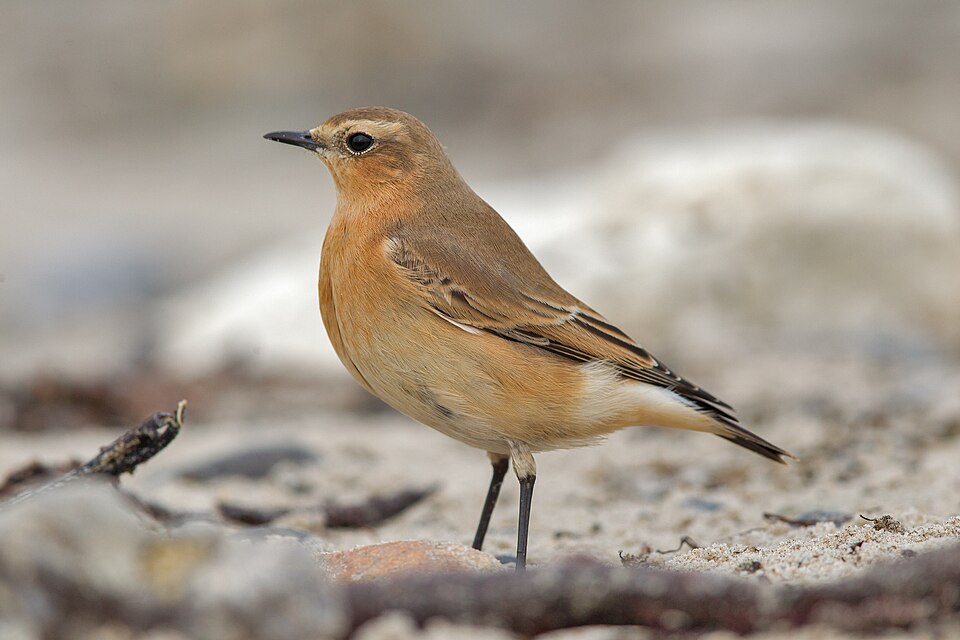 Northern Wheatear
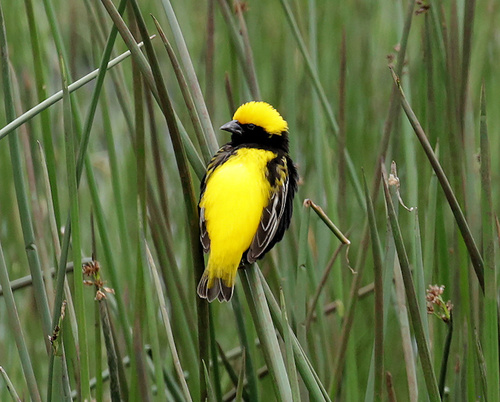 Yellow-crowned Bishop
In short
The most reliable separation is the striking plumage of the adult male Yellow-crowned Bishop in breeding season: a vivid yellow crown, back, and rump with a sharply contrasting black face, breast, and belly. By contrast, Northern Wheatear of all ages and sexes shows a white rump and tail with a black T-pattern, never the yellow-and-black combination. Females and non-breeding bishops are trickier, as both can appear brownish and streaked, but the wheatear’s white rump and tail pattern remain distinctive in flight. Structurally, the wheatear is larger and more upright, with a slimmer bill and longer legs, while the bishop is compact and short-billed. Habitat and behavior can help: wheatears favor open, stony ground and perch on rocks, while bishops are grassland birds, often in flocks and rarely far from dense vegetation.
Identification tips
- White rump and tail with black T-pattern (Wheatear only): All Northern Wheatears, regardless of age or sex, show a white rump and tail with a black inverted T at the tip—this is visible in flight and often when perched with tail flicks. No Yellow-crowned Bishop ever shows this pattern.
- Breeding male bishop is unmistakable: If you see a small bird with a bright yellow crown, back, and rump, and a sharply defined black face, throat, breast, and belly, it is a male Yellow-crowned Bishop in breeding plumage. Wheatear never shows this yellow/black combination.
- Female and non-breeding bishop vs. female/immature wheatear: Both can look brownish and streaked, but the bishop is more heavily streaked below and lacks the wheatear’s white rump/tail. Look for the pale eyebrow (bishop) vs. more uniform buff underparts (wheatear).
- Bill shape: Wheatear has a slim, straight bill suited to insect catching. Bishop has a short, thick, conical bill, typical of seed-eaters. This is especially clear at close range.
- Legs and stance: Wheatear is longer-legged and stands upright, often on rocks or posts. Bishop is shorter-legged, rounder, and sits low in grass or on stems.
- Flight style: Wheatear flies low and direct, often landing on open ground or rocks, flashing the white rump/tail. Bishop has a more fluttery, undulating flight, often dropping quickly into grass.
- Habitat context: Open, rocky, or barren ground points to wheatear. Dense grass, marsh edge, or weedy fields suggest bishop.
- Group size: Wheatear is usually alone or in pairs; bishop often in flocks, especially outside breeding season.
- Seasonal context: Only male bishops in breeding season (spring/summer in Africa) show the bright yellow/black plumage. At other times, both sexes are brownish and streaked.
- Underpart color: Wheatear is buff below (female/immature) or white with little streaking. Bishop (female/non-breeding) is off-white with fine dark streaks on breast and flanks.
- Wing and tail color: Wheatear wings are blackish (male) or dark brown (female), tail is white with black T. Bishop wings and tail are brown, never with white or black T.
- Size and shape: Wheatear is larger, more elongated, and upright. Bishop is smaller, rounder, and more compact.
- Perching behavior: Wheatear perches on rocks, walls, or bare ground. Bishop prefers grass stems, reeds, or low bushes.
- Voice: If you hear a sharp 'chack' or crackly song, it is likely a wheatear. Bishop’s voice is not distinctive in the provided notes.
- Pitfalls: Female and non-breeding bishop can be confused with wheatear in poor light or at distance. Always try to see the rump/tail pattern in flight or when the bird flicks its tail.
Size
Northern Wheatear is noticeably larger: 14.5–16 cm in length with a wingspan of 26–32 cm and a mass of 17–30 g [wikipedia]. Yellow-crowned Bishop is smaller and more compact, at 9.5–10.5 cm and about 14.5–15 g [wikidata]. In the field, wheatears look longer-legged and more upright, while bishops are rounder and more sparrow-like.
Plumage
-
Juvenile/immature and non-breeding birds: Female and non-breeding Yellow-crowned Bishops are pale brown above with darker streaking, a pale eyebrow, and off-white underparts with fine dark streaks. Northern Wheatear females and autumn males are pale brown above and buff below, but both sexes (all ages) show a white rump and tail with a black T-pattern—this is visible in flight and when perched with tail flicks. No bishop shows a white rump or tail pattern.
-
Adult breeding males: Male Yellow-crowned Bishop in breeding plumage is unmistakable: brilliant yellow crown, back, and rump, with a sharply defined black lower face, throat, breast, belly, and a wide black collar. Wings and tail are brown. Northern Wheatear males in summer have grey upperparts, buff throat, black wings, and a black face mask, but never show yellow or such a sharp black/yellow division. Both sexes of wheatear have the white rump and tail with black T-pattern.
-
Wings in flight: Wheatear wings are blackish in males, darker brown in females, but the key is the white rump and tail pattern, visible in all ages and sexes. Bishop wings are brown, with no white or black tail pattern.
Behaviour
Northern Wheatear is often seen singly or in pairs, perching upright on rocks or low posts, and making short sallies to the ground. Its tail is often flicked, flashing the white rump and tail pattern. Yellow-crowned Bishop is more likely to be seen in flocks, especially outside breeding season, and tends to stay low in grass or reeds, with a bouncy, undulating flight. Males may display by flying over grasslands, but usually return quickly to cover. Bishop’s feeding is more weaver-like, often clinging to grass stems.
Habitat
Northern Wheatear prefers open, stony ground, rocky fields, or tundra, often far from dense vegetation. It is rarely found in lush grass or reedbeds. Yellow-crowned Bishop is a grassland and wetland-edge specialist, favoring tall grass, weedy fields, and marshy areas, often near water and rarely in rocky or barren terrain. If you see the bird in a rocky, open landscape, it is much more likely to be a wheatear; in lush grass or near wetlands, bishop is more likely.
Voice
Northern Wheatear gives a sharp 'chack' call and, in breeding season, a whistling, crackly song. Yellow-crowned Bishop’s calls and songs are not described in the provided notes, so are not a reliable field mark for separation here.