

Northern Wheatear vs Atlas Wheatear
Oenanthe oenanthe versus Oenanthe seebohmi
Play a quiz with Northern Wheatear and Atlas Wheatear
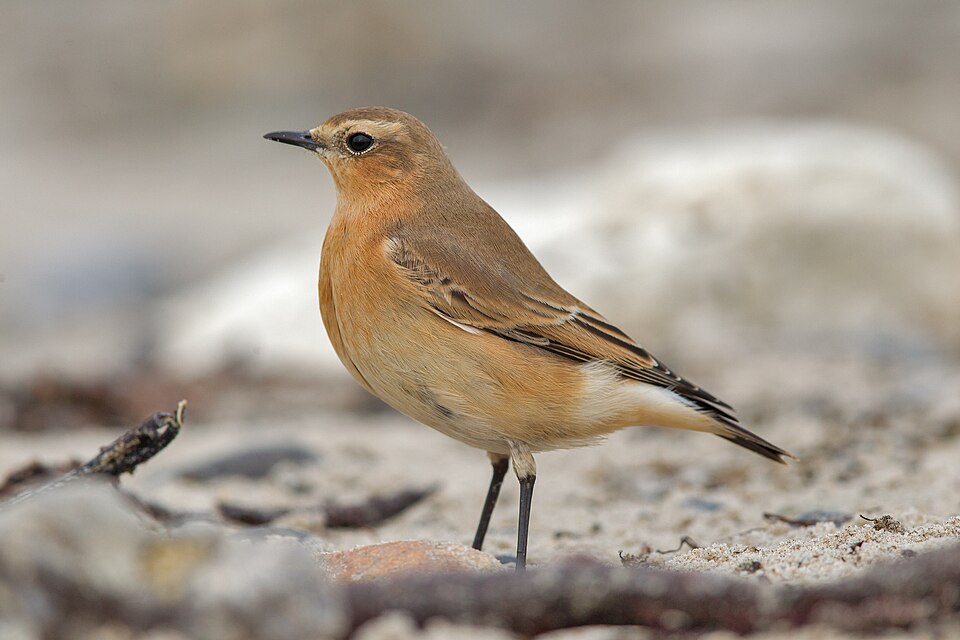 Northern Wheatear
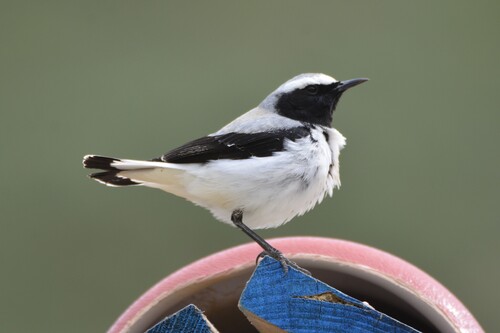 Atlas Wheatear
In short
The most reliable field mark to separate Atlas Wheatear from Northern Wheatear is the adult male's striking black throat, face, and ear coverts in breeding plumage—features never shown by Northern Wheatear. Females and non-breeding birds are trickier, but Atlas tends to show more white on the forehead and less black at the tail tip, with underparts often whiter and underwing coverts blackish. Both species share a white rump and black T-shaped tail pattern, so focus on head and throat color in males, and subtle tail and underpart differences in other plumages. Juvenile and first-winter birds are very similar and can be nearly inseparable in the field.
Identification tips
- Adult male in breeding plumage: Look for a solid black throat, face, lores, and ear coverts—if present, you have Atlas Wheatear. Northern Wheatear males never show a black throat or face, only a black mask and wings.
- Extent of black on tail: Atlas Wheatear may show less extensive black at the tail tip, with white extending further along the outer tail feathers. Northern Wheatear has a more pronounced black inverted T at the tail tip. This is subtle and best used in combination with other marks.
- Forehead color: Atlas Wheatear can show more white on the forehead than Northern Wheatear, especially in males.
- Underparts: Atlas Wheatear often has whiter underparts compared to the buffier tones of Northern Wheatear, especially in males.
- Underwing coverts and axillaries: Atlas Wheatear has black underwing coverts and axillaries, which can be a useful mark if seen in flight or when preening. Northern Wheatear does not show this feature.
- Females and non-breeding birds: Atlas Wheatear females and non-breeding males may show variable black or blackish-brown on the chin and lores, sometimes tipped with buff, grey, or sandy. Northern Wheatear females never show black on the throat or face.
- Post-breeding molt: Atlas Wheatear males retain a spotted black throat after molt, while Northern Wheatear males lose their black mask and become more like females.
- Juvenile/first-winter birds: Both species are extremely similar at this age, sharing the white rump and black T tail pattern. No reliable field marks separate them in this plumage.
- Song: If heard well, Atlas Wheatear's song is slower and lower-pitched with more distinct phrasing, but this is subtle and not always helpful.
- Habitat and range: In Europe, Asia, or the Americas, any wheatear is almost certainly Northern. In the Maghreb region of North Africa during the breeding season, Atlas is possible and males are distinctive. On migration in North Africa, both may occur, so plumage marks are essential.
- Size and structure: Both species are similar in size and structure, with upright stance and similar jizz; do not rely on size or shape for separation.
- Tail pattern: Both show a white rump and black inverted T tail pattern; this is not a separator.
- Behavior: Both species behave similarly, often perching upright on rocks and flicking their tails.
- Pitfalls: Beware of non-breeding and female Atlas Wheatears, which can closely resemble Northern Wheatear females. Only subtle differences in throat and chin coloration may help, and even these can be variable.
- When in doubt: If you cannot see a black throat or face, and are outside the Atlas Wheatear's limited breeding range, default to Northern Wheatear.
Size
Both species are very similar in size, with Northern Wheatear measuring 14.5–16 cm in length and having a wingspan of 26–32 cm, weighing 17–30 g [wikipedia]. Atlas Wheatear is described as a small passerine and is not noted as being larger or smaller, so expect them to be essentially the same size in the field. Size is not a reliable separator.
Plumage
- Adult breeding males: Atlas Wheatear stands out with a solid black throat, face, lores, and ear coverts, sometimes extending onto the upper breast. Northern Wheatear males never show a black throat or face; instead, they have a black mask and wings, with a buff throat and pale underparts. Atlas males may also show more white on the forehead and a less extensive black tip to the tail, with white sometimes extending along the outer tail feathers.
- Females and non-breeding birds: Both species are pale brown above and buff below, but Atlas females can be greyer above, sometimes with brown ear coverts and variable black or blackish-brown on the chin and lores, tipped with buff or sandy. Northern Wheatear females lack any black on the throat or face. After molt, Atlas males and females both become paler brown, but the black throat of males is still often visible, though spotted with pale tips.
- Juvenile/first-winter: No distinctive upperwing or flight pattern differences are described; both are very similar and can be nearly impossible to separate reliably in the field at this age. Both show the characteristic white rump and black T-shaped tail pattern.
Behaviour
Both species are ground-dwelling, upright, and often perch on rocks or low posts, frequently flicking their tails. No behavioral differences are noted that would help in field separation. Both are insectivorous and forage in open, stony habitats.
Habitat
Northern Wheatear breeds across open stony country in Europe, Asia, and parts of North America, while Atlas Wheatear is restricted to the Maghreb region of North Africa for breeding and winters in the western Sahel. If you are outside North Africa in the breeding season, you are almost certainly seeing a Northern Wheatear. Overlap is possible only on migration in North Africa, and even then, Northern is much more widespread.
Voice
Both species have similar calls, but Atlas Wheatear's song is slightly slower and lower-pitched, with more distinct rising and falling phrases compared to Northern Wheatear's whistling, crackly song. Calls are otherwise very similar and not reliably separable in the field.