
Northern Shoveler vs Pacific Black Duck
Spatula clypeata versus Anas superciliosa
Play a quiz with Northern Shoveler and Pacific Black Duck
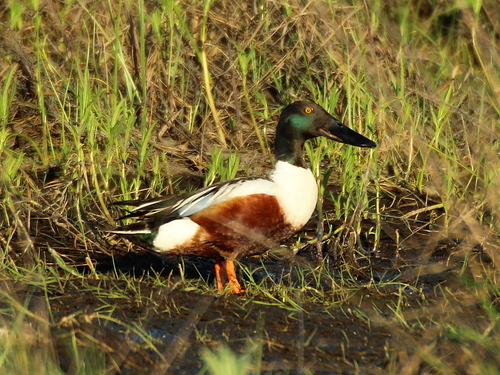 Northern Shoveler
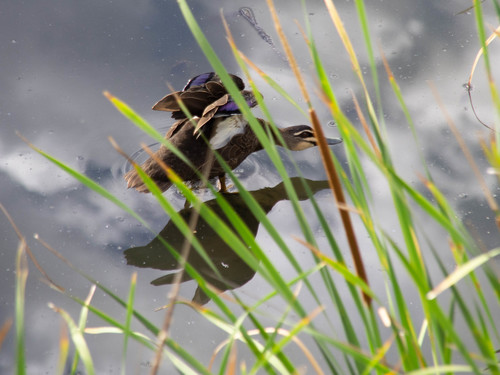 Pacific Black Duck
In short
The most reliable field mark for separating Northern Shoveler from Pacific Black Duck is the shoveler’s unique, broad, spatulate bill—noticeably longer and wider than the Pacific Black Duck’s standard duck bill, and obvious even at a distance. In flight, adult male shovelers show a distinctive pale blue forewing and a green speculum bordered by white, while Pacific Black Ducks show a green speculum but lack the blue and white wing paneling. Female and eclipse male shovelers can be confused with Pacific Black Ducks when perched, but the bill shape and (in flight) the blue forewing remain distinctive. Both species are dabbling ducks, but their structure, wing pattern, and facial markings provide clear separation with careful observation.
Identification tips
- Bill shape is the single most reliable mark: Northern Shoveler has a long, broad, spoon-shaped (spatulate) bill, much wider at the tip than the base, visible even at a distance or in silhouette. Pacific Black Duck has a standard duck bill, straight and evenly tapered.
- In flight, look for the forewing color: Adult male and female Northern Shovelers show a pale blue forewing patch, separated from the green speculum by a white border. Pacific Black Duck never shows blue or white on the upperwing—only a green speculum and pale underwing.
- Facial pattern: Pacific Black Duck has a bold pale supercilium (eyebrow stripe) and a dark eye-stripe, giving the face a strongly striped look in all plumages. Northern Shoveler (female/eclipsed male) has a plain face with no strong stripes, and breeding males have a clean white breast and dark green head.
- Male breeding plumage: Northern Shoveler drake has a dark green head, white breast, and chestnut flanks—none of which are shown by Pacific Black Duck.
- Female/eclipsed male confusion: Both can appear mottled brown, but the shoveler’s bill is always broad and spatulate, and the face is plain. Pacific Black Duck’s face is always boldly patterned.
- Leg color: Northern Shoveler has bright orange-red legs, which can be a supporting mark if seen well.
- Feeding behavior: If you see a duck swinging its bill side-to-side and straining food from the water, it is likely a Northern Shoveler. Pacific Black Duck does not show this specialized feeding action.
- Size and structure: Pacific Black Duck is larger and bulkier, but there is overlap. Use size only as a secondary clue.
- Habitat and context: In Australia/New Zealand, Pacific Black Duck is common and expected; Northern Shoveler is a rare vagrant. Only consider shoveler if the field marks are clear.
- Eclipse plumage pitfalls: Male Northern Shovelers in eclipse resemble females but retain the blue forewing in flight and the spatulate bill.
- Juvenile/immature confusion: Juvenile shovelers still show the spatulate bill and blue forewing in flight; Pacific Black Duck juveniles have the same facial stripes as adults and lack blue in the wing.
- Mixed flocks: If you see both species together, the shoveler will stand out by bill shape and flight pattern.
- Vocalizations: Not reliably diagnostic between these two species.
- Hybrid confusion: Pacific Black Duck hybridizes with Mallard, but not with Northern Shoveler; hybrids are not a likely confusion here.
- When in doubt: Focus on bill shape and wing pattern in flight—these are the most consistent and observable differences across all ages and sexes.
Size
Pacific Black Duck is the larger and heavier species, with a typical body mass of about 1035 g [wikidata], compared to the Northern Shoveler’s range of 500–800 g (occasionally up to 1000 g) [wikipedia]. Pacific Black Duck also averages longer (54–61 cm) than Northern Shoveler (44–52 cm). In the field, Pacific Black Duck appears bulkier and heavier-bodied, while Northern Shoveler is more slender and slightly smaller overall. However, size overlap can occur, especially with large shovelers or small Pacific Black Ducks, so size alone should not be relied upon for identification.
Plumage
-
Juvenile/immature/flight views: For all ages, Northern Shoveler in flight (especially males) shows a pale blue forewing (shoulder) patch, separated from the green speculum by a white border. Females and eclipse males retain the blue forewing, though less vivid. Pacific Black Duck, in all plumages, lacks the blue forewing and white border, showing instead a green speculum and pale underwing, with no blue or white paneling. The Pacific Black Duck’s upperwing is otherwise dark, and the speculum is not bordered by white.
-
Adult male (breeding): Northern Shoveler drake has an iridescent dark green head (less intense than a Mallard), white breast, chestnut flanks, and a black or dark grey bill. Pacific Black Duck is overall dark brown with a paler face, dark crown, and bold pale supercilium (eyebrow stripe), with no white breast or chestnut flanks.
-
Female/eclipsed male: Female Northern Shoveler is mottled brown, similar to female Mallard, but always with a large, broad, spatulate bill (grey tinged with orange). Pacific Black Duck female is also brown but with a distinctive pale face and strong facial stripes (supercilium and dark eye-stripe), and a normal duck bill. In all plumages, Pacific Black Duck’s face is more strongly patterned than the shoveler’s.
-
Leg color: Northern Shoveler has bright orange-red legs; Pacific Black Duck’s leg color is not specified as a field mark in the sources.
Behaviour
Both species are dabbling ducks, feeding by upending or dabbling at the water’s surface. Northern Shoveler is specialized for filter-feeding, swinging its bill side-to-side to strain small invertebrates and plant matter, thanks to its comb-like lamellae. This feeding style is distinctive and can be a behavioral clue if observed. Pacific Black Duck feeds more like a typical dabbling duck, upending and grazing. Northern Shoveler is less gregarious outside the breeding season, often in small flocks, while Pacific Black Duck is described as sociable. Both species frequent marshes, lakes, and wetlands.
Habitat
Northern Shoveler is widespread across the Northern Hemisphere, breeding in northern Eurasia and North America, and wintering further south. In Australia and New Zealand, it is a rare vagrant. Pacific Black Duck is resident and common throughout Australia, New Zealand, New Guinea, and many Pacific islands. In Australasia, Pacific Black Duck is the default dabbling duck in most wetlands, while Northern Shoveler is exceptional and should be considered only with strong field marks. Overlap is possible only with vagrant shovelers in Australia/New Zealand, where confusion is most likely.
Voice
Pacific Black Duck, like Mallard, produces a loud, raucous quack, especially the female. Northern Shoveler’s voice is not described in the notes, and is not a primary field mark for separation between these two species. Voice is not likely to be diagnostic in most field situations.