
Northern Royal Albatross vs Southern Royal Albatross
Diomedea sanfordi versus Diomedea epomophora
Play a quiz with Northern Royal Albatross and Southern Royal Albatross
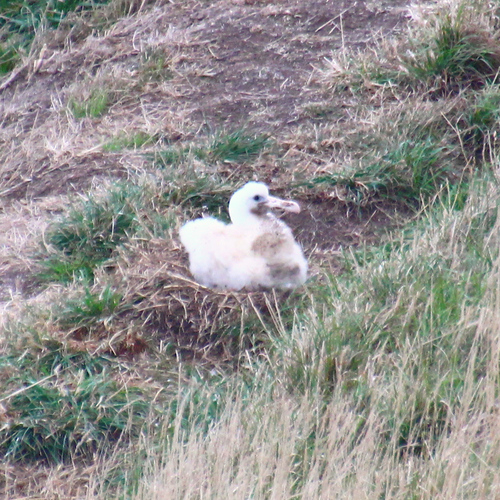 Northern Royal Albatross
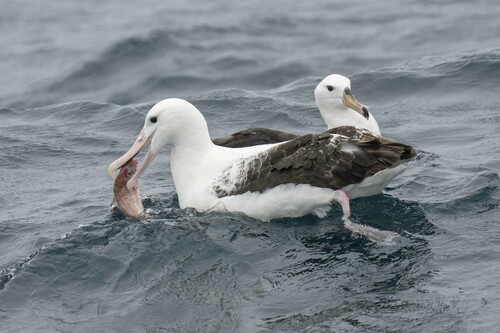 Southern Royal Albatross
In short
The most reliable way to separate Northern Royal Albatross from Southern Royal Albatross is by the upperwing pattern, especially in flight or on perched birds with spread wings. Adult and near-adult Southerns show extensive white on the upperwings, while Northerns remain almost entirely dark above regardless of age. Juveniles of both can look similar, but Southerns begin to develop white patches on the upperwing coverts and leading edge as they mature, whereas Northerns do not. Size is not a safe field mark, as both are among the largest albatrosses and overlap extensively. Focus on wing pattern, especially in subadults and adults, and use structure and bill color only as supporting clues.
Identification tips
- Upperwing pattern is key: In flight or with wings spread, look for white on the upperwing. Southern Royal Albatross (especially adults and older immatures) shows extensive white patches or panels on the upperwing, starting from the leading edge and expanding with age. Northern Royal Albatross always has dark upperwings with only scattered white flecks, never large white areas. This is the most reliable field mark for all but the youngest juveniles.
- Juvenile confusion: Very young Southern Royal Albatross can look similar to Northern, both showing mostly dark upperwings with some flecking. Watch for the early appearance of white along the leading edge in Southerns as they age; Northerns will not develop this.
- Tail pattern: Both start with white tails tipped black, but Southern Royal Albatross loses the black tail tip sooner as it matures. This is a subtle and unreliable mark unless seen well.
- Head and body plumage: Both species have white heads, necks, and underparts at all ages. Do not use head or underpart color for separation.
- Bill color: Both have pink bills with a black cutting edge. Bill color is not a useful separator.
- Leg color: Both have pale or flesh-colored legs; not a separator.
- Size and bulk: Southern Royal averages heavier, but overlap is extensive and size is not a safe field mark.
- Flight style: Both species soar and glide in a similar manner; flight jizz is not diagnostic.
- Breeding location: If observed at a known colony, location can help (e.g., Taiaroa Head for Northern, Campbell Island for Southern), but at sea this is not reliable.
- Sex differences: Southern Royal males are heavier than females, but this is not visible in the field and does not help with species ID.
- Seasonal variation: The key wing pattern differences persist year-round; no seasonal plumage change affects the main field marks.
- Confusion with Wandering Albatross: Both royals can be confused with Wandering Albatross, but between the two royals, focus on upperwing pattern as described above.
- Do not use behavior or vocalization: Courtship and other behaviors are similar and not useful for separation.
- Do not use habitat at sea: Both species can occur together over deep ocean waters; habitat is not a separator away from colonies.
- Summary tip: If you see a royal albatross with large white areas on the upperwing, it is a Southern Royal; if the upperwing is almost entirely dark, it is a Northern Royal.
Size
Both species are among the largest flying birds, and size alone is not a reliable separator. Southern Royal Albatross averages heavier (mean adult mass ~9 kg, with some males over 10 kg) [wikidata], while Northern Royal Albatross is slightly lighter (6.2–8.2 kg cited, but no AVONET value). Both have wingspans in the 2.7–3.3 m range, with Southerns possibly reaching up to 3.5 m. In the field, these differences are not obvious, and overlap is substantial. Do not rely on size or bulk for identification.
Plumage
- Juveniles/Immatures: Both start with mostly white heads, necks, underparts, and dark upperwings with some white flecking on coverts. However, Southern Royal Albatross juveniles soon begin to develop white speckling on the upperwing, starting at the leading edge and expanding with age. Northern Royal Albatross retains an almost entirely dark upperwing throughout all ages, with only scattered white flecks on coverts, never forming large white areas.
- Adults: Southern Royal Albatross adults show extensive white on the upperwing, often forming large panels or blotches, especially from the leading edge. Northern Royal Albatross adults remain dark above, with little to no white except for small flecks. Both have white tails with black tips as juveniles, but Southerns lose the black tail tip sooner.
- Bills and Legs: Both have pink bills with a black cutting edge and pale/flesh-colored legs; these are not reliable for separation.
Behaviour
Behavior is not a reliable separator between these two species in the field. Both display typical large albatross flight (slow, powerful glides and soaring), and both use similar courtship displays (bill-snapping, sky-calling, etc.). Any behavioral differences are subtle and not useful for field identification.
Habitat
Both species breed on subantarctic islands and forage widely at sea. There is some geographic separation in breeding colonies (e.g., Northerns at Chatham Islands and Taiaroa Head, Southerns at Campbell Island), but at sea their ranges overlap and habitat use is similar. Habitat is not a reliable separator unless you are at a known breeding colony.
Northern Royal Albatross · Southern Royal Albatross · My Tricky Birds