

Northern Rough-winged Swallow vs Cliff Swallow
Stelgidopteryx serripennis versus Petrochelidon pyrrhonota
Play a quiz with Northern Rough-winged Swallow and Cliff Swallow
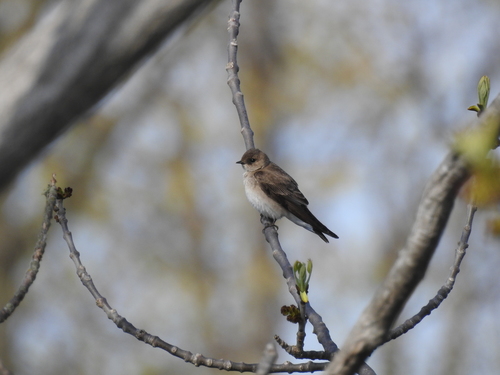 Northern Rough-winged Swallow
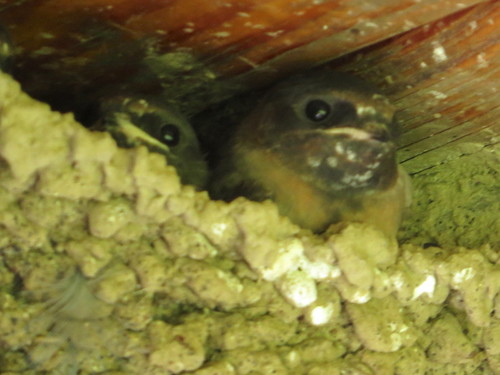 Cliff Swallow
In short
The most reliable field mark to separate Northern Rough-winged Swallow from Cliff Swallow is the presence of a bold white forehead and buffy rump on Cliff Swallow, which are never shown by Northern Rough-winged. Juvenile Cliff Swallows also show distinctive white speckling on the forehead and throat, while juvenile Northern Rough-winged Swallows have reddish-brown wing-bars. In flight, Cliff Swallow has a square tail and contrasting pale rump, whereas Northern Rough-winged Swallow has a subtly notched tail and plain brown upperparts. Both species are similar in size, but Cliff Swallow is more likely to be found in large, noisy colonies, while Northern Rough-winged Swallow is often solitary or in small groups.
Identification tips
- White Forehead (Cliff Swallow): Look for a bold white patch on the forehead; present in all ages of Cliff Swallow but never in Northern Rough-winged Swallow.
- Buffy Rump (Cliff Swallow): Cliff Swallow shows a pale, buffy rump in flight and when perched, contrasting with darker back and wings. Northern Rough-winged Swallow has a uniform brown back and rump.
- Juvenile Facial Markings: Juvenile Cliff Swallows have white-speckled forehead and throat, while juvenile Northern Rough-winged Swallows lack these and instead show reddish-brown wing-bars.
- Throat Color: Cliff Swallow has a dark throat with rich red cheeks; Northern Rough-winged Swallow has a plain, dusky brownish-grey washed throat.
- Tail Shape: Cliff Swallow has a square tail; Northern Rough-winged Swallow has a slightly forked or notched tail. This is most apparent in flight.
- Upperparts: Northern Rough-winged Swallow is uniformly brown above; Cliff Swallow is darker with iridescent crown and mantle in good light.
- Underparts: Both have white underparts, but Cliff Swallow's are cleaner and more sharply demarcated, while Northern Rough-winged Swallow's can appear dingier due to the dusky throat wash.
- Colony Size: Large, dense nesting colonies (hundreds to thousands of birds) strongly indicate Cliff Swallow. Solitary or loosely grouped birds favor Northern Rough-winged Swallow.
- Nesting Substrate: Cliff Swallow nests are mud-built and attached to vertical surfaces; Northern Rough-winged Swallow uses burrows in banks or pipes, usually not visible unless observed closely.
- Flight Flocks: Cliff Swallows often fly in tight, swirling flocks near colonies; Northern Rough-winged Swallows are more often seen singly or in small, loose groups.
- Juvenile Upperwing Pattern: Only Northern Rough-winged Swallow juveniles show reddish-brown wing-bars; check for this in late summer.
- Sex Differences: Not useful in the field; both species' sexes are similar in appearance.
- Bill Shape: Both have short, flat bills typical of swallows; not a useful field mark for separation.
- Voice: Not described in the provided notes; do not rely on vocalizations for separation here.
- Pitfalls: Beware of confusing juvenile Cliff Swallow (with white facial speckling) for other pale-faced swallows, and of mistaking the plain brown upperparts of Northern Rough-winged Swallow for a dull Cliff Swallow in poor light.
Size
Both species are very similar in length, with Northern Rough-winged Swallow at 13–15 cm and Cliff Swallow averaging about 13 cm. The body mass for Northern Rough-winged Swallow is around 13.9 g [wikidata], and Cliff Swallow is similar but not specified here. Overall, size is not a reliable field mark for separation in the field.
Plumage
- Juveniles: Juvenile Cliff Swallows have a distinctive white-speckled forehead and throat, which is highly variable between individuals, and lack the iridescence of adults. Juvenile Northern Rough-winged Swallows are plainer brown above and show reddish-brown wing-bars, a feature not present in Cliff Swallow.
- Adults: Adult Cliff Swallows have a bold white forehead, dark throat, rich rufous cheeks, and a buffy rump, with dark brown upperparts and wings. Northern Rough-winged Swallows are uniformly brown above with white underparts and a dusky, brownish-grey washed throat, lacking any bold facial or rump markings.
- Tail: Cliff Swallow has a square tail, while Northern Rough-winged Swallow has a subtly forked or notched tail.
- Sex differences: Cliff Swallow sexes are identical in plumage; Northern Rough-winged males have longer, broader undertail coverts and hooked barbs on outer primaries, but these are not field marks.
Behaviour
Cliff Swallows are highly social, nesting in large, dense colonies that can number in the thousands, and are often seen in noisy, swirling flocks. Northern Rough-winged Swallows are more solitary, typically nesting alone or in loose groups, sometimes near Bank Swallow colonies, but rarely in large aggregations. In flight, both species are agile, but Cliff Swallows may appear more frenetic and are more likely to be seen in large groups.
Habitat
Cliff Swallows are closely associated with vertical surfaces for nesting, such as cliffs, bridges, and buildings, and are almost always found in or near large colonies. Northern Rough-winged Swallows nest in burrows in banks, pipes, or other cavities, often singly or in small groups, and are less tied to large colonies. Both species forage over open water and fields, but the context of a large nesting colony strongly favors Cliff Swallow.
Northern Rough-winged Swallow · Cliff Swallow · My Tricky Birds