

Northern Lapwing vs Ruff
Vanellus vanellus versus Calidris pugnax
Play a quiz with Northern Lapwing and Ruff
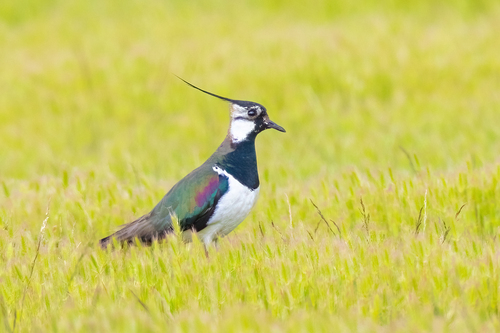 Northern Lapwing
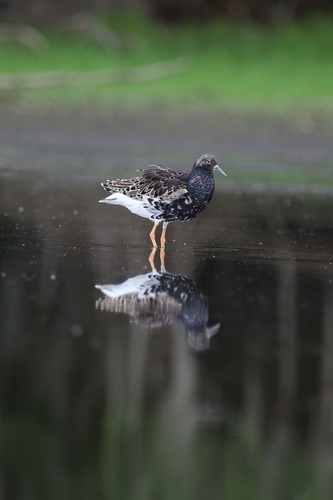 Ruff
In short
The most reliable field mark to separate Northern Lapwing from Ruff is the lapwing’s striking black-and-white upperwing pattern and rounded wings in flight, versus the Ruff’s more subdued, brownish upperparts with a thin, indistinct white wing bar and white ovals at the tail sides. Juvenile and non-breeding Ruff can be especially confusing, but Lapwing’s bold contrast and long, wispy crest (even in young birds) are unique. Structurally, Lapwing is stockier with shorter legs and a rounder, broader wing shape, while Ruff is longer-necked, pot-bellied, and longer-legged. Voice and behavior also differ, but the best separation is by wing pattern and jizz, especially in flight.
Identification tips
- Upperwing pattern in flight (all ages): Lapwing shows a bold black-and-white upperwing with rounded wings; Ruff has a plain brownish wing with only a thin, indistinct white bar and white ovals at the tail sides.
- Crest: Lapwing always has a crest, long and wispy in males, shorter in females and young; Ruff never shows a crest.
- Body shape: Lapwing is stocky, short-legged, and broad-winged; Ruff is pot-bellied, long-necked, and long-legged, with a small head and more slender build.
- Leg color: Lapwing has dark legs; Ruff’s legs are variable—dark greenish in juveniles, pink to orange in adults (sometimes reddish in breeding males).
- Face and head pattern: Lapwing has a striking black-and-white face with a black crown and throat (especially in males); Ruff is plain-faced, with no strong contrast.
- Back color: Lapwing’s back is greenish-black with a metallic gloss; Ruff is grey-brown above, sometimes with white-fringed, dark-centered feathers in breeding plumage (female).
- Underparts: Lapwing has a clean white belly; Ruff’s underparts are variably blotched or buff-tinged, especially in juveniles.
- Tail pattern in flight: Lapwing’s tail is white with a black terminal band; Ruff shows white ovals at the tail sides but not a terminal band.
- Flight style: Lapwing has slow, floppy, rounded wingbeats and erratic, acrobatic display flights; Ruff flies with deeper, slower wingbeats than other waders, but not as exaggerated as Lapwing.
- Vocalization: Lapwing is noisy, with a distinctive "pee-wit" call; Ruff is generally silent.
- Habitat: Lapwing is more likely in open fields and rough grassland, sometimes away from water; Ruff prefers wet meadows, marshes, and is often in large, mixed flocks.
- Seasonal confusion: In autumn and winter, both species are duller, but Lapwing’s bold pattern and crest remain diagnostic; juvenile Ruff can appear scaly above and buff below but never shows Lapwing’s strong contrasts.
- Sexual dimorphism: Only male Ruff in breeding plumage shows ornate ruffs and tufts, but this is rarely confused with Lapwing; female Ruff is always plain.
- Mixed flocks: If you see a large, tight flock of similarly sized waders in wet habitat, suspect Ruff; Lapwing flocks are looser and often in drier fields.
- When in doubt: Focus on the presence or absence of a crest, the upperwing pattern in flight, and the overall jizz—Lapwing’s bold, rounded, crested look is unique among European waders.
Size
Northern Lapwing is generally larger and heavier than Ruff, with a length of 28–33 cm and a wingspan of 67–87 cm, compared to female Ruff at 22–26 cm and a wingspan of 46–49 cm. Adult Ruff (female) weighs around 136 g, but Lapwing can be heavier (128–330 g). Ruff appears more slender and long-legged, while Lapwing is stockier, with a shorter-legged, more compact look. In the field, Lapwing’s size and bulk are noticeable, especially when both species are together.
Plumage
- Juvenile/First-winter: Northern Lapwing shows a bold black-and-white upperwing in flight at all ages, with a greenish gloss on the back and a white belly. Young Lapwings have a shorter crest and less distinct head markings but retain the strong contrast. Juvenile Ruff has a neat, scale-like pattern on the upperparts with dark feather centers and a buff tinge below, but lacks any bold wing pattern; in flight, Ruff shows a thin, indistinct white wing bar and white ovals at the tail sides, never the Lapwing’s dramatic contrast.
- Adult breeding: Male Lapwing has a long, wispy crest, black crown, throat, and breast, and a greenish-black back. Female Lapwing is similar but with a shorter crest and less distinct head pattern. Ruff males in breeding plumage are highly variable, with ornate ruffs and tufts (not present in Lapwing), but this is rarely confused in the field. Female Ruff in breeding plumage is plain grey-brown above with white-fringed, dark-centered feathers and variable black blotching on breast/flanks—never as contrasting as Lapwing.
- Non-breeding: Both Lapwing and Ruff become duller, but Lapwing still shows a white belly and bold upperwing pattern. Ruff (both sexes) is plainer, with a pot-bellied look and no strong contrasts. Leg color can help: Lapwing has dark legs, while Ruff’s are variable (dark greenish in juveniles, pink to orange in adults).
Behaviour
Lapwing is often seen alone or in loose flocks, especially in open fields, displaying with slow, floppy, rounded wingbeats and acrobatic tumbling flight. Ruff is highly gregarious, forming large flocks, especially in migration and winter, and has a deeper, slower wingbeat than other waders but not as exaggerated as Lapwing. Ruff feeds actively, probing in wet meadows or marshes, while Lapwing often stands upright, scanning for prey. Displaying male Lapwing is noisy and erratic in flight, while Ruff males display on leks but this is rarely observed outside breeding grounds.
Habitat
Both species can overlap in wet meadows and marshes, but Lapwing is more likely in open fields, rough grassland, and agricultural land, especially in temperate Eurosiberia. Ruff prefers wetter habitats, especially during migration and winter, and is more likely in large, mixed wader flocks. Lapwing is more likely to be seen in drier, open fields away from water, while Ruff sticks closer to marsh edges and wet grassland.
Voice
Lapwing is very vocal, especially in the breeding season, with a loud, shrill "pee-wit" or "peewit" call, and a wheezy "pee-wit, wit wit, eeze wit" in display flight. Ruff is generally quiet and does not have a distinctive, far-carrying call like Lapwing. If you hear a persistent "pee-wit" in suitable habitat, it is almost certainly Lapwing.