

Northern Hawk Owl vs Northern Pygmy-Owl
Surnia ulula versus Glaucidium gnoma
Play a quiz with Northern Hawk Owl and Northern Pygmy-Owl
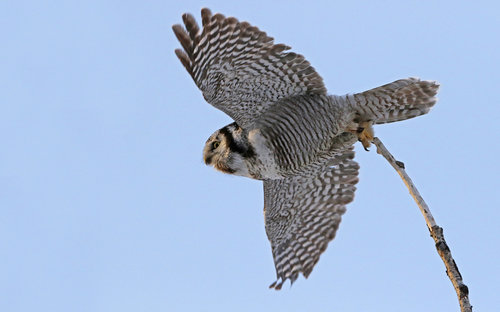 Northern Hawk Owl
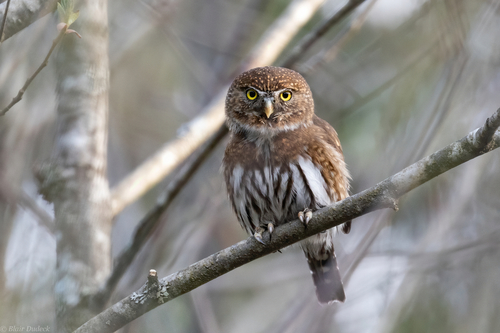 Northern Pygmy-Owl
In short
The most reliable field mark to separate Northern Hawk Owl from Northern Pygmy-Owl is size: Hawk Owl is dramatically larger, with a long, banded tail and a hawk-like silhouette, while Pygmy-Owl is tiny, compact, and often mistaken for a songbird. In flight or perched, Hawk Owl shows a boldly spotted brown-and-white pattern with a distinct black-bordered white face, whereas Pygmy-Owl is more uniformly brown, gray, or rufous with two striking black-and-white nape 'eyespots.' Juvenile Hawk Owls have pointed tail tips, while Pygmy-Owls' tails are always squared. Both have yellow eyes and rounded heads, but Hawk Owl's facial disc is much more sharply defined. If you see an owl hunting in broad daylight and it looks hawk-like, check the tail length and overall size first.
Identification tips
- Size is the first check: If the owl is anywhere near the size of a crow or jay, it's a Northern Hawk Owl. If it's closer to a thrush or large sparrow, it's a Northern Pygmy-Owl. This works at all ages and seasons.
- Tail length and shape: Hawk Owl has a very long, banded tail that extends well past the wingtips when perched; Pygmy-Owl's tail is proportionally long for its size but much shorter overall, and always squared at the tip. Juvenile Hawk Owls have pointed tail tips, while Pygmy-Owls' are squared.
- Facial pattern: Hawk Owl has a striking white face with a bold black border and a rounded head; Pygmy-Owl's facial disc is weakly defined, blending into the head, and the face is less contrasting.
- Nape spots: Only Pygmy-Owl has two black 'eyespots' outlined in white on the nape, visible from behind or in side view. Hawk Owl lacks these, instead showing a black V on the nape.
- Upperparts spotting: Hawk Owl is heavily spotted with off-white on a dark brown background; Pygmy-Owl is more uniform, with only fine white spots on the head and less contrast on the wings and back.
- Underparts: Hawk Owl shows white or off-white underparts with brown barring across the breast and belly; Pygmy-Owl has a dark upper breast and white lower breast with vertical streaks, not bars.
- Bill color: Both have yellowish bills, but Hawk Owl's is more strongly curved and yellow, while Pygmy-Owl's is yellowish-green and less prominent.
- Eye color: Both have yellow eyes, so this is not a useful separator.
- Perching behavior: Both perch high, but Hawk Owl often sits very exposed, scanning like a hawk; Pygmy-Owl may be harder to spot due to its size and tendency to blend in.
- Flight style: Hawk Owl flies with a hawk-like, direct flight and long glides; Pygmy-Owl's flight is more fluttery and its wings make a buzzing sound.
- Activity: Both can be active during the day, but Hawk Owl is more likely to be seen hunting in open areas in full daylight.
- Habitat context: If you are in the far north or in open boreal forest, Hawk Owl is more likely; in western North America in dense conifers, Pygmy-Owl is more likely.
- Juvenile tail tip: If you see a pointed tail tip, it's a juvenile Hawk Owl; Pygmy-Owl never has pointed tail tips.
- Facial border: The bold black border around the face is unique to Hawk Owl; Pygmy-Owl's face blends into the head.
- Nape pattern: If you see a black V on the nape, it's Hawk Owl; if you see two black 'eyespots,' it's Pygmy-Owl.
Size
Northern Hawk Owl is much larger: males are 35–42.5 cm long and females 37.2–44.7 cm, with a wingspan of 69–82 cm and weight around 300–340 g [wikipedia][avonet]. Northern Pygmy-Owl is tiny by comparison, at only 15–17 cm in length, with a much lighter build [wikipedia]. Even at a distance, Hawk Owl appears crow-sized, while Pygmy-Owl is closer to a large sparrow or a small thrush. This size difference is often apparent even without a direct comparison.
Plumage
Juvenile Northern Hawk Owls can be separated by their pointed tail tips, while adults have rounded tail tips; Pygmy-Owl tails are always squared off, regardless of age [wikipedia]. Hawk Owl upperparts are dark brown with off-white spotting, a black V on the nape, and a striking white face bordered in black. Underparts are white with brown barring. Pygmy-Owl is more uniform in color (gray, brownish-gray, or rufous), with a weakly defined facial disc, white-spotted head, and two black nape 'eyespots' outlined in white. Its breast is dark above, with white below and vertical streaks. In flight, Hawk Owl's long, banded tail and bold dorsal spotting stand out, while Pygmy-Owl shows a relatively plain upperwing and tail, with the nape spots sometimes visible from behind. Subspecies variation in Hawk Owl affects the tone and barring of the underparts, but not the overall contrast with Pygmy-Owl.
Behaviour
Northern Hawk Owl often perches high and exposed, scanning for prey in a hawk-like manner, and is active during the day (partially diurnal) [wikipedia]. Its flight is direct and hawk-like, with long glides and a long tail. Northern Pygmy-Owl also perches high, especially at the tops of conifers, but is much harder to spot due to its small size and cryptic coloration. Pygmy-Owl is not a silent flyer—its wings make a buzzing or whirring sound, unlike most owls. Both species can be seen hunting in daylight, but Hawk Owl's size and flight style are much more reminiscent of a small raptor.
Habitat
Hawk Owl is a boreal species, typically found in open coniferous forests or forest edges of the far north, and is generally non-migratory except for occasional irruptions [wikipedia]. Pygmy-Owl is native to western North America, favoring coniferous forests, often at lower elevations than Hawk Owl. Both may perch at treetops, but Hawk Owl is more likely in open, northern landscapes, while Pygmy-Owl is more often in dense, mixed or coniferous woods.