

Northern Harrier vs Montagu's Harrier
Circus hudsonius versus Circus pygargus
Play a quiz with Northern Harrier and Montagu's Harrier
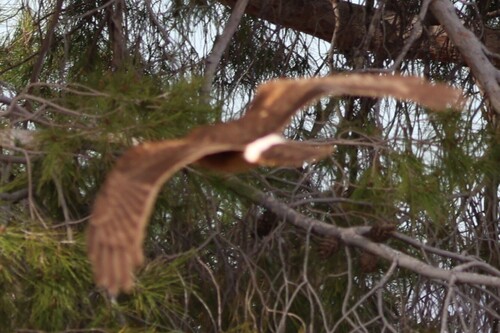 Northern Harrier
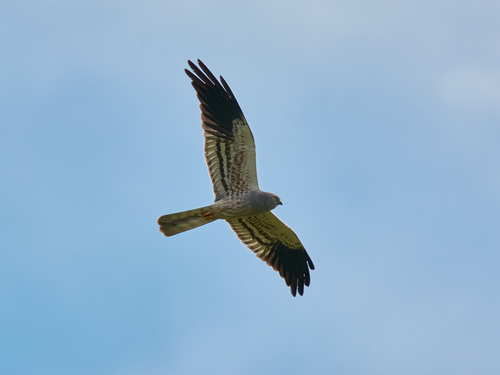 Montagu's Harrier
In short
The most reliable separation between Northern Harrier and Montagu's Harrier, especially in flight, is structural: Northern Harrier is bulkier and longer-winged, with broader, more rounded wings and a longer tail relative to body size, while Montagu's Harrier is noticeably slimmer, with narrower, more pointed wings and a more graceful, buoyant flight. For juveniles and females, plumage is very similar, so focus on shape and flight style. Adult males are easier: Northern Harrier males are darker grey overall than Montagu's, which show more mottling and distinct black secondary bars. Both species hunt low over open ground with a dihedral, but Montagu's appears more tern-like and elastic in wingbeat. Vocalizations are rarely diagnostic in the field. Range is usually decisive: Northern Harrier is North American, Montagu's is Palearctic, but vagrancy and overlap in migration can occur.
Identification tips
- Structure in flight is key: Northern Harrier is bulkier, with broader, more rounded wings and a longer tail; Montagu's Harrier is slimmer, with narrower, more pointed wings and a longer hand (primary projection). This is most obvious in side-by-side comparison or with experience.
- Flight style: Montagu's Harrier has a smoother, more buoyant, almost tern-like flight with elastic wingbeats, while Northern Harrier is heavier and more deliberate, often hugging the ground.
- Adult male plumage: Northern Harrier males are darker, more uniform grey above and below, with less contrast; Montagu's Harrier males are paler grey, with black wingtips, black secondary bars (above and below), and rusty streaks on the belly and flanks.
- Female and juvenile plumage: Both are brown above and pale below with streaks or spots, and both show a white rump. Northern Harrier females are darker and more rufous, but this is subtle and unreliable. Juvenile Montagu's have a more uniform rufous underbody compared to the streaked pattern of females.
- White rump: Both species show a striking white rump in flight; this is not a separator.
- Wing pattern (all ages): Montagu's Harrier shows longer, narrower wings with more pointed tips; Northern Harrier's wings are broader and more rounded. This is best seen in gliding or soaring birds.
- Head and facial disc: Both have an owl-like facial disc, but this is not a practical field mark for separation.
- Perched posture: Northern Harrier looks bulkier and longer-tailed when perched, while Montagu's is more slender and upright.
- Size: Northern Harrier is larger and heavier, especially females, but overlap occurs and size is best used with other marks.
- Habitat and range: Northern Harrier is North American; Montagu's is Palearctic. If seen outside expected range, consider vagrancy but rely on structure and plumage.
- Voice: Not a reliable separator; both are mostly silent.
- Melanistic forms: Montagu's Harrier can show melanistic morphs (all dark birds), which are rare and not present in Northern Harrier.
- Sexual dimorphism: Both species show strong sexual dimorphism; always consider sex when judging plumage.
- Confusion with other harriers: Both can be confused with Hen or Pallid Harrier, but those have their own distinctive marks (not covered here).
- Pitfalls: Do not rely on the white rump or general brown/grey coloration alone; focus on structure, flight style, and, for males, wing pattern and body color.
Size
Northern Harrier is the larger and heavier bird, especially among females. Northern Harrier length is 41–52 cm with a wingspan of 97–122 cm; Montagu's Harrier is slightly shorter at 43–47 cm and a wingspan of 97–115 cm. Mass is also greater in Northern Harrier (males average 350 g, females 530 g) compared to Montagu's (males average 265 g, females 345 g) [wikipedia][wikidata]. Northern Harrier has the longest wing and tail relative to body size of any North American raptor, making it look rangier and more substantial in the field.
Plumage
For adult males, Northern Harrier is a darker, more uniform grey above and below, sometimes called the 'Grey Ghost,' while Montagu's Harrier male is paler grey with black wingtips and distinct black bands along the secondaries (visible above and below) and rusty streaks on the belly and flanks. Female and juvenile plumages are very similar in both species: brown above, pale with streaks or spots below, and both show a white rump. However, Montagu's Harrier females and juveniles lack the pale collar seen in Pallid Harrier, and their underparts are more yellow-brown with longitudinal stripes and spotted wing coverts; juveniles have a more uniform rufous underbody. Northern Harrier females are darker and more rufous than Montagu's, but this is subtle and unreliable. In flight, Montagu's shows longer, narrower, and more pointed wings, with a more elegant, elastic wingbeat, while Northern Harrier's wings are broader and more rounded. Both species have a white rump, so this is not a separator.
Behaviour
Both species hunt by flying low over open ground with wings held in a shallow V (dihedral), but Montagu's Harrier's flight is smoother, more buoyant, and almost tern-like, with elastic wingbeats. Northern Harrier appears heavier and more methodical, hugging the contours of the land. Both use their facial disc to help locate prey by sound. Perched, Northern Harrier looks bulkier and longer-tailed, while Montagu's is more slender and upright. Both are ground nesters and can be seen quartering fields and marshes.
Habitat
Northern Harrier breeds in open habitats across northern North America, especially marshes, grasslands, and prairies. Montagu's Harrier breeds in large open areas across the Palearctic, including steppe, farmland, and grassland. Both prefer open country for hunting, but their ranges do not overlap except as rare vagrants. In winter, Northern Harrier moves south within the Americas, while Montagu's winters in Africa, the Indian subcontinent, and Arabia.
Voice
Vocalizations are not a reliable field separator. Northern Harrier is mostly silent, but both sexes can give fast 'kek' notes, especially when alarmed or during breeding. Montagu's Harrier is also generally quiet; no distinctive calls are noted for field separation.