

Narrow-billed Woodcreeper vs Plain Xenops
Lepidocolaptes angustirostris versus Xenops minutus
Play a quiz with Narrow-billed Woodcreeper and Plain Xenops
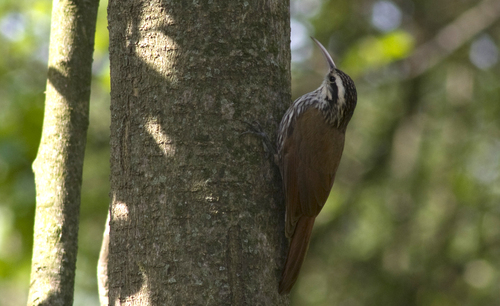 Narrow-billed Woodcreeper
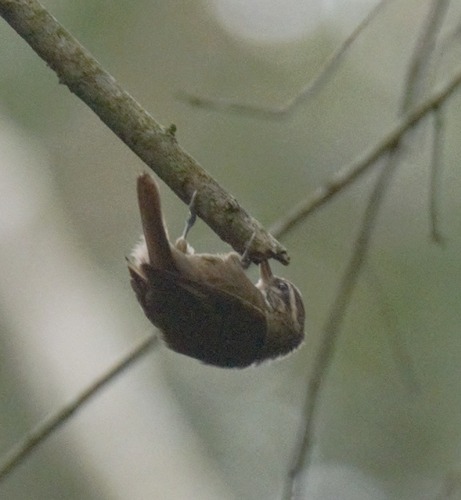 Plain Xenops
In short
The most reliable field mark to separate Narrow-billed Woodcreeper from Plain Xenops is overall structure: the woodcreeper is much larger, with a long, slender, and decurved bill, while the xenops is small, compact, and has a short, stubby, slightly upturned bill. In all plumages, the woodcreeper shows a streaked crown and upperparts, while the xenops is mostly unstreaked above except for a faintly streaked crown. In flight or perched, the woodcreeper’s slim, elongated body and long tail contrast sharply with the xenops’ short, rounded jizz and distinctive cinnamon tail with black. Both species can show a pale supercilium, but the xenops has a bold white malar stripe and a plain grayish-brown belly, while the woodcreeper’s underparts are streaked or spotted. Juvenile woodcreepers are darker and more streaked below, but still larger and longer-billed than any xenops.
Identification tips
- Size and shape: The woodcreeper is much larger and longer than the xenops. If the bird appears small, compact, and short-tailed, it is almost certainly a xenops.
- Bill shape: Woodcreeper has a long, slim, and distinctly decurved bill; xenops has a short, stubby, and slightly upturned bill. Bill shape is visible even at moderate range and is diagnostic.
- Crown and upperparts streaking: Woodcreeper (all ages) shows strong whitish buff streaks on a dark crown and nape, and often on the upper back. Xenops has only faint crown streaking and otherwise plain upperparts.
- Supercilium and malar: Both species have a pale supercilium, but xenops’ is bolder and paired with a wide, pure white malar stripe, forming a strong facial contrast. Woodcreeper’s supercilium is buffy white, widens rearward, and is bordered above by a blackish crown and behind by a black stripe, but lacks the xenops’ malar.
- Underparts: Woodcreeper has buffy-white underparts with dusky spots or streaks (more obvious on breast and undertail coverts, fading on belly). Xenops is plain dull grayish brown below, with a pale, mostly unstreaked throat.
- Tail and wing pattern: Xenops has a cinnamon tail with much black, and wings with a wide tawny or ochraceous band on the flight feathers—this is visible in flight or when the wings are spread. Woodcreeper’s tail and wings are rufous-chestnut, with browner outer webs and blackish tips on the primaries, but lack the xenops’ bold wing band.
- Juvenile plumage: Juvenile woodcreepers are darker above, with more ochraceous supercilium and underparts, and heavier streaking below—still larger and more streaked than any xenops. Juvenile xenops resemble adults.
- Leg color: Woodcreeper’s legs and feet are greenish gray to dark gray; xenops’ are bluish gray. This is subtle but can help at close range.
- Foraging behavior: Woodcreeper climbs trunks and large limbs, moving vertically; xenops forages on thin branches, often hanging acrobatically or working on rotten wood and vines.
- Posture and movement: Woodcreeper is upright, elongated, and deliberate; xenops is more horizontal, quick, and agile, often flicking wings and tail.
- Habitat context: In open woodland or savanna, expect woodcreeper; in dense, humid forest, xenops is more likely.
- Iris color: Both have brown to chestnut irides, not a strong separator.
- Sex differences: Both species are sexually monomorphic in plumage.
- Flight style: Woodcreeper’s flight is strong and direct; xenops is quick and fluttery, often making short hops between branches.
- Pitfalls: At a distance, both can show a pale supercilium and brownish upperparts, but the combination of size, bill shape, and underpart pattern will always separate them if seen well.
Size
Narrow-billed Woodcreeper is substantially larger (18–22 cm long; males 23–37.5 g, females 21.5–33.5 g) than Plain Xenops (about 12 cm, 8.5–13 g) [wikipedia][wikidata]. The woodcreeper’s size is obvious even at a distance, appearing slim and elongated, while xenops is noticeably small and compact. In mixed flocks, the woodcreeper will tower over the xenops, which is one of the smallest ovenbirds.
Plumage
Juvenile Narrow-billed Woodcreeper is darker overall than adults, with a blackish head, more ochraceous supercilium and underparts, and more distinct streaking below. This age is still larger and more streaked than any xenops. Adult woodcreepers have a pale buffy supercilium (widening rearward), blackish-brown crown and nape with whitish buff streaks, rufous-brown back and coverts with faint olive, and rufous-chestnut wings and tail. Underparts are buffy-white with dusky spots or streaks, fading on the belly but reappearing on undertail coverts. In contrast, Plain Xenops adults and juveniles are unstreaked above except for a lightly streaked crown, with dull brown to rufous-brown upperparts, a bold buff or white supercilium, and a wide pure white malar stripe. The tail is cinnamon with much black, and the wings show a wide tawny or ochraceous band on the flight feathers. Underparts are plain dull grayish brown, with a pale, mostly unstreaked throat. The xenops’ bill is blackish above and pale below, short and slightly upturned, while the woodcreeper’s is long, slim, and decurved, pale gray to pinkish horn.
Behaviour
Narrow-billed Woodcreeper typically forages by hitching up trunks and large branches, using its long bill to probe bark and crevices, often moving vertically. It is usually seen singly or in pairs, sometimes joining mixed-species flocks but keeping to trunks and main limbs. Plain Xenops is much more active and acrobatic, foraging on thin, often dead or fallen branches, vines, and in the understory to mid-levels. It hammers, pries, and gleans with its upturned bill, often joining mixed flocks and using a wider range of foraging substrates, including hanging upside down. In flight, the woodcreeper is direct and strong, while the xenops is quick and fluttery.
Habitat
Both species can occur in overlapping regions of Argentina, Brazil, and Paraguay, but their microhabitat preferences differ. Narrow-billed Woodcreeper favors open woodlands, gallery forests, savannas, and forest edges, often in drier or more open habitats. Plain Xenops is more closely tied to humid forest, especially the understory and mid-levels, and is often found in denser, more closed-canopy environments. If seen in a dry, open woodland, woodcreeper is more likely; in dense, humid forest, xenops is more expected.