

Narrow-billed Woodcreeper vs Bay-capped Wren-Spinetail
Lepidocolaptes angustirostris versus Spartonoica maluroides
Play a quiz with Narrow-billed Woodcreeper and Bay-capped Wren-Spinetail
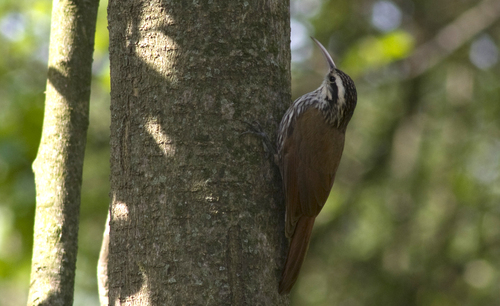 Narrow-billed Woodcreeper
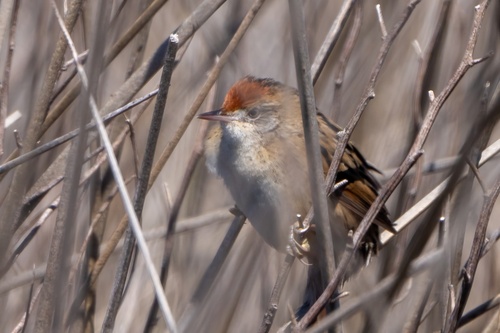 Bay-capped Wren-Spinetail
In short
The most reliable way to separate Narrow-billed Woodcreeper from Bay-capped Wren-Spinetail is by overall structure: the woodcreeper is much larger, slimmer, and has a long, slender, decurved bill, while the wren-spinetail is small, compact, and has a short, straight bill. Juvenile woodcreepers are darker above with more distinct streaking below, but even so, their shape and long tail stand out. In flight or perched, the woodcreeper's rufous-chestnut wings and tail contrast with the wren-spinetail's brown, graduated tail and sandy upperparts. Habitat is also a strong clue: woodcreepers are found in woodland and forest edges, while wren-spinetails are restricted to marshes and reedbeds.
Identification tips
- Size and shape: The woodcreeper is much larger and slimmer, with a long tail and elongated body; the wren-spinetail is small, compact, and round-bodied. This is obvious even at a distance.
- Bill structure: Woodcreeper has a long, slender, decurved bill; wren-spinetail has a short, straight bill. Bill shape is diagnostic when visible.
- Tail: Woodcreeper's tail is long, straight, and rufous-chestnut; wren-spinetail's tail is shorter, graduated (steps down), pointed, and mostly brown with some black on the central feathers.
- Wing and tail color in flight: Woodcreeper shows rufous-chestnut wings and tail, especially in flight; wren-spinetail's wings are brown with cinnamon at the base, tail brown with black centers.
- Supercilium and face: Both have a pale supercilium, but woodcreeper's is buffy white and widens to the rear, with a black stripe behind the eye; wren-spinetail's is whitish on a sandy brown face, with no black eye-stripe.
- Crown and nape: Woodcreeper has a blackish brown crown/nape with pale streaks; wren-spinetail has a rufous crown and bold black streaks only on the nape and upper back.
- Underparts: Woodcreeper's underparts are buffy-white with dusky spots/streaks (more distinct in juveniles); wren-spinetail's are whitish with a buff or cinnamon tinge, and generally unstreaked except for some color on the breast/sides.
- Juvenile marks: Juvenile woodcreepers are darker above, more blackish on the head, with ochraceous supercilium and underparts, and more distinct streaks below. No juvenile description for wren-spinetail, but unlikely to show heavy streaking below.
- Behavior: Woodcreeper climbs trunks and branches; wren-spinetail forages low in marsh vegetation, never climbing trees.
- Habitat: Woodcreeper in woodland/forest edge; wren-spinetail only in marshes and reedbeds. Habitat is often decisive.
- Leg color: Woodcreeper's legs are greenish gray to dark gray; wren-spinetail's are light tan. Useful if seen well.
- Iris color: Woodcreeper's iris is brown to chestnut; wren-spinetail's is dull white to pale bluish. Subtle but can help in close views.
- Voice: Wren-spinetail gives a grasshopper-like buzz; woodcreeper's voice not described here. If you hear the buzz in marshes, it's the wren-spinetail.
- Sexes: Both species are sexually monomorphic (males and females look alike), so sex is not useful for separation.
- Subspecies variation: Woodcreeper shows some regional variation in rufous/olive tones and streaking, but always keeps the same structure and general pattern; wren-spinetail is monotypic with only minor variation in darkness/size.
Size
Narrow-billed Woodcreeper is significantly larger (18–22 cm long; males 23–37.5 g, females 21.5–33.5 g) than Bay-capped Wren-Spinetail (13–14.5 cm, about 11 g) [wikipedia][wikidata]. The woodcreeper is almost twice as heavy and noticeably longer, with a more elongated body and tail. In the field, the woodcreeper appears slim and stretched, while the wren-spinetail is small, compact, and round-bodied.
Plumage
Juvenile Narrow-billed Woodcreeper has darker upperparts, a more blackish head, ochraceous supercilium and underparts, and more distinct streaks below compared to adults. Adults show a buffy white supercilium, blackish brown crown and nape with pale streaks, rufous-brown back and wing coverts, and rufous-chestnut wings and tail. The throat and cheeks are plain whitish, and the breast/belly are buffy-white with dusky spots or streaks. In contrast, Bay-capped Wren-Spinetail (adults; no juvenile description) has a rufous crown, sandy brown to olive-brown upperparts with bold black streaks on nape and upper back, brown wings with cinnamon at the base of the flight feathers, and a brown, graduated tail with pointed feathers (central pair with some black). The supercilium is whitish, the face sandy brown, and the underparts are whitish with a buff/cinnamon tinge on the breast, sides, and flanks. The woodcreeper's underwing coverts are rosy-cinnamon, while the wren-spinetail's underwing is not described. The woodcreeper's plumage is more streaked above and below (especially in juveniles), and its wings and tail are more rufous, while the wren-spinetail is more sandy-brown and less rufous overall.
Behaviour
Narrow-billed Woodcreeper typically forages by hitching up tree trunks and branches, probing bark and crevices with its long bill. Its movements are vertical and deliberate, often seen alone or in mixed flocks in wooded habitats. Bay-capped Wren-Spinetail forages by gleaning insects from marsh grasses and sedges, usually low to the ground and often deep within dense marsh vegetation. Its movements are quick and mouse-like, and it is rarely seen away from marshes. The woodcreeper's behavior is strongly arboreal, while the wren-spinetail is strictly terrestrial and marsh-bound.
Habitat
Narrow-billed Woodcreeper is found in a variety of wooded habitats, including forest edges, woodlands, and even human-modified areas with trees, across Argentina, Bolivia, Brazil, Paraguay, Suriname, and Uruguay. In contrast, Bay-capped Wren-Spinetail is restricted to reedbeds and sedges in freshwater, brackish, and saltwater marshes in Argentina, Brazil, Paraguay, and Uruguay. The wren-spinetail is absent from forests and woodlands, and its presence is a strong indicator of marsh habitat. If the bird is seen in dense marsh vegetation, it is almost certainly a wren-spinetail; if in trees or woodland, it is a woodcreeper.
Voice
The Bay-capped Wren-Spinetail's primary song is described as a 'grasshopper-like buzz, long and...' [wikipedia], which is distinctive among marsh birds. No vocal description is provided for Narrow-billed Woodcreeper in the notes, so voice is only useful if the wren-spinetail's buzzing is heard; otherwise, rely on visual marks.
Narrow-billed Woodcreeper · Bay-capped Wren-Spinetail · My Tricky Birds