

Nankeen Kestrel vs White-winged Fairywren
Falco cenchroides versus Malurus leucopterus
Play a quiz with Nankeen Kestrel and White-winged Fairywren
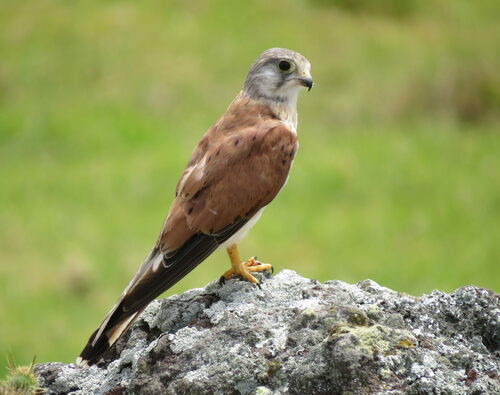 Nankeen Kestrel
 White-winged Fairywren
In short
The most reliable field mark separating Nankeen Kestrel from White-winged Fairywren is overall size and structure: kestrels are much larger, slim raptors with pointed wings and long tails, while fairywrens are tiny, round-bodied songbirds with very long, slender tails often held upright. In flight, Nankeen Kestrel shows pale rufous upperparts with contrasting black flight feathers, while male White-winged Fairywrens in breeding plumage display striking cobalt blue bodies with bold white wings, but most birds seen are brownish with pale blue tails. Immature and female fairywrens are sandy-brown with blue tails, easily confused at a distance for small, pale birds but never show raptor-like flight or proportions. Behavior and context are also strong clues: kestrels hover or perch openly, fairywrens flit low in shrubs. Size alone is usually decisive, but use multiple marks for certainty, especially with distant or fast-moving birds.
Identification tips
- Size is decisive: Nankeen Kestrel is nearly three times the length and vastly heavier than White-winged Fairywren. If the bird is sparrow-sized, it cannot be a kestrel.
- Flight style: Kestrels soar and hover with pointed wings and long tails; fairywrens have short, rounded wings and flutter in short, low flights, never hovering.
- Perched posture: Kestrels perch upright on exposed posts or wires, often scanning for prey; fairywrens perch low in shrubs, tails cocked upward, and are rarely still.
- Bill shape: Kestrel has a hooked raptor's bill; fairywren's bill is long, narrow, and pointed, suited for picking insects.
- Tail structure: Kestrel's tail is long, straight, and proportionate to body; fairywren's tail is extremely long, slender, and often held upright or fanned.
- Upperwing pattern (all ages): Kestrel shows black flight feathers contrasting with pale rufous upperparts; fairywren never shows this—only adult breeding males have white wing patches, but on a tiny, blue-bodied bird.
- Adult male plumage: Breeding male fairywrens are vivid cobalt blue with white wings; kestrels are never blue, always rufous or grey with black flight feathers.
- Female/immature confusion: Female and immature fairywrens are sandy-brown with blue tails, lacking any rufous or black wing pattern; female kestrels are larger, with rufous crowns and barred tails.
- Juvenile fairywren: Brown overall with a blue tail, never with rufous or black flight feathers.
- Juvenile kestrel: Rufous above, black flight feathers, never blue or sandy-brown overall.
- Habitat context: Kestrels are seen in open, elevated spots or hovering; fairywrens are always low, in or near shrubs.
- Group behavior: Fairywrens are usually in small, noisy groups; kestrels are solitary or in pairs.
- Leg color: Kestrel has yellow legs; fairywren legs are not described as yellow and are much finer.
- Eye-ring/cere: Kestrel has a yellow cere and eye-ring; fairywren lacks these features.
- When in doubt: If you see a hovering bird or one perched high and exposed, it's a kestrel; if it's flitting low, tail cocked, in a group, it's a fairywren.
Size
Nankeen Kestrel is dramatically larger, weighing about 172.5 g and measuring 28–35 cm in length with a wingspan of 66–78 cm [wikidata, wikipedia]. In contrast, White-winged Fairywren is one of the smallest Australian passerines, at just 11–13.5 cm long and 7–11 g in weight [wikipedia]. Even at a distance, the kestrel's size and wingspan are unmistakable compared to the tiny, sparrow-sized fairywren.
Plumage
-
Juvenile/immature comparison: Immature Nankeen Kestrels resemble adults but have rufous crowns and finely barred rufous tails, with pale rufous upperparts and black flight feathers. Juvenile and female fairywrens are sandy-brown with a pale blue tail and pinkish-buff bill, lacking any raptor-like patterning or wing contrast. Young male fairywrens gradually acquire blue tails and darker bills, but never develop the kestrel's black flight feathers or rufous tones.
-
Adult male comparison: Adult male Nankeen Kestrels have a pale grey crown and tail, rufous upperparts, and black flight feathers, with finely streaked white underparts. Breeding male White-winged Fairywrens are strikingly different: cobalt blue or black bodies, bright white wings and shoulders, and black bills. Their white wing patches are especially obvious in flight but are set on a much smaller, rounder bird.
-
Adult female comparison: Female kestrels are larger, with pale rufous crowns and barred rufous tails, while female fairywrens are sandy-brown with blue tails—no rufous, no barring, and no black flight feathers.
-
Flight views: Kestrels show pointed wings with black flight feathers and a long, straight tail; fairywrens have short, rounded wings and a long, slender tail often cocked upward, with white wing patches only in breeding males.
Behaviour
Nankeen Kestrels are classic open-country raptors, often seen hovering motionless over fields or perched on exposed posts and wires. Their flight is strong, with deep wingbeats and frequent gliding. In contrast, White-winged Fairywrens are highly active, social songbirds that hop and flit low through shrubs, rarely flying far and never hovering. Fairywrens often hold their tails upright and move in small family groups, while kestrels are usually solitary or in pairs. The kestrel's hovering and soaring are never matched by fairywren behavior.
Habitat
Both species occur in open habitats, but with distinct preferences. Nankeen Kestrel favors open grasslands, farmland, and lightly wooded areas, often perching in the open or hovering over fields. White-winged Fairywren prefers arid and semi-arid shrublands, especially areas with dense low vegetation for cover. While both can be found in open country, kestrels are seen in more exposed, elevated positions, while fairywrens keep to low shrubs and ground level.