

Namaqua Warbler vs Green-backed Camaroptera
Phragmacia substriata versus Camaroptera brachyura
Play a quiz with Namaqua Warbler and Green-backed Camaroptera
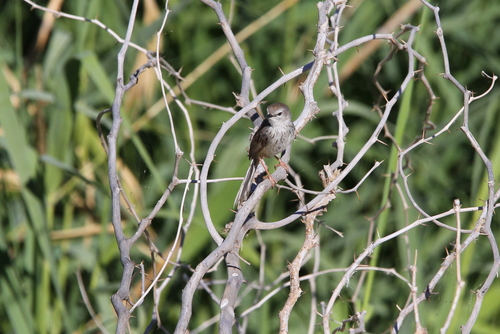 Namaqua Warbler
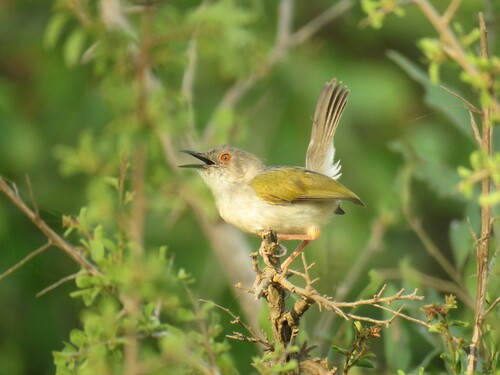 Green-backed Camaroptera
In short
The most reliable field mark between Namaqua Warbler and Green-backed Camaroptera is the tail: Namaqua Warbler has a distinctly long, brown, and often cocked tail, while Green-backed Camaroptera shows a much shorter, rounded tail. In addition, Namaqua Warbler is a rich russet brown above with a white, faintly streaked breast, whereas Green-backed Camaroptera is green-olive above with plain whitish-grey underparts. Juveniles of both are duller, but the Camaroptera's young show a paler yellowish breast, not streaked. Both species are small, active warblers, but their structure, tail, and upperpart color are key in the field.
Identification tips
- Tail length and shape: Namaqua Warbler has a long, brown tail, often cocked at an angle; Green-backed Camaroptera's tail is short and rounded. This is the single most consistent field mark in all ages and seasons.
- Tail behavior: Namaqua Warbler frequently cocks its tail up; Camaroptera rarely does, keeping its tail lowered or flicking it briefly.
- Upperpart color: Namaqua Warbler is rich russet brown above, while Camaroptera is green-olive. In strong light, the green of Camaroptera can be quite bright, whereas Namaqua Warbler always looks warm brown.
- Underparts: Namaqua Warbler shows a white throat and breast with faint streaking (adults), and buff flanks. Camaroptera is plain whitish-grey below, with no streaking; juveniles may show a paler yellowish wash but never streaks.
- Eyebrow: Namaqua Warbler has a distinct whitish eyebrow; Camaroptera lacks a strong eyebrow, with a plainer face.
- Bill: Namaqua Warbler has a short, straight, black bill; Camaroptera's bill is also short but may appear slightly stubbier. This is subtle and not always reliable in the field.
- Leg color: Namaqua Warbler has pinkish-brown legs; Camaroptera's leg color is not specified, so this is not a strong separator.
- Jizz/structure: Namaqua Warbler looks longer and more 'whispy' due to its tail; Camaroptera is compact and rounded.
- Flight view: In flight, Namaqua Warbler's long tail and russet tones are obvious; Camaroptera appears short-tailed and greenish.
- Juvenile confusion: Young Namaqua Warbler is duller but still shows the same structure and faint breast streaking; young Camaroptera is paler below, sometimes yellowish, but never streaked.
- Habitat: In very dense, leafy cover, Camaroptera is more likely; in open scrub, especially if the bird is visible and cocking its tail, suspect Namaqua Warbler.
- Group behavior: Namaqua Warbler is often in small groups or pairs, moving through open scrub; Camaroptera is usually single or in pairs, rarely out in the open.
- Vocalizations: If you hear a high-pitched 'treeep-treep-trrrrrr', it supports Namaqua Warbler; Camaroptera's call is not described here.
- Sex and season: Both species show little to no sexual dimorphism, so these marks apply year-round.
- Common pitfalls: The main confusion arises from similar size and overall small warbler shape. Always check tail length, upperpart color, and underpart pattern before deciding.
Size
Both species are small cisticolids, but Green-backed Camaroptera is slightly lighter at about 10 grams [wikidata]. Namaqua Warbler is a bit longer (12–13 cm vs. 11.5 cm for Camaroptera) [wikipedia], mainly due to its longer tail. In hand or at close range, Namaqua Warbler appears more elongated and 'whispy' due to its tail, while Camaroptera is more compact and rounded.
Plumage
- Juveniles: Namaqua Warbler juveniles are duller versions of adults but still show the long brown tail and faintly streaked white breast. Green-backed Camaroptera juveniles are paler overall, especially on the breast, which is yellowish rather than white or streaked.
- Adults: Namaqua Warbler has rich russet brown upperparts, a whitish eyebrow, white throat and breast with faint streaking, and buff rear flanks. The tail is long and brown, often cocked. Green-backed Camaroptera has green upperparts, olive wings, and plain whitish-grey underparts. Its tail is short and rounded. Both sexes are similar in each species.
- Flight views: Namaqua Warbler's long tail and russet tones are visible even in brief flight; Camaroptera's short tail and greenish upperparts stand out, with no streaking below.
Behaviour
Namaqua Warbler is usually seen in pairs or small groups, foraging low in scrub with its tail cocked up. It is more likely to be seen actively moving through open or semi-open scrub. Green-backed Camaroptera is highly skulking, typically staying low in dense cover and rarely exposing itself fully. Its movements are more secretive, often hopping within thick bushes and rarely cocking its tail.
Habitat
Namaqua Warbler prefers low scrub, often in drier or semi-arid regions, and is usually seen in more open situations compared to Camaroptera. Green-backed Camaroptera is strongly associated with dense cover, often in moist thickets, tangles, or bushy undergrowth. If the bird is seen in dense, leafy cover, Camaroptera is more likely; in open low scrub, suspect Namaqua Warbler.
Voice
Namaqua Warbler gives a high-pitched 'treeep-treep-trrrrrr' call. No vocal details are provided for Green-backed Camaroptera in the notes, so voice is not a reliable separator here.
Namaqua Warbler · Green-backed Camaroptera · My Tricky Birds