

Muscovy Duck vs Rosy-billed Pochard
Cairina moschata versus Netta peposaca
Play a quiz with Muscovy Duck and Rosy-billed Pochard
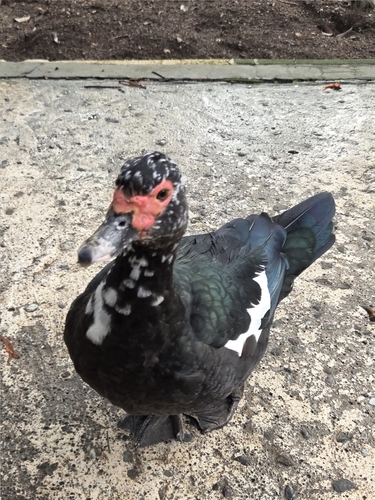 Muscovy Duck
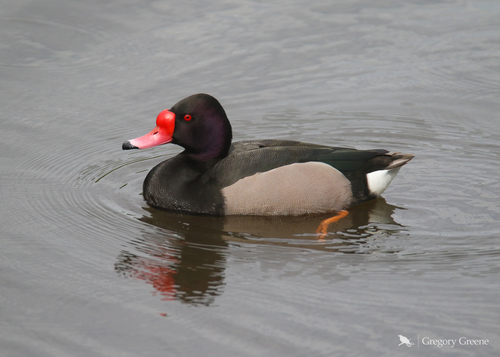 Rosy-billed Pochard
In short
The most reliable field mark between Muscovy Duck and Rosy-billed Pochard is the presence of extensive bare red facial skin and a prominent bill knob in adult Muscovy Ducks, versus the bright red bill with a rounded knob (but feathered face) in adult male Rosy-billed Pochards. In flight, both species show white in the wings, but the pattern and context differ: Muscovy Ducks (especially males) have large white patches on otherwise black wings, while Rosy-billed Pochards reveal a broad white stripe only when the wings are fully outstretched. Juvenile Muscovy Ducks are duller and lack much white on the wing, while young Rosy-billed Pochards resemble females with a contrasting white crissum. Muscovy Ducks are much larger and bulkier, with a flatter tail and longer claws, compared to the more compact, diving duck shape of the Rosy-billed Pochard.
Identification tips
- Bare red facial skin and caruncles (warty growths) in Muscovy Duck: Adult Muscovy Ducks, especially males, have extensive bare red skin around the face and a prominent knob at the bill base. This is never present in Rosy-billed Pochard, whose face is fully feathered.
- Bill color and shape: Male Rosy-billed Pochards have a bright red bill with a rounded knob at the base, fading to pink and ending with a black tip. Females have a bluish-gray bill with a black tip and no knob. Muscovy Ducks have a black bill with pale pink speckling (wild type), but feral/domestic birds may show yellow, pink, or mixed bills. The Muscovy's bill is broader and flatter.
- Wing pattern in flight: Muscovy Ducks show large white patches on the otherwise black wings (especially males), visible both at rest and in flight. Rosy-billed Pochards show a broad white stripe on the primaries and secondaries, but only when wings are fully outstretched (in flight or display), not at rest.
- Juvenile/immature confusion: Juvenile Muscovy Ducks are duller and lack much white on the wing, appearing mostly dark. Juvenile Rosy-billed Pochards resemble females (brownish) but have a contrasting white crissum (under-tail area), which is a useful mark.
- Body size and structure: Muscovy Ducks are much larger, bulkier, and longer-necked, with a flatter, broader tail and long claws. Rosy-billed Pochards are more compact, with a rounded body and a shorter tail.
- Leg and foot color: Muscovy Ducks have blackish legs and webbed feet; Rosy-billed Pochards have yellow to orange legs and feet (females may show gray).
- Face feathering: Muscovy Ducks have bare skin on the face (especially males), while Rosy-billed Pochards have fully feathered faces in both sexes.
- Plumage gloss: Male Muscovy Ducks have iridescent, glossy back and wing feathers, while Rosy-billed Pochards (males) have a purplish-black head and neck but lack the same level of gloss.
- Tail shape: Muscovy Ducks have a wide, flat tail, often held horizontally. Rosy-billed Pochards have a shorter, more rounded tail.
- Perching behavior: Muscovy Ducks may perch in trees or on structures, thanks to their long claws. Rosy-billed Pochards are rarely seen perched above ground.
- Habitat context: Muscovy Ducks (especially feral/domestic) are often found in urban parks, farms, or even on buildings. Rosy-billed Pochards are more likely in natural wetlands and less urbanized areas.
- Vocalizations: Muscovy Ducks have a low, breathy call (male) or quiet trilling coo (female), while Rosy-billed Pochards have a deeper, quieter 'honk'.
- Sexual dimorphism: Both species show sexual dimorphism, but in different ways. Muscovy males are much larger and have more extensive facial caruncles; Rosy-billed Pochard males have the bright red bill and knob, while females are brownish with a bluish-gray bill.
- Feral/domestic variability in Muscovy: Feral Muscovy Ducks may show more white on the head/neck and variable bill colors, which can confuse the observer. Focus on face skin and size for ID.
- Crissum contrast in Rosy-billed Pochard: The white area around the cloaca (crissum) is a key mark in both sexes of Rosy-billed Pochard, especially when other features are hard to see.
Size
Muscovy Ducks are substantially larger and heavier than Rosy-billed Pochards. Muscovy males can weigh up to 3–4 kg and measure 76–84 cm in length, with a wingspan of 137–152 cm. Females are smaller but still larger than any Rosy-billed Pochard. In contrast, Rosy-billed Pochards average around 1.1 kg and 56 cm in length, with a wingspan of 72–84 cm. In the field, Muscovy Ducks appear much bulkier and longer-necked, while Rosy-billed Pochards are more compact and rounded.
Plumage
-
Juvenile/immature Muscovy Ducks are overall duller than adults, with little or no white on the wing, making them appear mostly dark in flight. Adult Muscovy Ducks (especially males) show large, obvious white patches on otherwise black wings, and iridescent, glossy upperparts in males. Feral/domestic birds may have variable white on the neck and head, but wild-type birds keep the white to the wings.
-
Rosy-billed Pochard males have a purplish-black head, neck, and breast, gray sides, and a white area around the cloaca (crissum). Their most distinctive wing mark is a broad white stripe on the primaries and secondaries, visible only with wings fully outstretched (in flight or display). Females and juveniles are brownish, with a contrasting white crissum and lack the male's red bill and knob. Young birds are darker below than females but otherwise similar.
-
Key contrast: Muscovy Duck's white is in large patches on the wing (often visible at rest), while Rosy-billed Pochard's white is a stripe only seen in flight or stretching. Muscovy males have a naked, red, warty face; Rosy-billed Pochard males have a feathered face and a bright red bill with a knob.
Behaviour
Muscovy Ducks are strong fliers but often perch in trees or on structures, thanks to their long claws and flat tails. They are more likely to be seen walking well on land and roosting above ground or water. Rosy-billed Pochards, as diving ducks, have legs set further back, making them awkward on land but agile underwater. Their takeoff is labored, requiring fast wingbeats, and they are less likely to perch above ground. Muscovy Ducks are more likely to be seen loafing on land or perching, while Rosy-billed Pochards are usually on water or close to it.
Habitat
Both species can be found near water, but Muscovy Ducks (especially feral/domestic types) are often seen in urban parks, farms, and even nesting on balconies or roof overhangs. They are adaptable and may be found far from wild wetlands. Rosy-billed Pochards are more restricted to natural or semi-natural wetlands, lakes, and marshes in South America, and are less likely to be found in urban or highly modified habitats.
Voice
Muscovy Ducks have a low, breathy call in males and a quiet trilling coo in females. Rosy-billed Pochards produce a characteristic Anatidae 'honk', but deeper and quieter than a mallard. Neither species is especially vocal, but the Muscovy's calls are softer and less duck-like, while the Rosy-billed Pochard's are deeper and more typical of diving ducks.