

Motmot

Mulga Parrot vs Paradise Parrot

Psephotellus varius versus Psephotellus pulcherrimus

Play a quiz with Mulga Parrot and Paradise Parrot
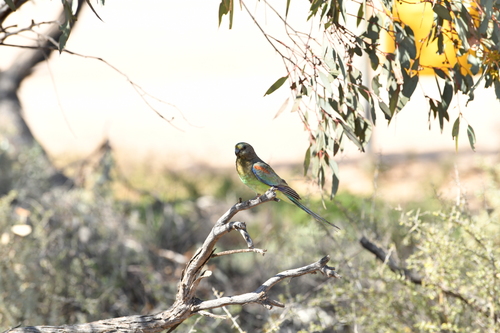
Mulga Parrot (Psephotellus varius) Mulga Parrot
Paradise Parrot (Psephotellus pulcherrimus) Paradise Parrot

Media

Loading…

In short

The most reliable way to separate Mulga Parrot from Paradise Parrot is by range and status: Paradise Parrot is extinct, while Mulga Parrot is still widespread in arid southern Australia. If comparing specimens, photos, or historical records, focus on the overall color palette and tail structure. Male Mulga Parrots are bright green with yellow, blue, and red highlights, while Paradise Parrots showed a striking mix of turquoise, aqua, scarlet, and black, with a tail nearly as long as the body. Females and immatures of Mulga Parrot are much duller and can be confused with Paradise Parrot in poor views, but the specific color placement and habitat context help. There are no detailed notes on age-specific upperwing patterns for either species, so rely on overall coloration, tail shape, and context.

Identification tips

  1. Status and range: Paradise Parrot is extinct; any live bird seen today is Mulga Parrot. Paradise Parrot was only ever found in eastern Queensland and northern New South Wales, never in the arid interior.
  2. Tail length and shape: Paradise Parrot had a tail almost as long as its body, giving it a very elongated look even among long-tailed parrots. Mulga Parrot's tail is long but not to the same extreme proportion.
  3. Adult male coloration: Male Mulga Parrot is bright green with blue, yellow, and red highlights, especially a yellow forehead and red patch on the back of the head. Paradise Parrot was a mix of turquoise, aqua, scarlet, and black, with more extensive and sharply contrasting colors.
  4. Female/immature confusion: Female and immature Mulga Parrots are much duller, with olive-brown and pale green tones, and may show a red shoulder. Paradise Parrot, even in less colorful individuals, showed more turquoise and scarlet, and never the olive-brown wash of female Mulga Parrot.
  5. Upperwing pattern: No age-specific upperwing or flight pattern marks are described for either species; do not rely on this feature.
  6. Ground-dwelling behavior: Paradise Parrot was highly terrestrial, often seen feeding on the ground in grassy woodlands. Mulga Parrot is more arboreal and less likely to be seen foraging on the ground for extended periods.
  7. Habitat context: Mulga Parrot is found in arid, often mulga-dominated scrub and grassland. Paradise Parrot was restricted to grassy, open woodland in the east.
  8. Bill color: Male Mulga Parrot has a blue-grey bill edged with black; females have a more brown-grey bill. Paradise Parrot's bill color is not described in detail, but is not a primary field mark.
  9. Red on upper tail coverts: Male Mulga Parrot shows some red on the upper tail coverts, a subtle but useful mark in good views. Paradise Parrot's tail was more uniformly colored with strong turquoise and black contrasts.
  10. Yellow median wing coverts: Male Mulga Parrot has yellow median wing coverts, which can be a useful field mark in perched birds. Paradise Parrot's wing coloration is not described in this detail.
  11. Sexual dimorphism: Mulga Parrot is strongly sexually dimorphic, with males much brighter than females. No mention of sexual dimorphism in Paradise Parrot, but both sexes were described as colorful.
  12. Historical context: Any record after 1927 is not Paradise Parrot. Unconfirmed reports in the north may be confusion with Golden-shouldered Parrot, not Mulga Parrot.
  13. Eggs: Both species laid white eggs, but size and shape are not useful for field identification.
  14. Group size: Mulga Parrot is usually in pairs; Paradise Parrot was also seen in pairs or small groups, so this is not diagnostic.
  15. Flight style: Paradise Parrot was described as a rapid flyer despite its long tail; Mulga Parrot's flight is not specifically described as rapid or slow, so use with caution.

Size

Mulga Parrot is a medium-sized, slim parrot weighing about 61 g [wikidata], with a length of 27–32 cm and a wingspan of 30–42 cm [wikipedia]. Paradise Parrot was also medium-sized and long-tailed, but no precise mass is available. Both species have long tails, but Paradise Parrot's tail was almost as long as its body, which is unusual even among parrots. In hand or in photos, Mulga Parrot may appear slightly stockier, but size alone is not diagnostic.

Plumage

There are no detailed descriptions of juvenile or immature upperwing patterns for either species, so focus on adult plumage. Adult male Mulga Parrots are predominantly bright green with a yellow forehead, red patch on the back of the head, blue-tinged neck, yellowish lower belly with orange-red, and a tail with blue and green tones and some red on the upper tail coverts. Females are duller, with olive-brown head and chest, dull yellow forehead, and pale green belly; some have a red shoulder. Paradise Parrot was even more vividly colored, with a mix of turquoise, aqua, scarlet, black, and brown; its tail was extremely long, nearly matching the body length. The placement of scarlet and turquoise was more extensive and contrasted than in Mulga Parrot. In both, the tail is long, but Paradise Parrot's is proportionally longer and more striking in color contrast. Female and immature Mulga Parrots are much duller and could be confused with faded illustrations of Paradise Parrot, but lack the strong turquoise-scarlet-black contrast.

Behaviour

Mulga Parrot is usually seen in pairs, often low in arid grassland or mulga scrub, and is not especially ground-dwelling. Paradise Parrot, in contrast, was highly terrestrial, spending most of its time on the ground in grassy woodlands, despite its rapid flight and long tail. This ground-dwelling habit was unusual among Australian parrots and is a strong behavioral clue in historical accounts.

Habitat

Mulga Parrot is found in arid scrublands and lightly timbered grasslands of southern and central Australia, especially where mulga (Acacia) is present. Paradise Parrot was native to grassy woodlands in the Queensland–New South Wales border region, in the east, and was never recorded in the arid interior. Thus, any modern sighting in arid southern Australia is Mulga Parrot; Paradise Parrot was restricted to more humid, grassy, open woodland and is now extinct.

Submit a better description

Use the same sections as the comparison. Your text is published immediately.

The most reliable way to separate Mulga Parrot from Paradise Parrot is by range and status: Paradise Parrot is extinct, while Mulga Parrot is still widespread in arid southern Australia. If comparing specimens, photos, or historical records, focus on the overall color palette and tail structure. Male Mulga Parrots are bright green with yellow, blue, and red highlights, while Paradise Parrots showed a striking mix of turquoise, aqua, scarlet, and black, with a tail nearly as long as the body. Females and immatures of Mulga Parrot are much duller and can be confused with Paradise Parrot in poor views, but the specific color placement and habitat context help. There are no detailed notes on age-specific upperwing patterns for either species, so rely on overall coloration, tail shape, and context.

  1. Status and range: Paradise Parrot is extinct; any live bird seen today is Mulga Parrot. Paradise Parrot was only ever found in eastern Queensland and northern New South Wales, never in the arid interior.
  2. Tail length and shape: Paradise Parrot had a tail almost as long as its body, giving it a very elongated look even among long-tailed parrots. Mulga Parrot's tail is long but not to the same extreme proportion.
  3. Adult male coloration: Male Mulga Parrot is bright green with blue, yellow, and red highlights, especially a yellow forehead and red patch on the back of the head. Paradise Parrot was a mix of turquoise, aqua, scarlet, and black, with more extensive and sharply contrasting colors.
  4. Female/immature confusion: Female and immature Mulga Parrots are much duller, with olive-brown and pale green tones, and may show a red shoulder. Paradise Parrot, even in less colorful individuals, showed more turquoise and scarlet, and never the olive-brown wash of female Mulga Parrot.
  5. Upperwing pattern: No age-specific upperwing or flight pattern marks are described for either species; do not rely on this feature.
  6. Ground-dwelling behavior: Paradise Parrot was highly terrestrial, often seen feeding on the ground in grassy woodlands. Mulga Parrot is more arboreal and less likely to be seen foraging on the ground for extended periods.
  7. Habitat context: Mulga Parrot is found in arid, often mulga-dominated scrub and grassland. Paradise Parrot was restricted to grassy, open woodland in the east.
  8. Bill color: Male Mulga Parrot has a blue-grey bill edged with black; females have a more brown-grey bill. Paradise Parrot's bill color is not described in detail, but is not a primary field mark.
  9. Red on upper tail coverts: Male Mulga Parrot shows some red on the upper tail coverts, a subtle but useful mark in good views. Paradise Parrot's tail was more uniformly colored with strong turquoise and black contrasts.
  10. Yellow median wing coverts: Male Mulga Parrot has yellow median wing coverts, which can be a useful field mark in perched birds. Paradise Parrot's wing coloration is not described in this detail.
  11. Sexual dimorphism: Mulga Parrot is strongly sexually dimorphic, with males much brighter than females. No mention of sexual dimorphism in Paradise Parrot, but both sexes were described as colorful.
  12. Historical context: Any record after 1927 is not Paradise Parrot. Unconfirmed reports in the north may be confusion with Golden-shouldered Parrot, not Mulga Parrot.
  13. Eggs: Both species laid white eggs, but size and shape are not useful for field identification.
  14. Group size: Mulga Parrot is usually in pairs; Paradise Parrot was also seen in pairs or small groups, so this is not diagnostic.
  15. Flight style: Paradise Parrot was described as a rapid flyer despite its long tail; Mulga Parrot's flight is not specifically described as rapid or slow, so use with caution.

Mulga Parrot is a medium-sized, slim parrot weighing about 61 g [wikidata], with a length of 27–32 cm and a wingspan of 30–42 cm [wikipedia]. Paradise Parrot was also medium-sized and long-tailed, but no precise mass is available. Both species have long tails, but Paradise Parrot's tail was almost as long as its body, which is unusual even among parrots. In hand or in photos, Mulga Parrot may appear slightly stockier, but size alone is not diagnostic.

There are no detailed descriptions of juvenile or immature upperwing patterns for either species, so focus on adult plumage. Adult male Mulga Parrots are predominantly bright green with a yellow forehead, red patch on the back of the head, blue-tinged neck, yellowish lower belly with orange-red, and a tail with blue and green tones and some red on the upper tail coverts. Females are duller, with olive-brown head and chest, dull yellow forehead, and pale green belly; some have a red shoulder. Paradise Parrot was even more vividly colored, with a mix of turquoise, aqua, scarlet, black, and brown; its tail was extremely long, nearly matching the body length. The placement of scarlet and turquoise was more extensive and contrasted than in Mulga Parrot. In both, the tail is long, but Paradise Parrot's is proportionally longer and more striking in color contrast. Female and immature Mulga Parrots are much duller and could be confused with faded illustrations of Paradise Parrot, but lack the strong turquoise-scarlet-black contrast.

Mulga Parrot is usually seen in pairs, often low in arid grassland or mulga scrub, and is not especially ground-dwelling. Paradise Parrot, in contrast, was highly terrestrial, spending most of its time on the ground in grassy woodlands, despite its rapid flight and long tail. This ground-dwelling habit was unusual among Australian parrots and is a strong behavioral clue in historical accounts.

Mulga Parrot is found in arid scrublands and lightly timbered grasslands of southern and central Australia, especially where mulga (Acacia) is present. Paradise Parrot was native to grassy woodlands in the Queensland–New South Wales border region, in the east, and was never recorded in the arid interior. Thus, any modern sighting in arid southern Australia is Mulga Parrot; Paradise Parrot was restricted to more humid, grassy, open woodland and is now extinct.

Discard your changes?

You have unsaved edits. If you leave now, those changes will be lost.

Mulga Parrot · Paradise Parrot · My Tricky Birds