

Montagu's Harrier vs Levant Sparrowhawk
Circus pygargus versus Tachyspiza brevipes
Play a quiz with Montagu's Harrier and Levant Sparrowhawk
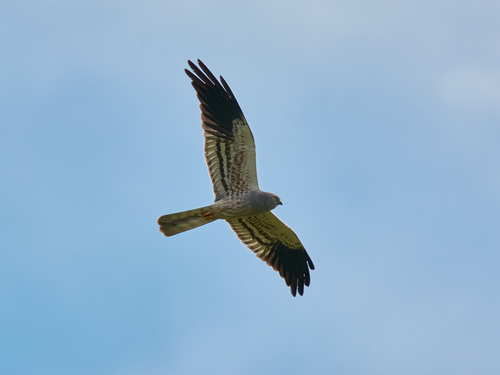 Montagu's Harrier
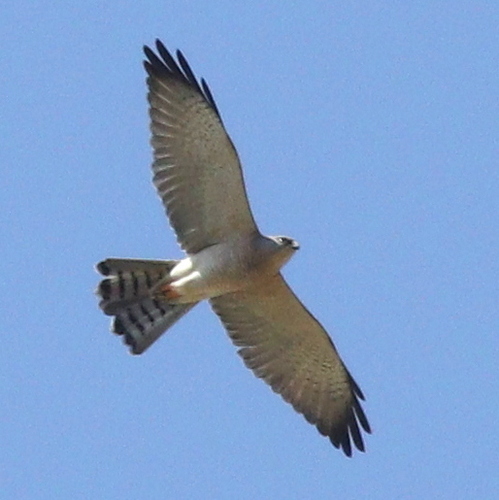 Levant Sparrowhawk
In short
The most reliable field mark to separate Montagu's Harrier from Levant Sparrowhawk is overall shape and flight style: Montagu's Harrier is a slender, long-winged, buoyant harrier with pointed wings and a long tail, while Levant Sparrowhawk is a much smaller, compact raptor with short, broad, more falcon-like wings and a shorter tail. Juvenile and female Montagu's Harriers can be confused with other brown raptors, but Levant Sparrowhawk never shows the harrier's long, elastic, low-hunting flight or the same wing/tail proportions. Adult male Montagu's Harrier is pale grey with black wingtips and distinctive black secondary bands, while male Levant Sparrowhawk is blue-grey above with fine rufous barring below. Juvenile Montagu's Harrier is uniformly reddish-brown below, lacking the streaked or barred underparts of Levant Sparrowhawk. Size, structure, and flight style are the quickest ways to separate these two in the field.
Identification tips
- Size and structure: Montagu's Harrier is much larger and longer-winged than Levant Sparrowhawk. If the bird looks slim, with very long wings and tail, think harrier; if compact and short-winged, think sparrowhawk.
- Flight style: Montagu's Harrier flies with slow, elastic, buoyant wingbeats and often glides low over open fields in a marked dihedral. Levant Sparrowhawk uses rapid flapping, direct flight, and is more likely to soar or dash through trees.
- Wingshape: In flight, Montagu's Harrier shows long, narrow, pointed wings ('hands'), especially obvious in juveniles and females. Levant Sparrowhawk has shorter, broader, more falcon-like wings with a more compact look.
- Tail: Montagu's Harrier has a long, slim tail, often held straight or slightly fanned. Levant Sparrowhawk's tail is shorter and more squared-off in proportion to the body.
- White rump: Montagu's Harrier (all ages/sexes) shows a prominent white rump (upper tail coverts) in flight; Levant Sparrowhawk lacks this feature.
- Juvenile underparts: Juvenile Montagu's Harrier is uniformly red-brown below with no streaking or barring. Juvenile Levant Sparrowhawk is streaked below and shows a dark throat line.
- Female underparts: Female Montagu's Harrier has pale yellow-brown underparts with longitudinal stripes and spotted wing coverts. Female Levant Sparrowhawk is barred reddish brown below, with a possible dark throat line.
- Adult male plumage: Male Montagu's Harrier is pale grey with black wingtips and bold black secondary bands, plus rusty streaks on the belly/flanks. Male Levant Sparrowhawk is blue-grey above, finely barred rufous and white below, with a white throat and dark central stripe.
- Upperwing pattern: In flight, Montagu's Harrier (especially males) shows black tips and black secondary bands; Levant Sparrowhawk lacks these bold wing markings.
- Perched posture: Montagu's Harrier appears slim and long-winged when perched, often with wingtips reaching or exceeding the tail tip. Levant Sparrowhawk is compact and upright.
- Habitat context: Montagu's Harrier is almost always seen in open country, rarely near dense trees. Levant Sparrowhawk is associated with woodland, forest edges, or tree clumps, and is rarely seen quartering over fields.
- Flight context: If seen quartering low over farmland or marsh, it's likely a harrier. If seen dashing through trees or perched in woodland, it's likely a sparrowhawk.
- Sexual dimorphism: Both species show sexual dimorphism, but in Montagu's Harrier it is more pronounced, with males much paler and greyer than females. Levant Sparrowhawk males and females are both barred below but differ in shade.
- Melanistic forms: Montagu's Harrier can show melanistic (all dark) morphs, which are not found in Levant Sparrowhawk. These are rare but can confuse identification.
- Migration timing: Both species are migratory, but Montagu's Harrier is a long-distance migrant, often seen moving in August–October and April–May, mainly over open country. Levant Sparrowhawk migrates in large numbers over the Middle East, often using thermals and passing over woodland or open areas.
Size
Montagu's Harrier is substantially larger and longer-winged: length 43–47 cm, wingspan 97–115 cm, and average body mass around 315 g ([wikidata]). In contrast, Levant Sparrowhawk is much smaller and more compact, with length 32–38 cm and wingspan 65–75 cm. The harrier's wings and tail are both much longer in proportion to the body, giving it a more graceful, buoyant appearance. Levant Sparrowhawk is closer in size to a Eurasian Sparrowhawk and appears noticeably smaller and chunkier than any harrier.
Plumage
- Juveniles: Juvenile Montagu's Harrier is uniformly red-brown below (belly and underwing coverts) with no spotting or streaking, while juvenile Levant Sparrowhawk is dark grey-brown above and heavily streaked below, with a distinct dark throat line. Juvenile harrier lacks the fine barring or streaking typical of sparrowhawks.
- Females: Female Montagu's Harrier is brown above with pale yellow-brown underparts, longitudinal stripes on the belly, and spotted wing coverts. Female Levant Sparrowhawk is slate-grey above, barred reddish brown below, and may show a dark throat line. Both can look brownish from a distance, but the harrier is more uniform above and lacks the sparrowhawk's strong barring.
- Adult males: Male Montagu's Harrier is pale grey with black wingtips and bold black bands on the secondaries, plus rusty streaks on the belly/flanks. Male Levant Sparrowhawk is blue-grey above, pale below with fine rufous and white barring, and a white throat bisected by a dark line. The harrier's wing pattern (black tips and bands) is unique.
- Upperwing in flight: Montagu's Harrier shows black secondaries and wingtips, with a long, narrow, pointed-winged look. Levant Sparrowhawk has short, broad, more pointed wings but lacks the harrier's black secondary bands and has a more compact profile.
- Other: Montagu's Harrier has a white rump (upper tail coverts) visible in flight; Levant Sparrowhawk does not.
Behaviour
Montagu's Harrier is a classic harrier: it hunts by flying low over open fields with slow, elastic, buoyant wingbeats and a marked dihedral, often gliding and tilting side to side. Its flight is described as smooth and tern-like. Levant Sparrowhawk, in contrast, is adapted for maneuvering through trees, with rapid, direct flight, quick flapping, and occasional soaring or gliding on migration. It rarely quarters low over open ground like a harrier. Perched, the harrier looks long-winged and slim, while the sparrowhawk is compact and upright.
Habitat
Montagu's Harrier breeds in large open areas—grasslands, marshes, and agricultural fields—across the Palearctic, and is typically seen in open country or low over fields. Levant Sparrowhawk prefers open woodland, forest edges, or isolated tree clumps, often near water, and is rarely seen far from trees except on migration. If you see a raptor quartering low over open fields, it's almost certainly a harrier; a small raptor dashing through woodland or perched in a tree is more likely a sparrowhawk.