

Mistle Thrush vs Redwing
Turdus viscivorus versus Turdus iliacus
Play a quiz with Mistle Thrush and Redwing
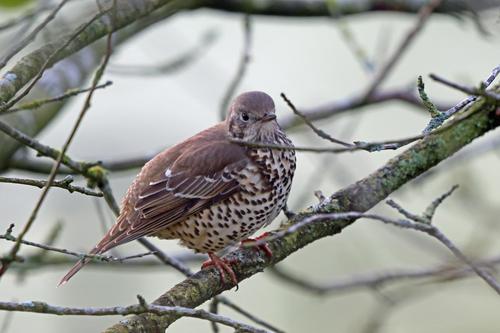 Mistle Thrush
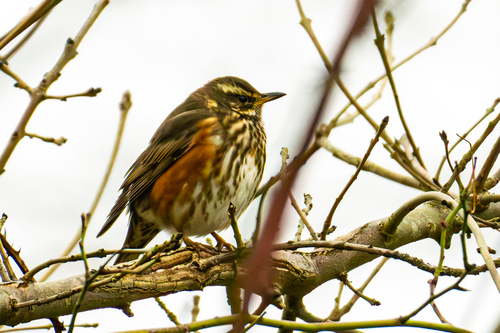 Redwing
In short
The most reliable way to separate Mistle Thrush from Redwing is by size and structure: Mistle Thrush is much larger, bulkier, and longer-tailed, while Redwing is noticeably smaller and more compact. In all plumages, Redwing shows bold reddish flanks and underwings and a strong pale eyebrow, which Mistle Thrush lacks. Mistle Thrush has round, irregular black spots on a buffy or yellowish background, while Redwing's underparts are whiter with more orderly dark spots. In flight, Redwing flashes red underwings, a feature never shown by Mistle Thrush. Both species may be seen in similar habitats in winter, but their structure and plumage differences are clear with good views.
Identification tips
- Size and Structure: Mistle Thrush is much larger and bulkier than Redwing, with a longer tail and upright stance. Use this as your first check, especially when birds are side by side or with other thrushes for scale.
- Redwing's Red Flanks and Underwing: Redwing always shows bold reddish flanks and underwing coverts, visible both perched and especially in flight. Mistle Thrush never shows any red.
- Supercilium (Eyebrow): Redwing has a strong, creamy-white eyebrow that stands out on the face. Mistle Thrush lacks this feature, showing a plainer face.
- Underpart Spotting: Mistle Thrush has round, irregular black spots on a buff or yellowish background, often denser on the lower chest. Redwing's spots are darker, more orderly, and set on a whiter background.
- Belly Color: Mistle Thrush's belly is more brownish or orange-buff, while Redwing's is cleaner white.
- Upperparts: Mistle Thrush is pale grey-brown above, while Redwing is plain brown. Juvenile Mistle Thrush may show creamy teardrop marks on upperparts, but Redwing juveniles do not.
- Tail Pattern: Mistle Thrush has white tips to the outer tail feathers, best seen in flight or when the tail is spread. Redwing lacks this feature.
- Underwing in Flight: Redwing's red underwing is diagnostic in all ages and seasons. Mistle Thrush shows white underwing coverts.
- Posture and Jizz: Mistle Thrush stands more upright and appears longer-legged and longer-tailed. Redwing is more compact and horizontal.
- Flock Size and Behavior: Redwing is more likely to be in flocks, especially in winter, and is often more secretive, feeding in bushes. Mistle Thrush is often solitary or in pairs, more likely to be seen in the open.
- Habitat Context: In open fields and parkland, especially outside the breeding season, Mistle Thrush is more expected as a lone bird or in small groups. Redwing is more likely in hedgerows and woodland edges, often in larger flocks.
- Juvenile Plumage: Juvenile Mistle Thrush is paler above with creamy teardrop marks and smaller spots below, but still larger and never shows red. Juvenile Redwing resembles adults and always shows the red flanks and eyebrow.
- Voice: If heard, Redwing gives a thin, high 'tsee' flight call, while Mistle Thrush has a louder, rattling call and song, but this is less often diagnostic without experience.
- Seasonality: Redwing is present in most of Europe only in winter; Mistle Thrush is resident or a short-distance migrant. In midwinter, both may occur together, but in spring and summer, Redwing is absent from most of the range.
- Pitfalls: Distant or backlit views may obscure the red flanks of Redwing, but structure and size should still separate them. Beware of pale-bellied Mistle Thrushes in bright light, but they never show the red or eyebrow of Redwing.
Size
Mistle Thrush is significantly larger and heavier than Redwing. Mistle Thrush averages around 130 g (range 93–167 g) and measures 27–28 cm in length with a 45 cm wingspan. Redwing is much smaller, weighing 50–75 g (mean 62 g), with a length of 20–24 cm and a wingspan of 33–34.5 cm. In the field, Mistle Thrush appears big, upright, and long-tailed, while Redwing is compact, short-tailed, and more delicate overall.
Plumage
Juvenile and adult Mistle Thrushes both show pale grey-brown upperparts and yellowish-buff to off-white underparts marked with round, irregular black spots. Juveniles are paler above with creamy teardrop centers to the feathers and smaller spots below, but by first winter are very similar to adults, though often more buff below. Redwing of all ages has plain brown upperparts, a strong creamy-white supercilium (eyebrow), and white underparts with neat, dark brown spots. The most diagnostic feature is the bold red on the flanks and underwing coverts, visible both at rest and especially in flight. Mistle Thrush never shows red in the wing or on the flanks. In flight, Redwing's red underwing is a key mark for all plumages and ages; Mistle Thrush shows white underwing coverts and white tips to the outer tail feathers. Sexes are similar in both species.
Behaviour
Mistle Thrush is often seen alone or in pairs, sometimes in family groups or loose flocks in late summer and autumn, and is more likely to be seen upright and alert on open ground, often flicking wings and tail when excited. Its flight is strong and bounding with glides. Redwing is more likely to be seen in flocks, especially in winter, and tends to be more skulking, feeding in trees and bushes as well as on the ground. Redwing's flight is direct and less undulating than Mistle Thrush.
Habitat
Both species may overlap in winter, especially in open woodlands, parks, and fields. Mistle Thrush is a year-round resident in much of Europe, with some northern and eastern birds migrating. Redwing is a migrant, breeding in northern forests and wintering further south, often appearing in large flocks in fields, hedgerows, and woodland edges. Mistle Thrush is more likely to be seen as a solitary or paired bird in open habitats, while Redwing is typically found in groups.
Voice
No direct comparison is available in the notes, but both species have distinctive calls and songs. Redwing gives a thin, high 'tsee' flight call and a varied, whistling song with local dialects. Mistle Thrush has a loud, rattling song and harsh calls, but these are not detailed in the provided notes.