

Military Macaw vs Great Green Macaw
Ara militaris versus Ara ambiguus
Play a quiz with Military Macaw and Great Green Macaw
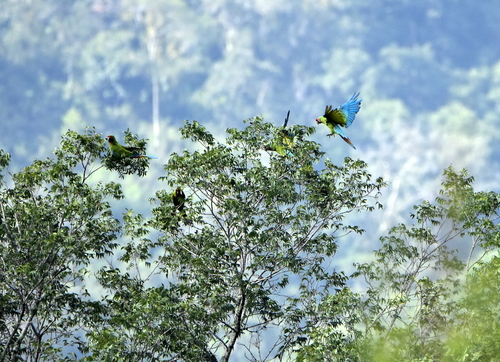 Military Macaw
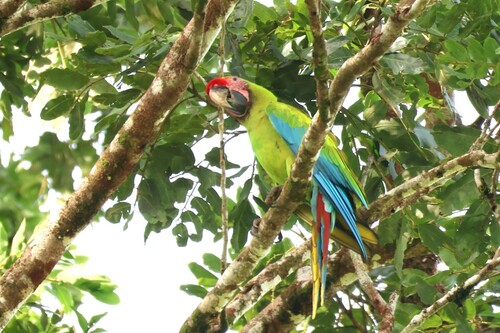 Great Green Macaw
In short
The most reliable field mark to separate Military Macaw from Great Green Macaw is size: Great Green is distinctly larger and bulkier, with a longer wingspan and heavier build. In the field, both species are mostly green with red foreheads and bare whitish faces, but Military Macaw is smaller, darker green overall, and has a completely black bill, while Great Green Macaw is paler green, larger, and has a paler bill base. Both can look similar at a distance, but careful attention to size, bill color, and overall shade of green will usually clinch the ID. Habitat can also help: Military Macaw favors drier, deciduous forests, while Great Green Macaw is a bird of humid lowland forests.
Identification tips
- Size is the best field mark: Great Green Macaw is significantly larger and bulkier than Military Macaw. If seen together or with a known size reference, the difference is obvious. This works for all ages and sexes.
- Bill color: Military Macaw has a completely black or slate-grey bill, while Great Green Macaw usually has a paler, horn-colored base to the upper mandible. This is visible at close range or in good light.
- Overall green shade: Military Macaw is a deeper, darker green; Great Green Macaw is paler and brighter green. This can be subtle and affected by light, but is useful in direct comparison.
- Red forehead patch: Both have a bright red forehead, so this is not diagnostic.
- Facial skin: Both have bare whitish faces with black striations, so this is not a reliable separator.
- Flight and tail feathers: Both species have blue and yellow in the wings and tail, so this is not a strong separator in the field.
- Habitat: Military Macaw prefers drier, more open deciduous forests; Great Green Macaw is found in humid lowland rainforest. Use habitat as a supporting clue, not a primary mark.
- Geographic range: Military Macaw ranges from Mexico to northern Argentina/Bolivia; Great Green Macaw is more restricted to Central America and northern South America (Nicaragua to Ecuador). Overlap is limited but possible in Colombia and adjacent areas.
- Behavior: Both species are social, noisy, and often seen in pairs or small groups. Great Green Macaw may appear heavier and more ponderous in flight.
- Voice: Both are loud and raucous; differences exist but are not detailed in the notes, so do not rely on voice unless you have prior experience.
- Iris color: Both have yellow irises; not a separator.
- Tail length: Great Green Macaw may appear longer-tailed due to its larger size, but tail color and shape are not reliable separators.
- In captivity: Both are kept in zoos and aviaries, so context is important for ID in non-wild settings.
- Juvenile/immature plumage: No age-specific wing or flight pattern differences are described in the notes, so do not rely on juvenile plumage for separation.
- Plumage variation: Subspecies of Military Macaw vary slightly in size and color, but all are smaller and darker than Great Green Macaw.
Size
Great Green Macaw is the larger of the two, with a length and wingspan exceeding that of Military Macaw. Military Macaw typically measures 70–85 cm (28–33 in) in length with a 99–110 cm (39–43 in) wingspan [wikipedia]. Great Green Macaw is noticeably larger and bulkier in direct comparison, though exact numbers are not given in the provided notes. In mixed flocks or side-by-side, Great Green will appear longer-tailed, deeper-chested, and heavier overall.
Plumage
There are no age-specific juvenile or immature wing patterns described for either species in the notes, so focus is on adult and general plumage. Both species are predominantly green, but Military Macaw is a deeper, darker green, while Great Green Macaw is paler and brighter green. Both have a bright red patch on the forehead, but the face of Military Macaw is bare, whitish with black striations, and the bill is entirely blackish-slate. Great Green Macaw also has a bare whitish face, but with a paler (often horn-colored) upper bill base. Flight and tail feathers in Military Macaw are light blue and yellow; Great Green Macaw is similar but may appear even more colorful due to its size and paler green body. Both species have yellow irises. Subtle differences in shade and bill color are most useful when seen well.
Behaviour
Both species are strong fliers and may be seen in pairs or small flocks. Great Green Macaw may appear heavier and more ponderous in flight due to its size. Both species are noisy and conspicuous when present. Feeding behavior is not a reliable field mark for separation, as both crack large nuts and forage in trees.
Habitat
Military Macaw is typically found in drier, deciduous forests, often in more open or fragmented woodland, especially in Mexico and northern South America. Great Green Macaw is a specialist of humid lowland forests, especially those with large emergent trees like Dipteryx oleifera (almendro), and is found from Nicaragua through northern South America. If you are in a humid, dense forest in Central America, Great Green Macaw is more likely; in drier, open woodland, especially further north, Military Macaw is more probable.
Voice
The notes mention that the two species differ in their calls and communication, but do not provide details. Both are loud, raucous macaws, and voice alone is not a reliable field mark unless you are very familiar with both species.