

Mexican Duck vs American Black Duck
Anas diazi versus Anas rubripes
Play a quiz with Mexican Duck and American Black Duck
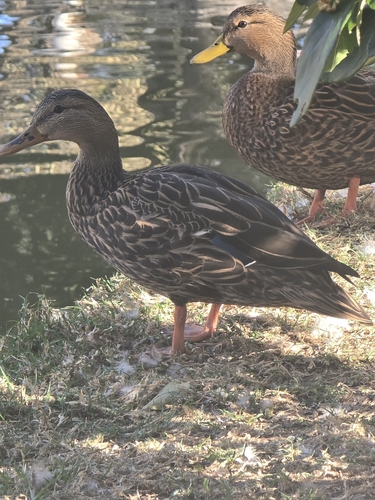 Mexican Duck
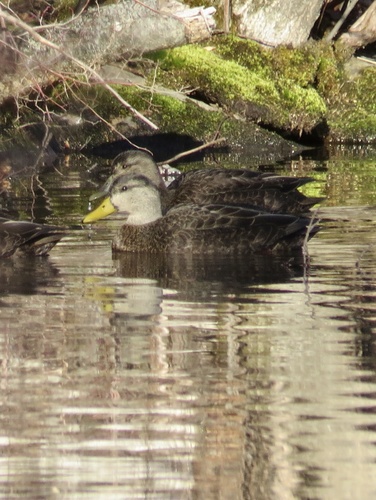 American Black Duck
In short
The most reliable field mark to separate Mexican Duck from American Black Duck is the color and edging of the speculum: Mexican Duck shows a blue speculum bordered with obvious white, while American Black Duck’s speculum is iridescent violet-blue with mostly black margins and rarely a white trailing edge. In flight, American Black Duck also shows a striking white underwing lining contrasting with a dark underbody, a feature not described for Mexican Duck. Both species are similar in structure and overall brown appearance, but American Black Duck is generally darker and bulkier, with more contrast between head and body. Bill color can help: male Mexican Ducks have a brighter yellow bill, while female American Black Ducks have a dull green bill with dark markings. Juvenile and female plumages are especially tricky, but careful attention to speculum and underwing pattern is key.
Identification tips
- Speculum color and edging: Look for the speculum (colored patch on the wing). Mexican Duck has a blue speculum with bold white borders front and rear, visible both at rest and in flight. American Black Duck’s speculum is violet-blue, bordered mostly by black, and rarely shows a white trailing edge. This is the single most reliable mark in all plumages.
- Underwing contrast in flight: American Black Duck shows a bright white underwing lining that stands out against a dark underbody and upperparts. This contrast is not described for Mexican Duck, so a white underwing is a strong pointer to Black Duck.
- Overall darkness: American Black Duck is generally darker and more uniform, especially on the body. Mexican Duck is brown but less dark and less contrasting.
- Head and throat pattern: American Black Duck has a brown head slightly paler than the body, with streaked cheeks and throat and a dark crown stripe. Mexican Duck lacks this strong contrast and streaking.
- Bill color (by sex): Male Mexican Ducks have a bright yellow bill; females are duller yellow. American Black Duck males have a yellow bill, but females have a dull green bill with dark markings on the upper mandible. Use this mark only if you can sex the bird reliably.
- Juvenile plumage: Juvenile American Black Ducks are browner than adults, with broken pale edges on underpart feathers (streaked look). Juvenile Mexican Ducks are not distinctly described, but likely resemble adult females and can be confused with Mallards.
- Feet color in juveniles: Juvenile male American Black Ducks have brownish-orange feet, while juvenile females have browner feet. This mark is subtle and not always visible.
- Size and bulk: American Black Duck is heavier and slightly longer, but the difference is subtle and not reliable unless birds are side by side.
- Habitat and range: If you are in the Southwest (Arizona, New Mexico, northern Mexico), Mexican Duck is expected. In the Northeast, Great Lakes, or Atlantic coast, American Black Duck is the default. Out-of-range records are rare.
- Voice: Both species have Mallard-like calls; female Black Duck gives a loud quack series falling in pitch, but this is not a reliable separation mark.
- Hybrid confusion: Both species can hybridize with Mallard, and hybrids may show intermediate features, especially in speculum and bill color. Be cautious with odd-looking birds.
- Sexual dimorphism: Both species show limited sexual dimorphism; bill color is the main difference, but overall body plumage is similar between sexes in both species.
- Comparison to Mallard: Both species can be confused with female or eclipse Mallards. Focus on speculum color and edging, and overall darkness, to avoid this pitfall.
- Perched vs. in flight: Speculum and underwing marks are visible in both perched and flying birds, but underwing contrast is best seen in flight for American Black Duck.
- Lighting conditions: In poor light, the speculum color may be hard to judge. Look for the presence or absence of white borders as the key feature.
Size
American Black Duck is the heavier and slightly larger of the two, averaging about 1180 g (with a range up to 1640 g) and measuring 54–59 cm in length. Mexican Duck is somewhat smaller, at 45–55 cm and 849–1243 g. In the field, this size difference is subtle and easily missed unless the birds are side by side, but American Black Duck often appears bulkier and longer-winged.
Plumage
-
Juvenile/immature plumage: Juvenile American Black Ducks resemble adult females but have broken, narrow, pale edges on the underparts, giving a streaked (not scalloped) look, and are overall browner than adults. Juvenile males have brownish-orange feet, and juvenile females have brownish feet and a dusky greyish-green bill. No distinctive juvenile upperwing pattern is described for Mexican Duck, but both species’ young can be confusingly similar to female Mallards.
-
Speculum: Mexican Duck shows a blue speculum with obvious white edging (both front and rear) visible at rest and in flight. American Black Duck’s speculum is iridescent violet-blue, bordered mostly by black, rarely with a white trailing edge, and lacks the prominent white borders of Mexican Duck.
-
Underwing: In flight, American Black Duck shows a white underwing lining contrasting with a blackish underbody and upperparts. This strong contrast is not described for Mexican Duck.
-
Body and head: American Black Duck is overall darker, with a brown head slightly paler than the body, and streaked cheeks and throat. Mexican Duck is mainly brown and less contrasting, with no mention of the darker body vs paler head contrast.
-
Bill color: Male Mexican Ducks have a brighter yellow bill, while female American Black Ducks have a dull green bill with dark marks on the upper mandible. Female Mexican Ducks’ bills are duller yellow.
Behaviour
Both species are dabbling ducks with similar feeding and swimming behavior. No distinctive behavioral differences are described in the sources for field separation.
Habitat
Mexican Duck is found in Mexico and the southwestern United States, while American Black Duck is native to eastern North America, breeding from Saskatchewan to the Atlantic and wintering mainly in the east-central US, especially coastal areas. Overlap is unlikely except in rare vagrancy or captivity. If you are in the Southwest, Mexican Duck is expected; in the Northeast or Great Lakes, American Black Duck is the default.
Voice
Both species have calls similar to Mallard, with the female American Black Duck producing a loud sequence of quacks that fall in pitch. No distinctive vocal differences are described for Mexican Duck, so voice is not a reliable field mark for separation.