

Mediterranean Short-toed Lark vs Turkestan Short-toed Lark
Alaudala rufescens versus Alaudala heinei
Play a quiz with Mediterranean Short-toed Lark and Turkestan Short-toed Lark
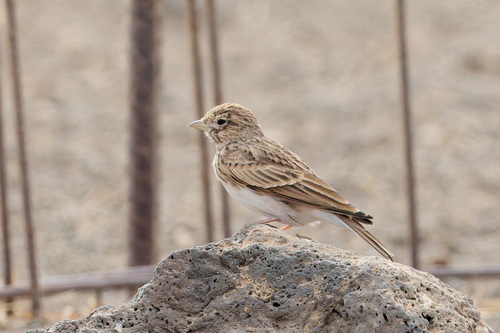 Mediterranean Short-toed Lark
 Turkestan Short-toed Lark
In short
The most reliable field separation between Mediterranean Short-toed Lark and Turkestan Short-toed Lark is subtle and relies on careful attention to structure and breast pattern. Mediterranean Short-toed Lark is generally duller overall, with a more heavily streaked breast and a shorter, less-conical bill paired with a smaller, rounder head. Both species are similar in size and coloration, and color alone is not a dependable mark. In the field, focus on the breast streaking, bill/head shape, and, if heard, the richer, more varied song of Mediterranean Short-toed Lark. Both species overlap in overall jizz and can be very challenging to separate without close views.
Identification tips
- Breast streaking: Mediterranean Short-toed Lark shows finer, more extensive streaking across the breast than Turkestan. This is most useful on perched birds at close range.
- Bill shape: Mediterranean has a shorter, less-conical bill compared to the slightly longer, more conical bill of Turkestan. This can be subtle and is best judged in profile.
- Head shape: Mediterranean's head is smaller and rounder, while Turkestan may appear to have a slightly larger, less rounded head. Use this in combination with bill shape.
- Overall coloration: Mediterranean is generally duller above, but color varies within both species and is not a reliable mark on its own.
- Supercilium: Both species have a pale supercilium; this is not a separating feature.
- Neck patches: Both species lack the strong dark neck patches seen in some other larks; do not use this mark to separate these two.
- Upperparts streaking: Both are dark-streaked greyish-brown above, so this is not useful for separation.
- Underparts color: Both are white below; focus on the pattern (streaking) rather than color.
- Song: Mediterranean's song is richer, more varied, and imitative. If you hear a complex, melodious song, this supports Mediterranean, but beware of variation and overlap.
- Range and habitat: If you are in the Mediterranean Basin, Mediterranean Short-toed Lark is expected; further east in Central Asia, Turkestan is more likely. In areas of overlap, do not rely on range alone.
- Sex and age: Sexes are similar in both species. No age-specific upperwing or flight marks are described, so focus on breast and head structure for all ages.
- In flight: No distinctive flight or upperwing pattern differences are noted for these two; separation in flight is extremely difficult without close, detailed views.
- Jizz: Both species share a similar overall jizz; structure (bill and head) and breast pattern are the best clues.
- Plumage pitfalls: Variation within each species can be considerable, so use a combination of marks and avoid relying on a single feature.
- Confusion with other larks: Both species can be confused with Calandrella larks, but those have different neck patch and bill/head structure; this is not relevant for separating these two.
Size
Both species are very similar in size, with Mediterranean Short-toed Lark reaching 13–14 cm in length. There is no evidence of a significant size difference between these two, and both sexes are alike in size. Bill size and head shape are more useful than overall body length for separation.
Plumage
Plumage differences are subtle and best assessed on perched birds at close range. Mediterranean Short-toed Lark is generally duller above, with a more streaked breast compared to Turkestan Short-toed Lark. Both have dark-streaked greyish-brown upperparts and white underparts, but Mediterranean shows finer, more extensive breast streaking. Both species have a pale supercilium and lack strong neck patches. Coloration varies greatly within both species, so do not rely on overall tone. There are no specific notes on juvenile or immature upperwing patterns for either species, so focus on breast and head details in all ages.
Behaviour
Behavior is not described as diagnostic between these two species. Both are typical short-toed larks, likely to be seen foraging on the ground in open habitats and may flush with bounding flight when disturbed.
Habitat
Mediterranean Short-toed Lark is found in and around the Mediterranean Basin, from the Canary Islands and Iberian Peninsula through North Africa and parts of the Middle East. Turkestan Short-toed Lark occurs further east, from Ukraine and central Turkey through Central Asia and southern Siberia to Mongolia and Afghanistan. While ranges overlap in parts of Turkey, habitat alone is not diagnostic where both may occur. Both species favor open, dry habitats.
Voice
Mediterranean Short-toed Lark has a song described as richer, more varied, and more imitative than that of its close relatives, including Turkestan Short-toed Lark. If you hear a complex, varied song, this favors Mediterranean, but field experience is needed as both species may have similar calls.
Mediterranean Short-toed Lark · Turkestan Short-toed Lark · My Tricky Birds