

Mediterranean Short-toed Lark vs Thekla's Lark
Alaudala rufescens versus Galerida theklae
Play a quiz with Mediterranean Short-toed Lark and Thekla's Lark
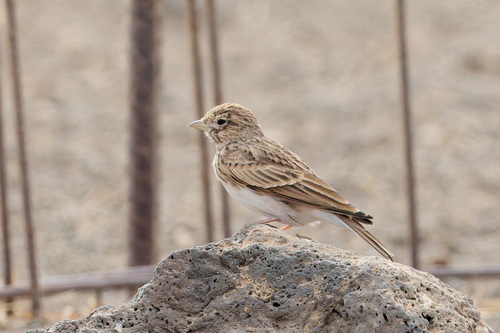 Mediterranean Short-toed Lark
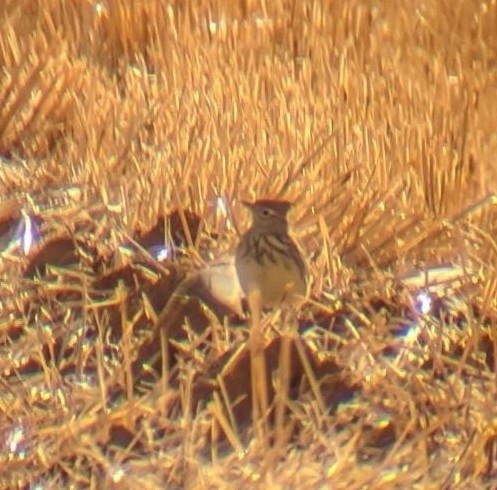 Thekla's Lark
In short
The most reliable field mark between Mediterranean Short-toed Lark and Thekla's Lark is the presence of a long, spiky crest on Thekla's Lark, which is always absent in Mediterranean Short-toed. Bill and head shape also differ: Mediterranean Short-toed Lark has a shorter, more rounded bill and smaller head, while Thekla's Lark shows a stouter, slightly longer bill and a more angular head. Both species are streaked above and below, but Thekla's Lark has heavier, blacker breast streaking and a greyer overall tone; Mediterranean Short-toed is paler and more finely streaked. In flight, neither species shows the reddish underwings of Crested Lark, but Thekla's underwings are grey. Both can occur in similar dry open habitats, but Thekla's is more likely at higher altitudes and is strictly resident.
Identification tips
- Crest presence: Thekla's Lark always shows a long, spiky, erectile crest, especially when alert or singing; Mediterranean Short-toed Lark never shows a crest. This is the single most reliable field mark.
- Bill shape: Mediterranean Short-toed Lark has a short, stubby, less-conical bill; Thekla's Lark's bill is slightly longer and more robust, though not as long as Crested Lark's. Bill shape is best judged at close range or in good light.
- Head shape: Mediterranean Short-toed Lark has a more rounded, smaller head; Thekla's Lark's head is more angular, accentuated by the crest.
- Breast streaking: Thekla's Lark has bold, blackish streaks on the breast; Mediterranean Short-toed Lark's breast streaking is finer and less contrasting. This is most useful on perched birds in good light.
- Overall color tone: Thekla's Lark is greyer above and below, while Mediterranean Short-toed Lark is paler and browner. Color can be variable and affected by light, so use with caution.
- Supercilium: Mediterranean Short-toed Lark shows a pale supercilium; Thekla's Lark's supercilium is less distinct.
- Underwing color in flight: Thekla's Lark has grey underwings (not reddish); Mediterranean Short-toed Lark's underwing color is not specifically described but does not show reddish tones. This is mainly useful to rule out Crested Lark.
- Tail and wing pattern: No distinctive age-specific upperwing or tail patterns separate these two species; both lack the white wing and tail edges of Eurasian Skylark.
- Voice: Mediterranean Short-toed Lark's song is richer and more varied than its relatives, but direct comparison with Thekla's Lark is not detailed in the notes.
- Habitat context: Thekla's Lark is more likely at higher altitude and is always resident; Mediterranean Short-toed Lark is more widespread and may occur in a wider range of open habitats.
- Behavior: Thekla's Lark often perches with crest raised and may appear more upright; Mediterranean Short-toed Lark is less likely to show a crest and may appear more compact.
- Pitfalls: Both species are similar in size and share streaked upperparts and underparts. Do not rely on overall color alone, as both are variable and overlap in tone.
- Sex and age: Sexes are similar in both species; no age-specific flight marks are described, so all ages must be separated by crest, bill, head shape, and breast streaking.
- Range: If seen outside the Mediterranean Basin or at high altitude in North Africa/Iberia, consider Thekla's Lark more likely, but overlap does occur.
- Comparison with other larks: Both species lack the reddish underwings of Crested Lark and the white wing/tail edges of Eurasian Skylark. Always check for crest and breast streaking before considering other larks.
Size
Both species are small larks, similar in size and slightly smaller than Eurasian Skylark. Mediterranean Short-toed Lark is 13–14 cm in length, and Thekla's Lark is similar, perhaps marginally larger but not enough to be reliably separated by size in the field. Sexes are alike in both species. Bill length and head size are more useful than overall body size for separation.
Plumage
- Juvenile/immature plumage: No distinctive age-specific upperwing or flight marks are described for either species; both are dark-streaked greyish-brown above and whitish below from an early age. No mention of contrasting wing panels, trailing edges, or 'W' patterns.
- Adult plumage: Thekla's Lark is greyer overall, with blacker, heavier breast streaking and a long, spiky crest. Mediterranean Short-toed Lark is paler, with finer streaking on the breast, a pale supercilium, and lacks any crest. Both have dark-streaked upperparts, but Thekla's is more ashy or grey, while Mediterranean Short-toed is more brownish-grey. Underwings in flight are grey in Thekla's; Mediterranean Short-toed Lark's underwing color is not specified but does not show reddish tones.
Behaviour
Both species are ground-dwelling larks of open, dry country. Thekla's Lark is often found at higher altitudes and is strictly non-migratory, while Mediterranean Short-toed Lark may be more widespread and locally abundant around the Mediterranean Basin. Both species forage on the ground and may flush with a fluttering flight, but Thekla's Lark is more likely to be seen perched with its crest raised.
Habitat
Mediterranean Short-toed Lark is widespread around the Mediterranean Basin, from the Canary Islands and Iberia through North Africa and into the Middle East. Thekla's Lark overlaps in range but is more often found at altitude and is strictly resident. Both prefer dry, open country, but Thekla's Lark may be more associated with rocky or hilly terrain.
Voice
Mediterranean Short-toed Lark has a richer, more varied and imitative song compared to its relatives. Thekla's Lark's song is not described in the notes, so vocal differences are not diagnostic based on the provided information.
Mediterranean Short-toed Lark · Thekla's Lark · My Tricky Birds