

Masked Shrike vs Woodchat Shrike
Lanius nubicus versus Lanius senator
Play a quiz with Masked Shrike and Woodchat Shrike
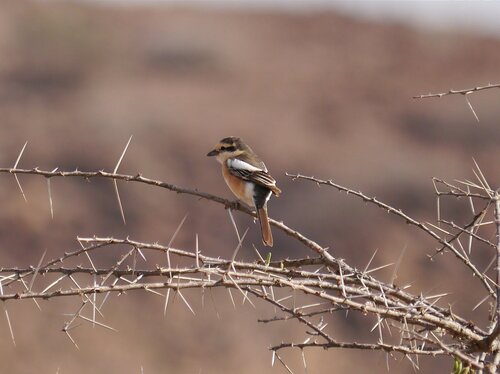 Masked Shrike
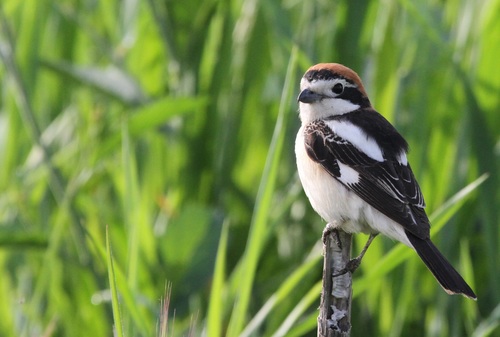 Woodchat Shrike
In short
Juvenile Masked and Woodchat Shrikes can be confusing, but look for the Masked Shrike's longer tail, paler face, and grey back and rump versus the Woodchat's sandy back and pale grey rump. Adult Masked Shrikes are easily told by their white crown and supercilium, while Woodchat Shrikes show a rich chestnut crown and nape. Masked Shrikes are smaller, more slender, and less conspicuous, often perching less openly. Both species share similar shrike structure, but careful attention to head pattern and upperpart color, especially in immatures, is key.
Identification tips
- Juvenile upperparts: Juvenile Masked Shrike has a grey back and rump with darker barring and a paler face, while juvenile Woodchat Shrike shows a sandy back and pale grey rump with vermiculated (finely barred) brown and white upperparts. This is a key field mark for immatures.
- Tail length: Masked Shrike, even as a juvenile, has a noticeably longer tail than Woodchat Shrike. Use this in perched birds or when comparing directly.
- Head pattern (adults): Adult Masked Shrike has a white crown, forehead, and supercilium, contrasting with black upperparts. Woodchat Shrike has a rich chestnut crown and nape, with no white on the crown.
- Wing patches: Masked Shrike shows large white patches on the shoulders and primaries (adults and juveniles), especially obvious in flight or when the wing is spread. Woodchat Shrike's wing patches are less extensive, and the western race may lack them entirely.
- Underparts: Masked Shrike has white underparts with orange flanks and breast (male), while Woodchat Shrike's underparts are pure white (male) or buff and vermiculated (female/juvenile).
- Female/immature confusion: Female Masked Shrike is duller, with brownish-black upperparts and a grey or buff tinge to the white patches; Woodchat Shrike females and juveniles are browner and more vermiculated, lacking the crisp black-and-white contrast.
- Face color (juveniles): Masked Shrike juveniles have a paler face and forehead compared to the generally darker-faced Woodchat juveniles.
- Rump color (juveniles): Masked Shrike has a grey rump, Woodchat Shrike a pale grey or sandy rump. This is subtle but useful in good light.
- Perching behavior: Masked Shrike is less likely to perch openly; if you see a shrike in a more hidden or shaded spot, consider Masked. Woodchat Shrike is bolder and often perches in the open.
- Size and jizz: Masked Shrike is smaller, more slender, and longer-tailed, while Woodchat Shrike is bulkier and more robust. This is best judged with experience or direct comparison.
- Bill structure: Both have hooked bills, but Masked Shrike's is relatively smaller and more delicate.
- Habitat context: Masked Shrike prefers areas with more cover and avoids very open ground; Woodchat Shrike is more likely in open orchards or fields with scattered trees.
- Vocalizations: If you hear melodic, warbler-like song, Masked Shrike is more likely, but calls are not reliably separable in the field based on these notes.
- Western Woodchat Shrike: If you are in the western Mediterranean and see a shrike lacking bold white wing patches, suspect Woodchat (L. s. badius), as Masked always shows strong white patches.
- Seasonal context: Both species breed in the Mediterranean region, but Masked Shrike is less widespread. In areas where both occur, focus on structural and plumage differences, especially in late summer when juveniles are abundant.
Size
Masked Shrike is the smallest of its genus, weighing around 25 g and measuring 17–18.5 cm in length with a 24–26.5 cm wingspan [wikidata]. Woodchat Shrike is slightly larger, at 17–19 cm in length, but no mass is given. In the field, Masked Shrike appears more slender and long-tailed, while Woodchat is a bit bulkier and more robust. Size alone is subtle, but the Masked Shrike's daintier build and longer tail can help when seen side by side.
Plumage
-
Juvenile/First-year: Juvenile Masked Shrike shows grey-brown upperparts with darker bars from head to rump, a paler grey forehead, and a grey back and rump. The face is paler, and the tail is longer. Juvenile Woodchat Shrike has brown and white vermiculated upperparts, a sandy back, and a pale grey rump; the underparts are buff and also vermiculated. Masked Shrike juveniles have white primary patches on brown wings, while Woodchat juveniles lack this strong contrast.
-
Adult males: Masked Shrike males have a striking white crown, forehead, and supercilium, black upperparts, and large white patches on the shoulders and primaries. The throat and underparts are white with orange flanks and breast. Woodchat Shrike males show a rich chestnut crown and nape, black and white upperparts, and pure white underparts. The western race of Woodchat (L. s. badius) lacks large white wing patches.
-
Adult females: Female Masked Shrike is a duller version of the male, with brownish-black upperparts and a grey or buff tinge to the white shoulder patches and underparts. Female Woodchat Shrike is browner above and also vermiculated, with less contrast overall.
-
In flight: Masked Shrike shows large white patches on the wings and outer tail feathers, especially in adults and juveniles. Woodchat Shrike's wing pattern is less bold, especially in the western race.
Behaviour
Masked Shrike is less conspicuous, often perching in less exposed positions and avoiding very open country. It tends to be more secretive and is often seen within bushes or trees rather than on prominent perches. Woodchat Shrike is more typical of shrikes, frequently perching openly on exposed branches, wires, or fence posts, usually 2–6 meters above ground, and making sallying flights after prey. Both species hunt from perches, but Woodchat is bolder and more visible.
Habitat
Both species favor open woodland with scattered trees, but Masked Shrike prefers areas with more cover, avoiding very open country and often staying within denser bushes or trees. Woodchat Shrike is found in open wooded areas, orchards, and places with bare or sandy ground, and is more likely to be seen in open habitats. Masked Shrike breeds in southeastern Europe and the eastern Mediterranean, while Woodchat Shrike is more widespread in the Mediterranean region.
Voice
Masked Shrike's calls are short and grating, but its song includes melodic, warbler-like phrases. No distinctive vocal differences are described for Woodchat Shrike in these notes, so voice is not a primary separator here.