

Marsh Sandpiper vs Spotted Redshank
Tringa stagnatilis versus Tringa erythropus
Play a quiz with Marsh Sandpiper and Spotted Redshank
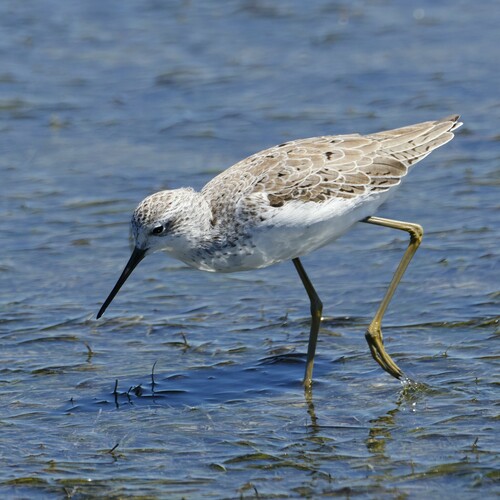 Marsh Sandpiper
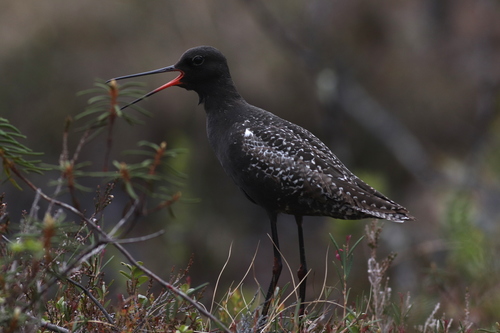 Spotted Redshank
In short
The most reliable field mark between Marsh Sandpiper and Spotted Redshank is the leg color and overall structure: Marsh Sandpiper shows very long, yellowish legs and a fine, needle-like bill, while Spotted Redshank has red legs and a heavier, slightly upturned bill. In flight, both show a white wedge or oval up the back, but Spotted Redshank is much larger and bulkier. Breeding Spotted Redshank is strikingly black, while Marsh Sandpiper is always pale and delicate. Juveniles and winter birds are trickier, but the Spotted Redshank remains larger, with a heavier bill and red legs, while Marsh Sandpiper is slim, with yellowish legs and a daintier look.
Identification tips
- Leg color: Marsh Sandpiper always shows very long, yellowish legs; Spotted Redshank has red legs (sometimes darkening in breeding plumage). This is visible both when perched and in flight.
- Bill structure: Marsh Sandpiper has a fine, straight, needle-like bill; Spotted Redshank's bill is heavier, longer, and slightly upturned, with a reddish base.
- Size and build: Spotted Redshank is much larger and heavier, with a bulkier body and longer neck. Marsh Sandpiper is slim, elegant, and dainty.
- Breeding plumage: Spotted Redshank is almost entirely black with white spots and dark legs—unique and unmistakable. Marsh Sandpiper remains pale grey-brown with subtle mottling.
- Non-breeding/juvenile plumage: Marsh Sandpiper is always pale and plain above, with diffuse spotting on the breast; Spotted Redshank juveniles are more patterned, with fine white speckling above and pale barred underparts.
- Flight pattern: Both show a white wedge or oval up the back, but Spotted Redshank's is larger and rounder due to its size. Marsh Sandpiper's flight is lighter and more buoyant.
- Leg projection in flight: Marsh Sandpiper's legs are very long and project well beyond the tail; Spotted Redshank's legs are proportionally shorter, though still obvious.
- Habitat context: In open, grassy steppe or taiga wetlands, Marsh Sandpiper is more likely. Spotted Redshank is more often found in a variety of wetland types, including coastal and larger inland waters.
- Behavior: Marsh Sandpiper feeds with quick, light picking and a more upright stance; Spotted Redshank moves more steadily and may wade deeper.
- Voice: If you hear a creaking 'teu-it' or 'kyip-kyip-kyip', it's Spotted Redshank. Marsh Sandpiper's calls are not described here.
- Bill color: Spotted Redshank's bill has a reddish base, especially outside breeding; Marsh Sandpiper's bill is all dark and finer.
- Leg color in breeding: Spotted Redshank's legs may darken to grey-black in full breeding plumage, but are still thicker and less yellow than Marsh Sandpiper.
- Overall impression: Marsh Sandpiper is always slim, pale, and elegant; Spotted Redshank is larger, heavier, and more robust, especially obvious when both are seen together.
- Pitfalls: In poor light, leg color can be hard to judge—use size, bill shape, and structure as backup. Juvenile Spotted Redshank may look paler, but remains larger and more patterned than Marsh Sandpiper.
- Sex/age: No strong sexual dimorphism in either species; age differences are mainly in plumage patterning as above.
Size
Spotted Redshank is substantially larger and heavier than Marsh Sandpiper. Adult Spotted Redshank averages 151.5 g, with a length of 29–31 cm and a wingspan of 61–67 cm. Marsh Sandpiper is much lighter at 71.55 g, 22–26 cm long, and a wingspan of 55–59 cm. In the field, Spotted Redshank appears bulkier, longer-bodied, and longer-billed, while Marsh Sandpiper is notably slim and elegant.
Plumage
Juvenile and non-breeding Marsh Sandpiper is always pale grey-brown above and whitish below, with a subtle, diffuse spotting on the breast and neck. Juvenile Spotted Redshank is grey-brown above, finely speckled white, and has pale, finely barred underparts—giving a more patterned appearance than the Marsh Sandpiper. In flight, both show a white wedge or oval up the back, but Spotted Redshank's is larger and rounder due to its size. In breeding plumage, Marsh Sandpiper remains pale grey-brown with some mottling, while Spotted Redshank turns almost entirely black with white spots and dark legs—a dramatic difference. In winter, both species become paler, but Spotted Redshank is still larger, paler overall, and keeps its red legs and bill, while Marsh Sandpiper's legs remain yellowish and its bill is finer.
Behaviour
Marsh Sandpiper is daintier in movement, often feeding with rapid, light picking and a more upright stance due to its long legs. Spotted Redshank moves more deliberately, with a heavier gait, and may wade deeper. In flight, Marsh Sandpiper appears slim and buoyant, while Spotted Redshank is powerful and strong-winged, with a longer, more robust silhouette.
Habitat
Both species use shallow wetlands, but Marsh Sandpiper is more likely in open grassy steppe and taiga wetlands, especially during breeding. Spotted Redshank breeds in boggy taiga and is more likely to be seen in a wider range of wetland habitats on migration and winter, including larger lakes, estuaries, and coastal lagoons. Local abundance may vary, but Spotted Redshank is generally less likely in very open, grassy steppe habitats.
Voice
Spotted Redshank gives a distinctive creaking whistle 'teu-it' and a sharp 'kyip-kyip-kyip' alarm, somewhat reminiscent of a tern. Marsh Sandpiper's vocalizations are not described in the provided notes, so voice is only reliably diagnostic for Spotted Redshank if heard.