

Motmot

Marsh Sandpiper vs Lesser Yellowlegs

Tringa stagnatilis versus Tringa flavipes

Play a quiz with Marsh Sandpiper and Lesser Yellowlegs
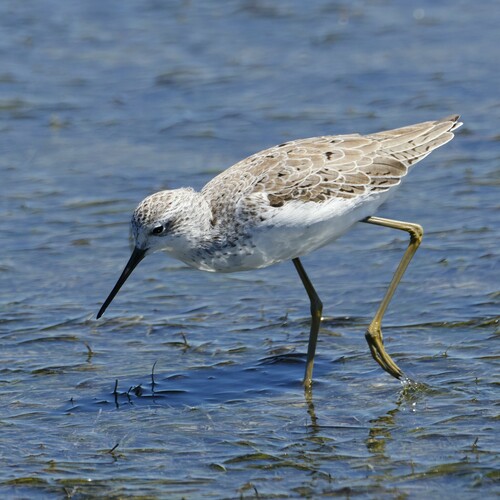
Marsh Sandpiper (Tringa stagnatilis) Marsh Sandpiper
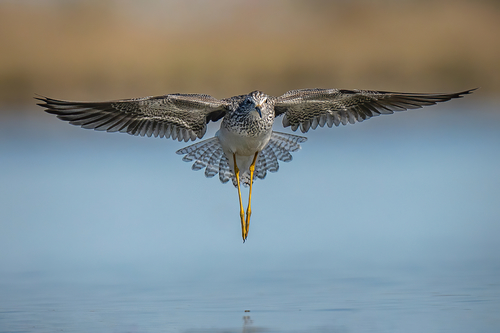
Lesser Yellowlegs (Tringa flavipes) Lesser Yellowlegs

Media

Loading…

In short

The most reliable field mark to separate Marsh Sandpiper from Lesser Yellowlegs is bill structure: Marsh Sandpiper has a noticeably longer, finer, and needle-like bill, while Lesser Yellowlegs shows a straight, slim, but shorter bill about the length of its head. Both have long yellowish legs, but Marsh Sandpiper’s are even longer and often appear more delicate. In flight, Marsh Sandpiper shows a white wedge up its back, a feature that can be helpful at any age. Plumage differences are subtle, especially in non-breeding birds, but Marsh Sandpiper tends to look paler and more elegant overall. Size is not a strong separator, as both are similar, but Lesser Yellowlegs is slightly heavier on average.

Identification tips

  1. Bill structure is key: Marsh Sandpiper has a long, fine, needle-like bill that is noticeably longer than the head; Lesser Yellowlegs has a straight, slim, but shorter bill about equal to head length. This is reliable in all ages and seasons.
  2. Leg length and color: Both species have yellowish legs, but Marsh Sandpiper’s are longer and often paler or slightly greenish. Lesser Yellowlegs’ legs are bright yellow and proportionally shorter.
  3. White wedge up the back (in flight): Marsh Sandpiper shows a white wedge up the back in flight at all ages; Lesser Yellowlegs lacks this feature. Look for this when birds flush or fly past.
  4. General shape and jizz: Marsh Sandpiper appears more slender, elegant, and upright, with a finer build and longer legs. Lesser Yellowlegs is slightly bulkier and more compact.
  5. Breast and neck markings (breeding): Marsh Sandpiper has diffuse small brownish spots on the breast and neck; Lesser Yellowlegs shows irregular, bolder brown streaking in these areas.
  6. Upperparts (breeding): Marsh Sandpiper is subdued light brown above with darker mottling; Lesser Yellowlegs is more mottled with grey-brown, black, and white.
  7. Non-breeding plumage: Marsh Sandpiper becomes paler and more uniform above; Lesser Yellowlegs is more uniform grey-brown but retains fine flank markings.
  8. Size: Both are similar in length, but Lesser Yellowlegs is slightly heavier and broader-winged. This is subtle and unreliable in the field.
  9. Foraging behavior: Lesser Yellowlegs is very active, with a high-stepping gait and outstretched neck; Marsh Sandpiper is more graceful and deliberate.
  10. Posture: Marsh Sandpiper often stands more upright and appears longer-legged, especially when alert.
  11. Habitat context: If in Eurasia, Marsh Sandpiper is expected; in North America, Lesser Yellowlegs is the default. Both can occur as vagrants, so check all field marks.
  12. No strong age-specific upperwing panel or trailing edge differences are noted, so focus on structure and flight pattern.
  13. Voice is not diagnostic with the given information; do not rely on calls for separation.
  14. In mixed flocks: Marsh Sandpiper may stand out by its elegance and longer legs among yellowlegs.
  15. Pitfalls: In dull light or at distance, both can look similar in size and color. Always check bill length and flight pattern for confirmation.

Size

Both species are close in size, but Lesser Yellowlegs is marginally heavier (mean body mass: Marsh Sandpiper ~71.5g, Lesser Yellowlegs ~81g) and has a slightly broader wingspan (Lesser Yellowlegs: 59–64 cm; Marsh Sandpiper: 55–59 cm). Length overlaps (Marsh Sandpiper: 22–26 cm; Lesser Yellowlegs: 23–25 cm), so size alone is not reliable in the field. Marsh Sandpiper may appear more slender and fine-billed, while Lesser Yellowlegs is a bit bulkier and more robust in structure.

Plumage

Juvenile and non-breeding birds of both species can be confusing, but Marsh Sandpiper in all plumages shows a distinctive white wedge up the back in flight, which Lesser Yellowlegs lacks. In breeding plumage, Marsh Sandpiper is greyish brown above with diffuse small brownish spots on the breast and neck, while Lesser Yellowlegs is more boldly and irregularly streaked on the breast and neck, with upperparts mottled grey-brown, black, and white. Non-breeding Marsh Sandpiper is paler and more uniform above, while Lesser Yellowlegs becomes more uniform grey-brown but retains some fine markings on the flanks. Both have yellow legs, but Marsh Sandpiper's are longer and may appear slightly greener or paler. No strong age-specific upperwing panel or trailing edge differences are noted, but the white wedge up the back is a consistent Marsh Sandpiper feature.

Behaviour

Both species forage actively in shallow water, but Lesser Yellowlegs is described as very active, moving quickly with a high-stepping gait and neck outstretched. Marsh Sandpiper may appear more graceful and delicate in its movements. Lesser Yellowlegs is known for being aggressive in nest defense, but this is not a field mark for separation. In mixed flocks, Marsh Sandpiper tends to stand out by its more elegant, upright posture and longer legs.

Habitat

Marsh Sandpiper breeds in open grassy steppe and taiga wetlands from easternmost Europe to the Russian Far East, while Lesser Yellowlegs breeds in North American boreal forests and winters as far south as South America. In regions where both might occur as vagrants, habitat overlap is possible in shallow wetlands, but Marsh Sandpiper is more likely in open, grassy, or steppe-like wetlands, while Lesser Yellowlegs prefers forested or brushy wetland edges. However, in migration and winter, both can be found in similar shallow freshwater or brackish habitats.

Voice

No direct comparison of calls is available in the provided notes. Lesser Yellowlegs is noted to have a softer call than Greater Yellowlegs, but this is not directly useful for separating it from Marsh Sandpiper. Voice is not a reliable separator with the given information.

Submit a better description

Use the same sections as the comparison. Your text is published immediately.

The most reliable field mark to separate Marsh Sandpiper from Lesser Yellowlegs is bill structure: Marsh Sandpiper has a noticeably longer, finer, and needle-like bill, while Lesser Yellowlegs shows a straight, slim, but shorter bill about the length of its head. Both have long yellowish legs, but Marsh Sandpiper’s are even longer and often appear more delicate. In flight, Marsh Sandpiper shows a white wedge up its back, a feature that can be helpful at any age. Plumage differences are subtle, especially in non-breeding birds, but Marsh Sandpiper tends to look paler and more elegant overall. Size is not a strong separator, as both are similar, but Lesser Yellowlegs is slightly heavier on average.

  1. Bill structure is key: Marsh Sandpiper has a long, fine, needle-like bill that is noticeably longer than the head; Lesser Yellowlegs has a straight, slim, but shorter bill about equal to head length. This is reliable in all ages and seasons.
  2. Leg length and color: Both species have yellowish legs, but Marsh Sandpiper’s are longer and often paler or slightly greenish. Lesser Yellowlegs’ legs are bright yellow and proportionally shorter.
  3. White wedge up the back (in flight): Marsh Sandpiper shows a white wedge up the back in flight at all ages; Lesser Yellowlegs lacks this feature. Look for this when birds flush or fly past.
  4. General shape and jizz: Marsh Sandpiper appears more slender, elegant, and upright, with a finer build and longer legs. Lesser Yellowlegs is slightly bulkier and more compact.
  5. Breast and neck markings (breeding): Marsh Sandpiper has diffuse small brownish spots on the breast and neck; Lesser Yellowlegs shows irregular, bolder brown streaking in these areas.
  6. Upperparts (breeding): Marsh Sandpiper is subdued light brown above with darker mottling; Lesser Yellowlegs is more mottled with grey-brown, black, and white.
  7. Non-breeding plumage: Marsh Sandpiper becomes paler and more uniform above; Lesser Yellowlegs is more uniform grey-brown but retains fine flank markings.
  8. Size: Both are similar in length, but Lesser Yellowlegs is slightly heavier and broader-winged. This is subtle and unreliable in the field.
  9. Foraging behavior: Lesser Yellowlegs is very active, with a high-stepping gait and outstretched neck; Marsh Sandpiper is more graceful and deliberate.
  10. Posture: Marsh Sandpiper often stands more upright and appears longer-legged, especially when alert.
  11. Habitat context: If in Eurasia, Marsh Sandpiper is expected; in North America, Lesser Yellowlegs is the default. Both can occur as vagrants, so check all field marks.
  12. No strong age-specific upperwing panel or trailing edge differences are noted, so focus on structure and flight pattern.
  13. Voice is not diagnostic with the given information; do not rely on calls for separation.
  14. In mixed flocks: Marsh Sandpiper may stand out by its elegance and longer legs among yellowlegs.
  15. Pitfalls: In dull light or at distance, both can look similar in size and color. Always check bill length and flight pattern for confirmation.

Both species are close in size, but Lesser Yellowlegs is marginally heavier (mean body mass: Marsh Sandpiper ~71.5g, Lesser Yellowlegs ~81g) and has a slightly broader wingspan (Lesser Yellowlegs: 59–64 cm; Marsh Sandpiper: 55–59 cm). Length overlaps (Marsh Sandpiper: 22–26 cm; Lesser Yellowlegs: 23–25 cm), so size alone is not reliable in the field. Marsh Sandpiper may appear more slender and fine-billed, while Lesser Yellowlegs is a bit bulkier and more robust in structure.

Juvenile and non-breeding birds of both species can be confusing, but Marsh Sandpiper in all plumages shows a distinctive white wedge up the back in flight, which Lesser Yellowlegs lacks. In breeding plumage, Marsh Sandpiper is greyish brown above with diffuse small brownish spots on the breast and neck, while Lesser Yellowlegs is more boldly and irregularly streaked on the breast and neck, with upperparts mottled grey-brown, black, and white. Non-breeding Marsh Sandpiper is paler and more uniform above, while Lesser Yellowlegs becomes more uniform grey-brown but retains some fine markings on the flanks. Both have yellow legs, but Marsh Sandpiper's are longer and may appear slightly greener or paler. No strong age-specific upperwing panel or trailing edge differences are noted, but the white wedge up the back is a consistent Marsh Sandpiper feature.

Both species forage actively in shallow water, but Lesser Yellowlegs is described as very active, moving quickly with a high-stepping gait and neck outstretched. Marsh Sandpiper may appear more graceful and delicate in its movements. Lesser Yellowlegs is known for being aggressive in nest defense, but this is not a field mark for separation. In mixed flocks, Marsh Sandpiper tends to stand out by its more elegant, upright posture and longer legs.

Marsh Sandpiper breeds in open grassy steppe and taiga wetlands from easternmost Europe to the Russian Far East, while Lesser Yellowlegs breeds in North American boreal forests and winters as far south as South America. In regions where both might occur as vagrants, habitat overlap is possible in shallow wetlands, but Marsh Sandpiper is more likely in open, grassy, or steppe-like wetlands, while Lesser Yellowlegs prefers forested or brushy wetland edges. However, in migration and winter, both can be found in similar shallow freshwater or brackish habitats.

No direct comparison of calls is available in the provided notes. Lesser Yellowlegs is noted to have a softer call than Greater Yellowlegs, but this is not directly useful for separating it from Marsh Sandpiper. Voice is not a reliable separator with the given information.

Discard your changes?

You have unsaved edits. If you leave now, those changes will be lost.

Marsh Sandpiper · Lesser Yellowlegs · My Tricky Birds