

Manx Shearwater vs Barolo Shearwater
Puffinus puffinus versus Puffinus baroli
Play a quiz with Manx Shearwater and Barolo Shearwater
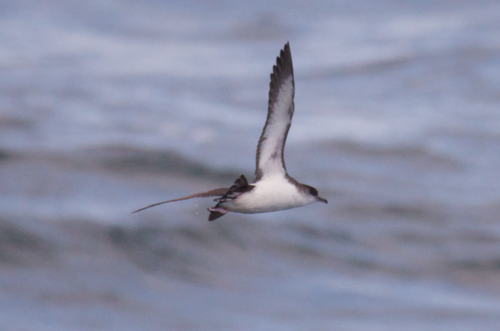 Manx Shearwater
 Barolo Shearwater
In short
The most reliable field mark to separate Manx Shearwater from Barolo Shearwater is the presence of a silvery panel on the upperwing of Barolo, which is absent in Manx. Barolo also shows a distinctly pale face with a dark eye, while Manx has a plainer, darker face. In flight, Barolo appears smaller, with shorter, more rounded wings and blue feet (if seen), compared to the longer, straighter wings and larger size of Manx. Both species are superficially similar black-and-white shearwaters, but careful attention to wing pattern, face contrast, and overall structure will separate them in most field conditions.
Identification tips
- Silvery upperwing panel: Barolo Shearwater shows a distinct silvery panel on the upperwing, visible in flight and diagnostic at all ages. Manx Shearwater lacks this feature; its upperwing is uniformly dark.
- Face pattern: Barolo has a pale face with a sharply contrasting dark eye, giving a masked look. Manx's face is plainer and darker overall, without strong contrast around the eye.
- Wing shape and flight style: Barolo's wings are shorter and more rounded, resulting in a more fluttery, less direct flight. Manx has longer, straighter wings, held stiffly at right angles, creating a 'flying cross' silhouette and a more powerful, gliding flight.
- Size and bulk: Manx is noticeably larger and heavier-bodied than Barolo. In mixed flocks or side-by-side, Barolo will look smaller and more delicate.
- Feet color: Barolo has blue feet, which may be visible when perched or in close flight views. Manx's feet are not blue.
- Underpart contrast: Both species have white underparts and dark upperparts, but Manx's division is more even and lacks the silvery upperwing panel of Barolo.
- Bill and head shape: Not described in detail in the sources, but Barolo's smaller size may be reflected in a finer bill and proportionally smaller head.
- Habitat and range: If observed near breeding colonies, location is a strong clue: Barolo breeds only in the Azores and Canaries, while Manx breeds in the UK, Ireland, and nearby northern Atlantic islands.
- Behavior at colonies: Manx visits colonies only at night, while Barolo may be active during the day.
- Flight jizz: Manx typically flies with fewer wingbeats and more gliding, while Barolo may appear more active and fluttery.
- Pitfalls: Overlapping black-and-white pattern can cause confusion, especially at distance. Always look for the silvery upperwing panel and facial contrast for Barolo.
- Age/season: No age-specific differences are detailed, so the above marks apply to both adults and immatures.
- Sex: No sexual dimorphism is described; these marks work for both sexes.
- Voice: Not described in the sources; do not rely on vocalizations for separation based on available information.
- Context: If seen from a boat in Macaronesia, Barolo is far more likely; in northern Atlantic waters, Manx is dominant.
Size
Manx Shearwater is the larger of the two, with a body mass around 521 g [wikidata], a length of 30–38 cm, and a wingspan of 76–89 cm [wikipedia]. Barolo Shearwater is distinctly smaller, though exact mass is not given here, and is described as a 'small shearwater.' In direct comparison, Manx will look bulkier and longer-winged, while Barolo appears daintier and more compact, especially in flight.
Plumage
For all ages, Barolo Shearwater shows a silvery panel on the upperwing, a key feature not present in Manx. Barolo's face is noticeably paler with a sharply contrasting dark eye, while Manx has a more uniformly dark face. Both have black upperparts and white underparts, but Manx lacks the silvery upperwing panel and has a more even black-and-white division. Juvenile and immature plumages are not detailed separately in the sources, so these contrasts apply to adults and likely to immatures as well. Barolo also has blue feet, which may be visible at close range or in good light, while Manx's feet are not blue.
Behaviour
Both species exhibit typical 'shearing' flight, but Manx Shearwater's flight is described as more direct, with stiff, straight wings held at right angles to the body, giving a 'flying cross' appearance. Barolo's flight is likely more fluttery due to its shorter, more rounded wings. Manx is known for flying low over the sea with minimal wingbeats, often appearing to alternate black and white as it banks. Barolo may be more active during daylight hours, while Manx visits colonies only at night.
Habitat
Manx Shearwater breeds mainly in the northeast Atlantic, especially off the UK, Ireland, and nearby islands, and migrates to the South Atlantic in winter. Barolo Shearwater breeds in Macaronesia (Azores and Canaries), and is not found as far north as the main Manx colonies. Both are entirely marine outside the breeding season, but if seen near breeding sites, location can be a strong clue: Barolo in Macaronesia, Manx in northern Atlantic islands.