

Mangrove Cuckoo vs Scaly-breasted Thrasher
Coccyzus minor versus Allenia fusca
Play a quiz with Mangrove Cuckoo and Scaly-breasted Thrasher
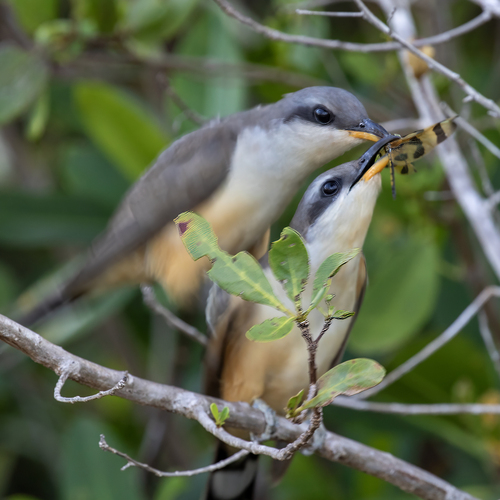 Mangrove Cuckoo
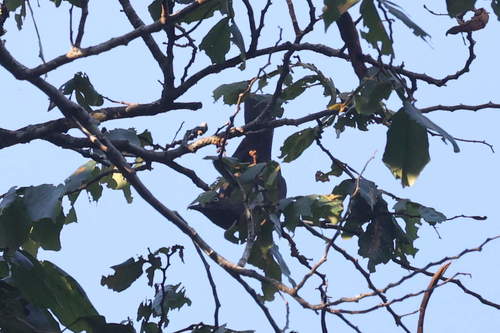 Scaly-breasted Thrasher
In short
The most reliable field mark to separate Mangrove Cuckoo from Scaly-breasted Thrasher is the presence of a bold black facial mask and buffy underparts on the cuckoo, versus the thrasher's scaly-marked whitish underparts and lack of a facial mask. In flight or perched, the cuckoo’s long tail with black-and-white underside and yellow eye-ring stand out, while the thrasher shows a single white wing bar and white-tipped tail feathers. Bill shape is also key: the cuckoo’s bill is long, black with yellow on the lower mandible, and strongly decurved, while the thrasher’s is shorter, only slightly decurved, and lacks strong color contrast. Both are similar in size, so focus on face, underparts, and bill for a confident ID.
Identification tips
- Facial mask (all ages): Mangrove Cuckoo has a bold black facial mask; Scaly-breasted Thrasher does not. This is the quickest way to separate them if the head is visible.
- Underparts color and pattern (all ages): Cuckoo shows plain buffy underparts, while thrasher has whitish underparts with bold gray-brown scalloping or 'scaly' marks, especially on the chest and flanks. The scaly pattern is unique to the thrasher.
- Bill shape and color (all ages): Cuckoo’s bill is long, strongly decurved, black above with yellow on the lower mandible. Thrasher’s bill is shorter, only slightly decurved, and lacks strong color contrast.
- Eye-ring (all ages): Cuckoo has a conspicuous yellow eye-ring; thrasher does not.
- Tail pattern (all ages): Cuckoo’s tail is long, brown above, and black-and-white below. Thrasher’s tail is darker brownish-black with white tips on the outer feathers, but not black-and-white underneath.
- Wing bar (all ages): Thrasher shows a single white wing bar on the folded wing; cuckoo lacks any wing bars.
- Overall coloration (all ages): Cuckoo is brown above with buffy below; thrasher is gray-brown above with a reddish rump and whitish, heavily marked underparts.
- Head shape and jizz (all ages): Cuckoo’s head appears sleeker with a more pronounced bill curve; thrasher’s head is rounder, more thrush-like.
- Posture (all ages): Cuckoo often appears elongated and horizontal when perched; thrasher is more upright, like a thrush.
- Vocalizations (all ages): Listen for the cuckoo’s repeated guttural 'gawk' calls versus the thrasher’s softer, more varied and melodic song.
- Habitat (all ages): If in dense mangroves, cuckoo is more likely; in drier or upland scrub, thrasher is more likely, but overlap can occur.
- Tail length (all ages): Cuckoo’s tail is proportionally longer, often extending well past the wingtips when perched.
- Subspecies variation (thrasher): All thrasher subspecies retain the scaly underparts and wing bar, but some are paler or darker above. Do not let this variation confuse you if the underparts pattern is visible.
- No age-specific flight marks: Neither species shows distinctive juvenile or immature upperwing patterns, so focus on facial and underpart marks regardless of age.
- Avoid size as a separator: Both species are nearly identical in mass and similar in length; do not rely on perceived size for identification.
Size
Both species are very close in size and mass: Mangrove Cuckoo averages 66 g and Scaly-breasted Thrasher 68 g [wikidata]. The cuckoo is slightly longer (28–34 cm vs. 23 cm for the thrasher), but this difference is subtle in the field. Neither species is notably bulkier or more slender than the other, so size alone is not a reliable separator.
Plumage
-
Juvenile/immature wing pattern: No age-specific upperwing or flight pattern marks are described for either species in the sources, so focus on adult plumage for separation.
-
Mangrove Cuckoo (adult): Shows a brown upper body, black facial mask, yellow eye-ring, and buffy underparts. The tail is long, brown above, and strikingly black-and-white below. The bill is black above with yellow on the lower mandible and strongly curved. No wing bars.
-
Scaly-breasted Thrasher (adult): Has a dark gray-brown head and upperparts with a reddish tinge on the rump, and a darker brownish-black tail with white tips on the outer feathers. The folded wing shows a single white bar. Underparts are whitish with bold gray-brown scalloping or 'scaly' marks, especially on the chest and flanks. The bill is shorter, only slightly decurved, and lacks the strong color contrast of the cuckoo. No facial mask or yellow eye-ring.
-
Subspecies variation (thrasher): Some subspecies are paler or darker, but all retain the scaly underparts and white wing bar.
Behaviour
No strong behavioral differences are described in the sources. Both species are likely to be seen perched or moving through dense vegetation. The cuckoo may appear more elongated and deliberate in movement, while the thrasher may resemble a large thrush in posture and foraging style, but these are subtle and not always reliable in the field.
Habitat
Mangrove Cuckoo is typically found in Neotropical mangrove habitats [wikipedia], while Scaly-breasted Thrasher is widespread in the Lesser Antilles [wikipedia]. Both can occur in dense, shrubby areas, but the cuckoo is more tightly associated with mangroves. If seen in classic mangrove habitat, cuckoo is more likely, but habitat overlap can occur, so do not rely solely on this.
Voice
Mangrove Cuckoo gives a guttural 'gawk gawk gawk gawk gauk gauk' and sometimes a single 'whit' [wikipedia]. Scaly-breasted Thrasher sings a series of varied notes and phrases, reminiscent of a mockingbird but softer and slower [wikipedia]. The cuckoo’s call is more repetitive and less musical, while the thrasher’s is more complex and variable. If you hear a repeated, harsh call, think cuckoo; if you hear a softer, more melodious and varied song, think thrasher.