
Motmot

Mangrove Cuckoo vs Grey Trembler

Coccyzus minor versus Cinclocerthia gutturalis

Play a quiz with Mangrove Cuckoo and Grey Trembler
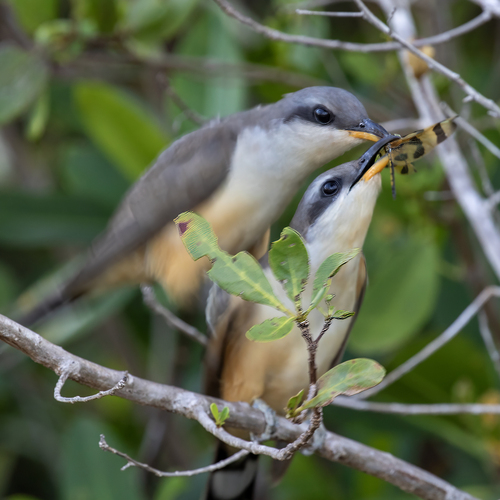
Mangrove Cuckoo (Coccyzus minor) Mangrove Cuckoo
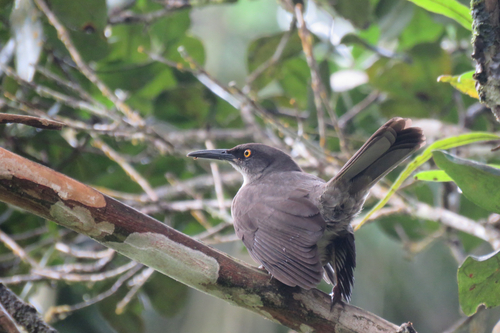
Grey Trembler (Cinclocerthia gutturalis) Grey Trembler

Media

Loading…

In short

The most reliable field mark to separate Mangrove Cuckoo from Grey Trembler is the Mangrove Cuckoo’s bold black facial mask and yellow eye-ring, which are absent in the Grey Trembler. Mangrove Cuckoo also has buffy underparts and a long tail with black-and-white patterning below, while Grey Trembler is overall gray-brown with a buffy white throat and breast center, lacking any facial mask. Structurally, the cuckoo’s bill is strongly decurved and bicolored (black above, yellow below), whereas the trembler’s bill is long, slightly downcurved, and uniform in color. Juvenile Grey Tremblers are browner and have a mottled chest, which can be a pitfall. Both species are similar in size, but their behavior and posture are very different: Mangrove Cuckoo is more upright and deliberate, while Grey Trembler is often seen shivering its wings and moving actively through vegetation.

Identification tips

  1. Facial Mask (Adults): Mangrove Cuckoo shows a bold black facial mask through the eye, absent in Grey Trembler of all ages. If you see a mask, it is the cuckoo.
  2. Eye-ring: Mangrove Cuckoo has a clear yellow eye-ring, while Grey Trembler does not.
  3. Bill Shape and Color: Mangrove Cuckoo’s bill is strongly decurved and bicolored (black above, yellow below); Grey Trembler’s bill is long, slightly downcurved, and uniform in color, with the female’s bill longer than the male’s.
  4. Tail Pattern: Mangrove Cuckoo’s tail is brown above and strikingly black-and-white below. Grey Trembler’s tail is plain gray-brown above and below, lacking any bold pattern.
  5. Underparts: Mangrove Cuckoo has buffy underparts; Grey Trembler has buffy white on throat and central breast, but the flanks are more cinnamon or olive-tinged. Juvenile tremblers are browner and mottled on the chest, but never as cleanly buff as the cuckoo.
  6. Upperparts: Both are brown or gray-brown above, but the cuckoo is warmer brown, while the trembler is more grayish, especially in the subspecies macrorhyncha.
  7. Behavior: Grey Trembler often shivers or trembles its wings in a distinctive display, which Mangrove Cuckoo never does. If you see this behavior, it is diagnostic for trembler.
  8. Posture: Mangrove Cuckoo perches upright and moves slowly; Grey Trembler is more horizontal, active, and restless.
  9. Habitat: Mangrove Cuckoo is found in mangroves and coastal thickets; Grey Trembler is only on Martinique and Saint Lucia, in a variety of forests. If you are not on these islands, it is not a trembler.
  10. Voice: Mangrove Cuckoo’s guttural "gawk gawk gawk" is distinctive. If you hear this, it is the cuckoo. Trembler’s song is not described here.
  11. Juvenile Pitfall: Juvenile Grey Trembler is browner and mottled below, which could be confused with the buffy underparts of the cuckoo, but always lacks the facial mask and tail pattern.
  12. Sex Differences: Only the trembler shows sexual dimorphism in bill length (female longer), but this is subtle and not a primary field mark.
  13. Flight: No distinctive flight or wing pattern is described for either species; rely on head and tail pattern.
  14. Local Abundance: Grey Trembler is only found on Martinique and Saint Lucia and is locally common there; Mangrove Cuckoo is more widespread in the Neotropics but less common overall.
  15. Common Pitfall: Overlooking the facial mask of the cuckoo or the trembling behavior of the trembler leads to most misidentifications. Always check for these first.

Size

Both species are very close in size and mass, with Mangrove Cuckoo averaging 66 g and Grey Trembler 69 g [wikidata]. Mangrove Cuckoo is slightly longer (28–34 cm) compared to Grey Trembler (23–26 cm), but this difference is subtle in the field. Wingspan is only given for the cuckoo (38–43 cm), but the overall impression is that both are medium-sized, long-tailed birds. Size alone is not a reliable separator between these two.

Plumage

Adult Mangrove Cuckoo is best recognized by its brown upperparts, bold black facial mask, yellow eye-ring, and buffy underparts. The tail is long, brown above, and strikingly black-and-white below. The bill is black above and yellow below. In contrast, adult Grey Trembler is warm gray-brown above with a slightly darker face (but no mask), buffy white throat and central breast, and paler cinnamon or olive-tinged flanks. The trembler’s bill is long and slightly downcurved, with females having a longer bill. Juvenile Grey Trembler is browner overall and has a mottled chest, which can be confused with the buffy underparts of the cuckoo, but lacks the facial mask and tail pattern. No distinctive age-specific wing pattern is described for either species, so separation relies on head and underpart coloration, facial markings, and tail pattern.

Behaviour

Mangrove Cuckoo tends to perch upright and move deliberately through mangroves and dense thickets, often remaining still for long periods. In contrast, Grey Trembler is highly active, foraging from ground to canopy, and is famous for its wing-shivering display: wings drooped and rapidly quivering away from the body. This trembling behavior is unique and diagnostic for the trembler. The cuckoo does not show this behavior.

Habitat

Mangrove Cuckoo is typically found in mangroves and dense coastal thickets throughout the Neotropics. Grey Trembler is restricted to the islands of Martinique and Saint Lucia, where it inhabits a range of forested habitats from lowland to montane, often foraging in tangles and epiphyte-laden trees. If the bird is seen outside of these islands, it is not a Grey Trembler. Habitat overlap is minimal except in dense forested areas on these islands.

Voice

Mangrove Cuckoo gives a guttural "gawk gawk gawk gawk gauk gauk" and sometimes a single "whit" note. Grey Trembler’s vocalizations are not described in the provided notes, so voice is only diagnostic if the cuckoo’s distinctive call is heard.

Submit a better description

Use the same sections as the comparison. Your text is published immediately.

The most reliable field mark to separate Mangrove Cuckoo from Grey Trembler is the Mangrove Cuckoo’s bold black facial mask and yellow eye-ring, which are absent in the Grey Trembler. Mangrove Cuckoo also has buffy underparts and a long tail with black-and-white patterning below, while Grey Trembler is overall gray-brown with a buffy white throat and breast center, lacking any facial mask. Structurally, the cuckoo’s bill is strongly decurved and bicolored (black above, yellow below), whereas the trembler’s bill is long, slightly downcurved, and uniform in color. Juvenile Grey Tremblers are browner and have a mottled chest, which can be a pitfall. Both species are similar in size, but their behavior and posture are very different: Mangrove Cuckoo is more upright and deliberate, while Grey Trembler is often seen shivering its wings and moving actively through vegetation.

  1. Facial Mask (Adults): Mangrove Cuckoo shows a bold black facial mask through the eye, absent in Grey Trembler of all ages. If you see a mask, it is the cuckoo.
  2. Eye-ring: Mangrove Cuckoo has a clear yellow eye-ring, while Grey Trembler does not.
  3. Bill Shape and Color: Mangrove Cuckoo’s bill is strongly decurved and bicolored (black above, yellow below); Grey Trembler’s bill is long, slightly downcurved, and uniform in color, with the female’s bill longer than the male’s.
  4. Tail Pattern: Mangrove Cuckoo’s tail is brown above and strikingly black-and-white below. Grey Trembler’s tail is plain gray-brown above and below, lacking any bold pattern.
  5. Underparts: Mangrove Cuckoo has buffy underparts; Grey Trembler has buffy white on throat and central breast, but the flanks are more cinnamon or olive-tinged. Juvenile tremblers are browner and mottled on the chest, but never as cleanly buff as the cuckoo.
  6. Upperparts: Both are brown or gray-brown above, but the cuckoo is warmer brown, while the trembler is more grayish, especially in the subspecies macrorhyncha.
  7. Behavior: Grey Trembler often shivers or trembles its wings in a distinctive display, which Mangrove Cuckoo never does. If you see this behavior, it is diagnostic for trembler.
  8. Posture: Mangrove Cuckoo perches upright and moves slowly; Grey Trembler is more horizontal, active, and restless.
  9. Habitat: Mangrove Cuckoo is found in mangroves and coastal thickets; Grey Trembler is only on Martinique and Saint Lucia, in a variety of forests. If you are not on these islands, it is not a trembler.
  10. Voice: Mangrove Cuckoo’s guttural "gawk gawk gawk" is distinctive. If you hear this, it is the cuckoo. Trembler’s song is not described here.
  11. Juvenile Pitfall: Juvenile Grey Trembler is browner and mottled below, which could be confused with the buffy underparts of the cuckoo, but always lacks the facial mask and tail pattern.
  12. Sex Differences: Only the trembler shows sexual dimorphism in bill length (female longer), but this is subtle and not a primary field mark.
  13. Flight: No distinctive flight or wing pattern is described for either species; rely on head and tail pattern.
  14. Local Abundance: Grey Trembler is only found on Martinique and Saint Lucia and is locally common there; Mangrove Cuckoo is more widespread in the Neotropics but less common overall.
  15. Common Pitfall: Overlooking the facial mask of the cuckoo or the trembling behavior of the trembler leads to most misidentifications. Always check for these first.

Both species are very close in size and mass, with Mangrove Cuckoo averaging 66 g and Grey Trembler 69 g [wikidata]. Mangrove Cuckoo is slightly longer (28–34 cm) compared to Grey Trembler (23–26 cm), but this difference is subtle in the field. Wingspan is only given for the cuckoo (38–43 cm), but the overall impression is that both are medium-sized, long-tailed birds. Size alone is not a reliable separator between these two.

Adult Mangrove Cuckoo is best recognized by its brown upperparts, bold black facial mask, yellow eye-ring, and buffy underparts. The tail is long, brown above, and strikingly black-and-white below. The bill is black above and yellow below. In contrast, adult Grey Trembler is warm gray-brown above with a slightly darker face (but no mask), buffy white throat and central breast, and paler cinnamon or olive-tinged flanks. The trembler’s bill is long and slightly downcurved, with females having a longer bill. Juvenile Grey Trembler is browner overall and has a mottled chest, which can be confused with the buffy underparts of the cuckoo, but lacks the facial mask and tail pattern. No distinctive age-specific wing pattern is described for either species, so separation relies on head and underpart coloration, facial markings, and tail pattern.

Mangrove Cuckoo tends to perch upright and move deliberately through mangroves and dense thickets, often remaining still for long periods. In contrast, Grey Trembler is highly active, foraging from ground to canopy, and is famous for its wing-shivering display: wings drooped and rapidly quivering away from the body. This trembling behavior is unique and diagnostic for the trembler. The cuckoo does not show this behavior.

Mangrove Cuckoo is typically found in mangroves and dense coastal thickets throughout the Neotropics. Grey Trembler is restricted to the islands of Martinique and Saint Lucia, where it inhabits a range of forested habitats from lowland to montane, often foraging in tangles and epiphyte-laden trees. If the bird is seen outside of these islands, it is not a Grey Trembler. Habitat overlap is minimal except in dense forested areas on these islands.

Mangrove Cuckoo gives a guttural "gawk gawk gawk gawk gauk gauk" and sometimes a single "whit" note. Grey Trembler’s vocalizations are not described in the provided notes, so voice is only diagnostic if the cuckoo’s distinctive call is heard.

Discard your changes?

You have unsaved edits. If you leave now, those changes will be lost.

Mangrove Cuckoo · Grey Trembler · My Tricky Birds