

Malachite Kingfisher vs African Dwarf Kingfisher
Corythornis cristatus versus Ispidina lecontei
Play a quiz with Malachite Kingfisher and African Dwarf Kingfisher
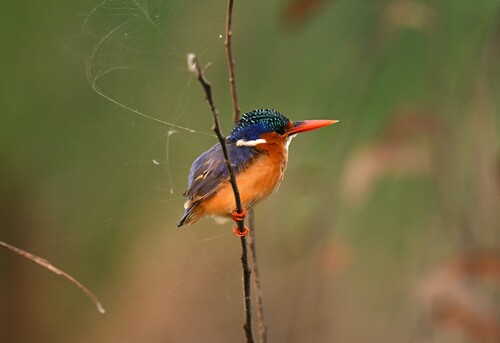 Malachite Kingfisher
 African Dwarf Kingfisher
In short
The most reliable field mark between Malachite Kingfisher and African Dwarf Kingfisher is the presence of a short blue-and-black crest on the Malachite, which is absent in the African Dwarf. Both are tiny, brilliantly colored kingfishers, but Malachite is slightly larger and more often seen near open water, while African Dwarf Kingfisher prefers dense forest. Juvenile Malachite Kingfishers are duller but still show the crest, while both species have similar rufous underparts and blue upperparts, making careful attention to head pattern and habitat essential. Bill and leg color also help, especially in adults.
Identification tips
- Crest presence: Malachite Kingfisher always shows a short blue-and-black crest, even in juveniles; African Dwarf Kingfisher lacks any crest. This is the single most reliable mark if you get a clear look at the head.
- Bill color: Adult Malachite has a reddish-orange bill, while juveniles have a black bill; African Dwarf typically has a dark bill at all ages. Bill color is useful but be cautious with young Malachites.
- Leg color: Malachite's legs are bright red; African Dwarf's leg color is not specified in the notes but is usually duller in field guides. Use with caution.
- Size and jizz: Malachite is slightly larger and bulkier with a longer bill, but both are very small. Size is best used in direct comparison or with experience.
- Head pattern: Look for the blue-and-black crest on Malachite; African Dwarf has a smooth, rounded crown with no crest.
- Upperparts color: Both are bright blue above, but Malachite's blue is more metallic and may show black banding or greenish tinge on the forehead; African Dwarf is blue but lacks the banded crest.
- Underparts: Both have rufous underparts and white on the throat, so this is not a useful separator.
- Throat and neck: Malachite shows a white throat patch and white on the rear neck sides, which may be less distinct in African Dwarf.
- Habitat: Malachite is almost always near open water, reeds, or slow streams; African Dwarf is a forest interior specialist and rarely seen in open aquatic habitats.
- Perching behavior: Malachite perches upright, tail down, often in the open; African Dwarf is more secretive and stays in dense cover.
- Flight: Malachite's flight is rapid and low over water, with whirring, rounded wings; African Dwarf's flight is less often observed but is typically within forest undergrowth.
- Juvenile confusion: Juvenile Malachite is duller but still crested; African Dwarf juveniles are also dull but never show a crest.
- Sex differences: Both species are sexually similar, so sex is not a useful separator.
- Season: Both species are resident; seasonal movement is not a reliable field mark.
- Pitfall: Do not rely solely on size or underpart color; focus on crest, bill color, and especially habitat context for the most reliable separation.
Size
Malachite Kingfisher is slightly larger, with a length of about 13–14 cm depending on region, compared to the African Dwarf Kingfisher, which is smaller and lighter (body mass ~10.3 g [wikidata]). In the field, Malachite can look noticeably bulkier and longer-billed, but both are among the smallest kingfishers in Africa. Size alone is not always reliable unless both species are seen together, but Malachite's slightly longer body and heavier jizz can be apparent with experience.
Plumage
- Juvenile/immature birds: Both species have duller versions of the adult plumage as juveniles. Malachite Kingfisher juveniles are specifically noted as duller but still show the short blue-and-black crest, which is absent in African Dwarf Kingfisher at all ages. No distinctive juvenile upperwing pattern is described for either species, so focus on head pattern and overall coloration.
- Adults: Malachite Kingfisher shows bright metallic blue upperparts, a short blue-and-black crest, rufous face and underparts, white throat patch, and white on the rear neck sides. The bill is reddish-orange in adults (black in juveniles), and legs are bright red. African Dwarf Kingfisher also has blue upperparts and rufous underparts but lacks the crest and has a proportionally shorter bill. Both sexes are similar in both species.
- Bill color: Malachite's bill is black in juveniles, reddish-orange in adults; African Dwarf's bill color is not detailed in the notes but is typically dark in field guides.
Behaviour
Malachite Kingfisher is often seen perched upright on low reeds or branches over water, tail pointed down, and makes rapid, low flights over ponds and slow streams. It uses regular perches for fishing and returns quickly after diving. African Dwarf Kingfisher's behavior is less detailed in the notes, but it is generally more secretive, foraging in dense forest undergrowth and less likely to be seen in open or over water. Malachite's behavior is more conspicuous and tied to open aquatic habitats.
Habitat
Malachite Kingfisher is strongly associated with reeds and aquatic vegetation near slow-moving water or ponds, and is widespread across Sub-Saharan Africa except for the driest regions. African Dwarf Kingfisher, by contrast, is a forest species, typically found in dense, shaded woodland and rarely near open water. If you see a tiny kingfisher in a forest interior, especially away from water, African Dwarf is much more likely; if it is in reeds or open water margins, Malachite is the default.
Malachite Kingfisher · African Dwarf Kingfisher · My Tricky Birds