

Motmot

Magpie-lark vs Broad-billed Flycatcher

Grallina cyanoleuca versus Myiagra ruficollis

Play a quiz with Magpie-lark and Broad-billed Flycatcher
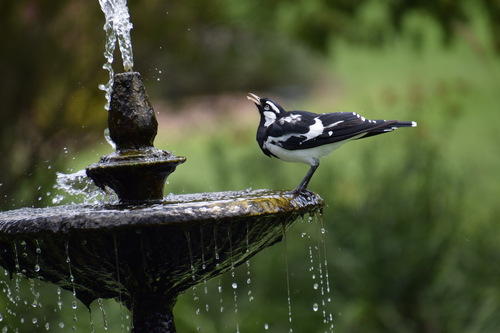
Magpie-lark (Grallina cyanoleuca) Magpie-lark
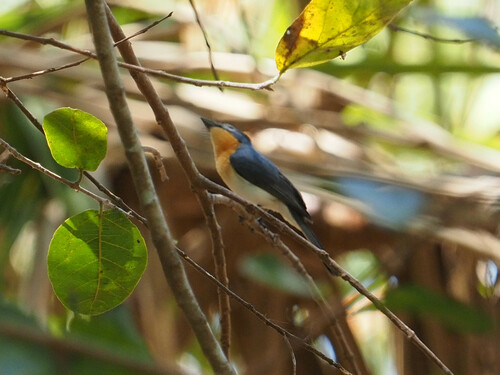
Broad-billed Flycatcher (Myiagra ruficollis) Broad-billed Flycatcher

Media

Loading…

In short

The most reliable field mark distinguishing Magpie-lark from Broad-billed Flycatcher is overall structure and plumage: Magpie-lark is a boldly black-and-white, medium-sized bird with a strong, upright stance, while Broad-billed Flycatcher is much smaller, plain, and more uniformly colored, with a noticeably broad bill. Juvenile Magpie-larks show the same striking contrast as adults, while Broad-billed Flycatchers are always much more subdued. In flight, the Magpie-lark's white panels and sharp contrast are obvious, unlike the flycatcher's more muted pattern. Size and jizz are also strikingly different, with Magpie-lark being nearly five times heavier and much more robust. Habitat can help: Magpie-lark is often seen in open areas, while Broad-billed Flycatcher keeps to forested or mangrove edges.

Identification tips

  1. Size is a major clue: Magpie-lark is nearly five times heavier and much longer than Broad-billed Flycatcher. If the bird looks small, delicate, and flycatcher-like, it is not a magpie-lark.
  2. Bold black-and-white plumage: All ages and sexes of Magpie-lark show strong black-and-white contrast, especially on the face, throat, wings, and underparts. Broad-billed Flycatcher is always much plainer, lacking any sharp black-and-white pattern.
  3. Face pattern by sex and age: Adult male Magpie-lark has a black throat and white eyebrow; adult female has a white throat. Juveniles have a white throat (like the female) and a black eyestripe (like the male). Broad-billed Flycatcher never shows these patterns.
  4. White belly and throat: Magpie-lark always shows a white belly and, in most ages/sexes, a white throat. Broad-billed Flycatcher is more uniformly colored below, never with a sharply white belly or throat.
  5. Flight pattern: In flight, Magpie-lark flashes white in the wings and tail, visible at a distance. Broad-billed Flycatcher lacks any such contrasting flight pattern.
  6. Bill shape: Broad-billed Flycatcher has a noticeably broad, flat bill typical of monarch flycatchers, suited for catching insects in flight. Magpie-lark has a more conventional, pointed passerine bill.
  7. Perching behavior: Magpie-lark often perches upright in the open, on fences, wires, or on the ground. Broad-billed Flycatcher perches in the canopy or at forest edge, rarely in the open.
  8. Habitat context: If seen in open parkland, lawns, or urban areas, Magpie-lark is likely. If deep in mangroves, forest, or dense waterside scrub, Broad-billed Flycatcher is more probable.
  9. Territorial aggression: Magpie-lark may chase off larger birds or even people; Broad-billed Flycatcher is not aggressive and is more secretive.
  10. Vocalizations: Loud, melodious, duet calls indicate Magpie-lark. Quiet or unobtrusive calls (or silence) are more typical of Broad-billed Flycatcher.
  11. Jizz: Magpie-lark is upright, robust, and struts or runs on the ground. Broad-billed Flycatcher is light, flits between perches, and rarely walks on the ground.
  12. Upperwing pattern in juveniles: Juvenile Magpie-lark shows the same bold contrast as adults; Broad-billed Flycatcher juveniles are plain and lack any strong pattern.
  13. Sex differences: Only Magpie-lark shows clear sexual dimorphism in the face/throat pattern; Broad-billed Flycatcher does not.
  14. Confusion risk: At a distance, a quick glimpse of a small, dark bird in a tree could cause confusion, but the size, structure, and lack of bold white in the flycatcher should quickly rule out Magpie-lark.
  15. Regional context: Both species can occur in northern Australia, but Magpie-lark is much more widespread and common in open habitats, while Broad-billed Flycatcher is restricted to specific moist or forested areas.

Size

Magpie-lark is substantially larger and heavier (body mass ~47.5g) than Broad-billed Flycatcher (~10.1g). The Magpie-lark reaches 25–30 cm in length—about the size of a European blackbird—while the flycatcher is much smaller at 14–17 cm. This size gap is obvious in the field, even at a distance or in flight. Magpie-lark appears stocky and robust, whereas Broad-billed Flycatcher is dainty and light-bodied.

Plumage

Juvenile and adult Magpie-larks are always boldly pied in black and white, with a white belly and distinct face patterns: adult males have a black throat and white eyebrow, females have a white throat, and juveniles combine the female's white throat with the male's black eyestripe. These contrasts are visible at all ages and in all seasons. In flight, the Magpie-lark shows strong black-and-white wing and tail patterning. Broad-billed Flycatcher, by contrast, lacks any bold black-and-white patterning at any age; it is overall plain, with more uniform coloration and no sharp contrast between underparts and upperparts. The flycatcher never shows a white belly or throat sharply set off from dark upperparts. There are no age-specific wing or tail patterns in the flycatcher that could be confused with the magpie-lark's striking contrast.

Behaviour

Magpie-lark is often seen walking or running on open ground, perching upright and boldly in the open, and is highly territorial—sometimes attacking larger birds or even people. It is conspicuous and not shy. Broad-billed Flycatcher, on the other hand, is usually found flitting quietly in the canopy or at forest/mangrove edges, rarely venturing into open ground. It feeds by sallying for insects but is much less conspicuous and more retiring than the magpie-lark.

Habitat

Magpie-lark prefers open habitats such as parks, lawns, roadsides, and open woodland, often near water but not restricted to forest. It is common and visible in urban and rural open spaces throughout much of Australia. Broad-billed Flycatcher is found in moist forests, mangroves, and dense scrub near water, especially in northern Australia and adjacent islands. It avoids open ground and is rarely seen away from dense vegetation or the forest edge.

Voice

Magpie-lark is well known for its loud, melodious duet singing, with pairs producing alternating notes that can sound like a single bird to human ears. Its calls are sharp, repeated 'pee-wee' or 'pee-wit' notes, often given from exposed perches. Broad-billed Flycatcher's vocalizations are not described in detail in the sources, but it does not produce the loud, duet calls of the magpie-lark and is generally much quieter and less conspicuous vocally.

Submit a better description

Use the same sections as the comparison. Your text is published immediately.

The most reliable field mark distinguishing Magpie-lark from Broad-billed Flycatcher is overall structure and plumage: Magpie-lark is a boldly black-and-white, medium-sized bird with a strong, upright stance, while Broad-billed Flycatcher is much smaller, plain, and more uniformly colored, with a noticeably broad bill. Juvenile Magpie-larks show the same striking contrast as adults, while Broad-billed Flycatchers are always much more subdued. In flight, the Magpie-lark's white panels and sharp contrast are obvious, unlike the flycatcher's more muted pattern. Size and jizz are also strikingly different, with Magpie-lark being nearly five times heavier and much more robust. Habitat can help: Magpie-lark is often seen in open areas, while Broad-billed Flycatcher keeps to forested or mangrove edges.

  1. Size is a major clue: Magpie-lark is nearly five times heavier and much longer than Broad-billed Flycatcher. If the bird looks small, delicate, and flycatcher-like, it is not a magpie-lark.
  2. Bold black-and-white plumage: All ages and sexes of Magpie-lark show strong black-and-white contrast, especially on the face, throat, wings, and underparts. Broad-billed Flycatcher is always much plainer, lacking any sharp black-and-white pattern.
  3. Face pattern by sex and age: Adult male Magpie-lark has a black throat and white eyebrow; adult female has a white throat. Juveniles have a white throat (like the female) and a black eyestripe (like the male). Broad-billed Flycatcher never shows these patterns.
  4. White belly and throat: Magpie-lark always shows a white belly and, in most ages/sexes, a white throat. Broad-billed Flycatcher is more uniformly colored below, never with a sharply white belly or throat.
  5. Flight pattern: In flight, Magpie-lark flashes white in the wings and tail, visible at a distance. Broad-billed Flycatcher lacks any such contrasting flight pattern.
  6. Bill shape: Broad-billed Flycatcher has a noticeably broad, flat bill typical of monarch flycatchers, suited for catching insects in flight. Magpie-lark has a more conventional, pointed passerine bill.
  7. Perching behavior: Magpie-lark often perches upright in the open, on fences, wires, or on the ground. Broad-billed Flycatcher perches in the canopy or at forest edge, rarely in the open.
  8. Habitat context: If seen in open parkland, lawns, or urban areas, Magpie-lark is likely. If deep in mangroves, forest, or dense waterside scrub, Broad-billed Flycatcher is more probable.
  9. Territorial aggression: Magpie-lark may chase off larger birds or even people; Broad-billed Flycatcher is not aggressive and is more secretive.
  10. Vocalizations: Loud, melodious, duet calls indicate Magpie-lark. Quiet or unobtrusive calls (or silence) are more typical of Broad-billed Flycatcher.
  11. Jizz: Magpie-lark is upright, robust, and struts or runs on the ground. Broad-billed Flycatcher is light, flits between perches, and rarely walks on the ground.
  12. Upperwing pattern in juveniles: Juvenile Magpie-lark shows the same bold contrast as adults; Broad-billed Flycatcher juveniles are plain and lack any strong pattern.
  13. Sex differences: Only Magpie-lark shows clear sexual dimorphism in the face/throat pattern; Broad-billed Flycatcher does not.
  14. Confusion risk: At a distance, a quick glimpse of a small, dark bird in a tree could cause confusion, but the size, structure, and lack of bold white in the flycatcher should quickly rule out Magpie-lark.
  15. Regional context: Both species can occur in northern Australia, but Magpie-lark is much more widespread and common in open habitats, while Broad-billed Flycatcher is restricted to specific moist or forested areas.

Magpie-lark is substantially larger and heavier (body mass ~47.5g) than Broad-billed Flycatcher (~10.1g). The Magpie-lark reaches 25–30 cm in length—about the size of a European blackbird—while the flycatcher is much smaller at 14–17 cm. This size gap is obvious in the field, even at a distance or in flight. Magpie-lark appears stocky and robust, whereas Broad-billed Flycatcher is dainty and light-bodied.

Juvenile and adult Magpie-larks are always boldly pied in black and white, with a white belly and distinct face patterns: adult males have a black throat and white eyebrow, females have a white throat, and juveniles combine the female's white throat with the male's black eyestripe. These contrasts are visible at all ages and in all seasons. In flight, the Magpie-lark shows strong black-and-white wing and tail patterning. Broad-billed Flycatcher, by contrast, lacks any bold black-and-white patterning at any age; it is overall plain, with more uniform coloration and no sharp contrast between underparts and upperparts. The flycatcher never shows a white belly or throat sharply set off from dark upperparts. There are no age-specific wing or tail patterns in the flycatcher that could be confused with the magpie-lark's striking contrast.

Magpie-lark is often seen walking or running on open ground, perching upright and boldly in the open, and is highly territorial—sometimes attacking larger birds or even people. It is conspicuous and not shy. Broad-billed Flycatcher, on the other hand, is usually found flitting quietly in the canopy or at forest/mangrove edges, rarely venturing into open ground. It feeds by sallying for insects but is much less conspicuous and more retiring than the magpie-lark.

Magpie-lark prefers open habitats such as parks, lawns, roadsides, and open woodland, often near water but not restricted to forest. It is common and visible in urban and rural open spaces throughout much of Australia. Broad-billed Flycatcher is found in moist forests, mangroves, and dense scrub near water, especially in northern Australia and adjacent islands. It avoids open ground and is rarely seen away from dense vegetation or the forest edge.

Magpie-lark is well known for its loud, melodious duet singing, with pairs producing alternating notes that can sound like a single bird to human ears. Its calls are sharp, repeated 'pee-wee' or 'pee-wit' notes, often given from exposed perches. Broad-billed Flycatcher's vocalizations are not described in detail in the sources, but it does not produce the loud, duet calls of the magpie-lark and is generally much quieter and less conspicuous vocally.

Discard your changes?

You have unsaved edits. If you leave now, those changes will be lost.

Magpie-lark · Broad-billed Flycatcher · My Tricky Birds