

Long-tailed Thrush vs Scaly Thrush
Zoothera dixoni versus Zoothera dauma
Play a quiz with Long-tailed Thrush and Scaly Thrush
 Long-tailed Thrush
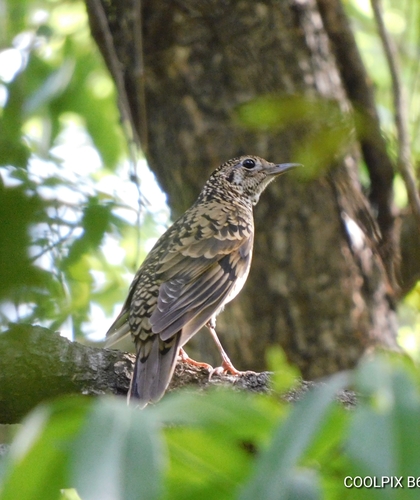 Scaly Thrush
In short
The most reliable field mark to separate Scaly Thrush from Long-tailed Thrush is the bold black band on the white underwing, visible in flight on Scaly Thrush of all ages—a feature not described for Long-tailed Thrush. Both are medium-large Zoothera thrushes of montane forests in the Himalayas and southwest China, but Scaly Thrush shows distinctive black scaling on a pale background, while Long-tailed Thrush is less well described but lacks mention of such strong scaling. Structure and jizz are similar, so focus on underwing pattern and overall plumage contrast. Habitat overlap is significant, so visual ID is key.
Identification tips
- Underwing pattern in flight: Scaly Thrush always shows a bold black band on the white underwing, visible when the bird takes off or flies overhead. Long-tailed Thrush lacks this feature (not described for the species), making this the single best separator in flight for all ages.
- Body scaling: Scaly Thrush has prominent black scaling on a pale white or yellowish background over the whole body, giving a scaly look. Long-tailed Thrush does not show such strong scaling, appearing plainer or less patterned.
- Overall coloration: If you see a thrush with a very pale, strongly marked body, suspect Scaly Thrush. If the bird is more uniformly colored and lacks bold scaling, Long-tailed Thrush is more likely.
- Sex and age: Both species have similar sexes and no strong age-related differences in the field marks described, so focus on the underwing and body pattern.
- Song: If you hear a loud, far-carrying mechanical whistle with long pauses, this is diagnostic for Scaly Thrush male. Long-tailed Thrush song is not described, so use this only as a positive for Scaly Thrush.
- Habitat: Both occur in similar montane forests and high-altitude shrubland in the Himalayas and southwest China. Do not rely on habitat for separation.
- Size and structure: Both are medium-large thrushes with similar structure; size is not a reliable field mark.
- Perched vs. flight views: In perched birds, focus on the scaling and overall contrast. In flight, always look for the underwing pattern.
- Confusion risk: If the bird is not showing its underwing and is in deep shade, rely on the degree of scaling. If you glimpse the underwing, the presence or absence of the black band is decisive.
- Season: Scaly Thrush may descend to lower altitudes in winter, but both species can overlap in range and elevation, so do not use season alone for ID.
- Subspecies and splits: Scaly Thrush has several closely related taxa, but in the Himalayas and southwest China, the nominate Z. d. dauma is the relevant form; Long-tailed Thrush is more restricted in range.
- Flock context: Both are usually seen singly or in pairs, not in mixed flocks, so flocking behavior does not help.
- Bill and tail: No distinctive differences in bill shape or tail length are described in the sources, so these are not reliable for separation.
- Lighting conditions: In poor light, scaling may be hard to see; try to observe the bird in flight for the underwing pattern.
- When in doubt: If you cannot see the underwing and the scaling is not obvious, record as Zoothera sp. and try for better views.
Size
Both species are medium-large thrushes. Long-tailed Thrush has a recorded body mass of about 90 g [wikidata], which is typical for Zoothera thrushes. Scaly Thrush is described as 27–31 cm long [wikipedia], but no direct mass is given; both are similar in bulk and length, so size alone is not a reliable separator in the field.
Plumage
For all ages, Scaly Thrush shows a striking black band on the white underwing in flight—a key diagnostic mark within Zoothera. Its body plumage is heavily marked with black scaling on a pale white or yellowish background, giving a scaly appearance. Long-tailed Thrush lacks any mention of a black underwing band or strong scaling; its plumage is less well detailed, but the absence of these marks is notable. Both sexes are similar in Scaly Thrush; no sex-specific notes for Long-tailed Thrush. No age-specific upperwing or juvenile marks are described for either species beyond the underwing pattern in Scaly Thrush.
Behaviour
Both species are typical Zoothera thrushes in behavior, foraging on the forest floor and being shy and elusive. No distinct behavioral differences are noted in the sources.
Habitat
Both species inhabit subtropical or tropical moist montane forests and high-altitude shrubland in the Himalayas and southwest China. Scaly Thrush may also descend to foothills in winter as an altitudinal migrant. Habitat overlap is substantial, so habitat alone is not a reliable separator.
Voice
Scaly Thrush males sing a loud, mechanical whistle with 5–10 second pauses between each 1-second phrase ("tuuu....tuuu....tuuu"). No vocal description is provided for Long-tailed Thrush, so voice is only useful if Scaly Thrush is singing.