

Long-billed Murrelet vs Kittlitz's Murrelet
Brachyramphus perdix versus Brachyramphus brevirostris
Play a quiz with Long-billed Murrelet and Kittlitz's Murrelet
 Long-billed Murrelet
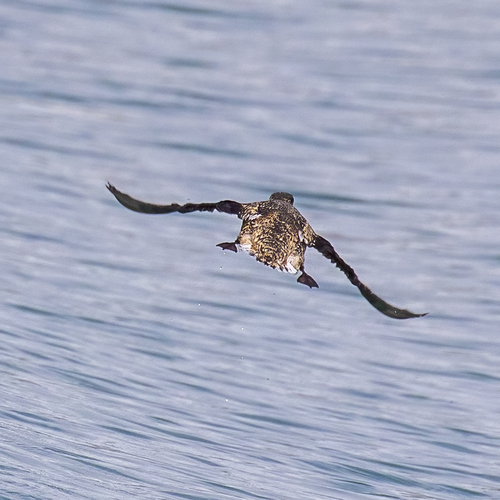 Kittlitz's Murrelet
In short
The most reliable field mark to separate Long-billed Murrelet from Kittlitz's Murrelet is the bill: Long-billed shows a distinctly longer, slender black bill, while Kittlitz's has a notably shorter bill. In breeding plumage, Long-billed Murrelet has a paler throat and weaker scaly pattern, while Kittlitz's is more uniformly greyish-brown. In non-breeding (winter) plumage, Long-billed lacks the white collar that Kittlitz's can show. Both are compact auks with pointed wings, but subtle differences in structure and plumage, especially around the head and throat, are key. Immature and winter birds are especially challenging, so bill length and throat/face pattern are the most practical field marks.
Identification tips
- Bill length and shape: Long-billed Murrelet always has a noticeably longer, slender black bill; Kittlitz's Murrelet has a short, stubby bill. This is the most consistent field mark at all ages and seasons.
- Breeding plumage throat: Long-billed Murrelet shows a pale throat, contrasting with the darker face and breast; Kittlitz's Murrelet has a more uniform greyish-brown head and throat without a pale area. Use this in spring and summer.
- Breeding plumage scaling: Long-billed Murrelet has a weak scaly pattern on the upperparts due to pale feather edges, but Kittlitz's is more evenly colored and lacks this scaly effect.
- Non-breeding (winter) collar: Kittlitz's Murrelet may show a white collar in winter, which Long-billed Murrelet never has. If you see a white collar, it's not Long-billed.
- Crown and nape in winter: Both have dark crowns and napes in winter, but Long-billed's is more sharply defined against the white underparts.
- Eye ring: Long-billed Murrelet has a distinct white eye ring, which may be less obvious or absent in Kittlitz's, but this is a subtle mark and not always visible in the field.
- Size and bulk: Long-billed is slightly larger and heavier, but this is only apparent with direct comparison or experience.
- Jizz and posture: Both are compact and chunky with short tails and pointed wings; differences are subtle and not reliable for quick ID.
- Flight style: Both species have rapid wingbeats and direct flight; no consistent difference noted.
- Habitat context: In Alaska, a murrelet near tidewater glaciers or on barren mountain slopes is likely Kittlitz's. A murrelet found inland, away from the coast, especially in North America or Europe, is almost certainly Long-billed.
- Vagrancy: Long-billed Murrelet is prone to appearing far from its normal range, including inland lakes and rivers; Kittlitz's is not known for such vagrancy.
- Nesting context: Not a field mark, but if you have information about nesting on bare, snow-adjacent slopes, this points to Kittlitz's.
- Plumage pitfalls: Both species can appear similar in poor light or at distance; always check bill length and throat pattern before relying on overall color.
- Immature/first-winter birds: No unique upperwing pattern differences are described; rely on bill and head/throat pattern for these ages.
- Voice: No diagnostic vocal differences are described in the available sources; do not use voice for separation.
Size
Both species are similar in overall length, around 25 cm, but Long-billed Murrelet is slightly larger and about 20% heavier than Kittlitz's Murrelet [wikipedia]. In the field, this difference is subtle and rarely diagnostic unless birds are side by side. The bill, however, is noticeably longer and more slender in Long-billed, while Kittlitz's has a shorter, stubbier bill. Body shape is similarly chunky in both, with short tails and pointed wings.
Plumage
For all ages and especially in flight, both species have pointed wings and dark upperparts, but there are key differences by season:
- Breeding plumage (adults): Long-billed Murrelet is mainly brown with pale feather edges, creating a weak scaly look, and shows a pale throat. Kittlitz's Murrelet is more uniformly greyish-brown, matching its preference for nesting on bare ground, and lacks the pale throat. The scaly effect is much less pronounced in Kittlitz's.
- Non-breeding (winter) plumage: Long-billed Murrelet is white below with a black crown, nape, back, and wings, and lacks a white collar. Kittlitz's Murrelet adopts a more classic black-and-white seabird look and can show a white collar, which Long-billed never has. Both have white underparts, but the head pattern is a key point.
- Immature/first-winter birds: No specific upperwing pattern differences are described in the sources, so focus on bill length and head/throat pattern for these ages.
Both species have a white eye ring, but this is more consistently noted in Long-billed Murrelet.
Behaviour
Both species are typically solitary or in pairs, rarely forming large flocks. Long-billed Murrelet is prone to vagrancy and may be found far inland or on freshwater lakes, while Kittlitz's Murrelet is more closely tied to coastal waters, especially near tidewater glaciers. In flight, both appear compact with rapid wingbeats and pointed wings. Nesting behavior is not a field mark, but both species nest away from colonies.
Habitat
Long-billed Murrelet breeds from Kamchatka to the Sea of Okhotsk and winters mainly around northern Japan, sometimes wandering far inland or to distant coasts. Kittlitz's Murrelet is found off Alaska and eastern Siberia, breeding on mountain slopes near snowfields and foraging near tidewater glaciers. If seen inland in North America or Europe, Long-billed is vastly more likely due to its vagrancy. In Alaska, Kittlitz's is more likely near glaciers or barren coastal slopes.
Long-billed Murrelet · Kittlitz's Murrelet · My Tricky Birds