

Long-billed Curlew vs Marbled Godwit
Numenius americanus versus Limosa fedoa
Play a quiz with Long-billed Curlew and Marbled Godwit
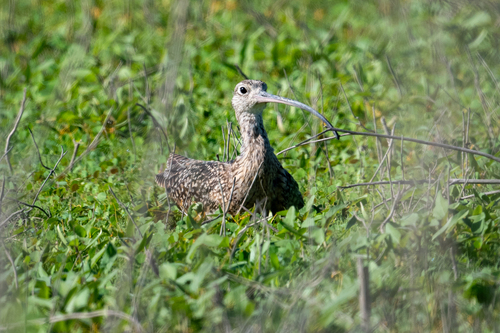 Long-billed Curlew
 Marbled Godwit
In short
The most reliable field mark between Long-billed Curlew and Marbled Godwit is the bill: curlew’s is extremely long, thin, and strongly downcurved, while godwit’s is long but straighter with a slight upturn and a pinkish base. In flight, both show rich cinnamon tones under the wings, but godwit’s are especially obvious as bright cinnamon wing linings. The curlew is noticeably larger and bulkier, with a longer neck and a more exaggerated bill. Both species share similar overall brownish, streaked plumage, but careful attention to structure and bill shape will resolve most field confusion, especially at a distance or among immatures.
Identification tips
- Bill shape and length: The single most diagnostic feature. Long-billed Curlew has an extremely long, thin, and strongly downcurved bill, often nearly twice the length of the head. Marbled Godwit’s bill is long but only slightly upturned, with a pinkish base and dark tip. This is visible at great distance and in all plumages.
- Size and bulk: Curlew is much larger and heavier, with a noticeably longer neck and bulkier body. In mixed flocks, curlews dwarf godwits.
- Neck and head: Curlew has a proportionally longer neck and smaller head, giving a more stretched appearance. Godwit’s head and neck are more balanced and compact.
- Underwing color in flight: Both show cinnamon underwings, but godwit’s are especially bright and concentrated in the wing linings, flashing rich orange-cinnamon in flight. Curlew’s underwing is cinnamon but less striking and more diffuse.
- Leg color: Godwit has long blue-grey legs, which can stand out in good light. Curlew’s legs are less conspicuous and not as distinctly colored.
- Back and flank pattern: Godwit’s back is more heavily mottled and the breast/flanks are distinctly barred. Curlew’s underparts are more uniformly pale cinnamon, with a streaked crown.
- Bill color: Godwit’s bill is distinctly pink at the base with a dark tip, especially obvious at close range. Curlew’s bill is all dark.
- Foraging posture: Curlew often feeds with its long bill sweeping side to side in soft mud or grass, while godwit may pick at prey by sight in short grass.
- Flight silhouette: Curlew’s long neck and bill project well beyond the body in flight, giving a stretched, almost awkward look. Godwit is more compact, with a straighter bill and less neck projection.
- Sex differences: Female curlews are even larger and longer-billed than males, but both sexes are readily separated from godwit by structure.
- Habitat context: Curlew is more likely in dry grasslands or open fields, especially in breeding season, while godwit is more tied to wet mudflats and marshes, but both overlap widely in migration and winter.
- Seasonal confusion: In winter, both species may be found together on coastal mudflats; structure and bill shape remain the best separation points.
- Juvenile confusion: No distinctive juvenile wing patterns are described for either species, so rely on structure and bill even for immatures.
- Voice: Not covered in detail in the sources; do not rely on vocalizations for separation in this pair.
- Pitfalls: At long range, a godwit with its bill angled down can look superficially like a curlew, but the bill is never as long or as deeply curved. A curlew’s bill is always dramatically longer and more curved than any godwit.
Size
Long-billed Curlew is substantially larger and heavier than Marbled Godwit. Curlew averages about 699 g in mass [wikidata], with a length of 50–65 cm and a wingspan of 62–90 cm [wikipedia]. Marbled Godwit is smaller, with a length of 40–50 cm and a wingspan of 70–88 cm, and females average around 391 g [wikipedia]. In the field, curlews appear bulkier, with a longer neck and proportionally much longer bill. Godwits, while large for shorebirds, are still noticeably more slender and lighter than curlews.
Plumage
-
Juvenile/immature wing pattern: Both species show cinnamon tones in the underwing in flight, but Marbled Godwit’s are especially bright and obvious as rich cinnamon wing linings. Long-billed Curlew also shows cinnamon underwings, but the effect is less striking and more diffuse. No distinctive black or white upperwing panels or trailing edges are mentioned for either species at any age.
-
Adults: Both species have brown, streaked upperparts and pale cinnamon to brownish underparts. Curlew’s underparts and neck are a paler, more uniform cinnamon, while godwit’s breast and flanks are barred and the back is more heavily mottled. Godwit’s legs are blue-grey and stand out, while curlew’s are less conspicuous. The godwit’s bill is pink-based with a dark tip, while the curlew’s is all dark and much longer.
-
Sex/season: Female curlews are even larger and longer-billed than males, but otherwise plumage differences are subtle. Godwit sexes are similar in plumage, with females slightly larger and longer-billed.
Behaviour
Both species forage by probing in mudflats, marshes, and beaches, but Marbled Godwit is more likely to be seen picking insects in short grass by sight. Both species may be seen roosting in open areas, often standing on one leg. In flight, curlews show a more languid, looping flight with a long neck and bill projecting, while godwits are more direct and compact. Curlews display elaborate courtship flights on breeding grounds, but this is rarely a field separation point outside the breeding season.
Habitat
Both species breed in grasslands and migrate to coastal mudflats and beaches in winter. Long-billed Curlew breeds in west-central North America and winters mainly southward and coastward. Marbled Godwit breeds in central Canada, the north-central US, and Alaska (for L. f. beringiae), wintering along southern US coasts and into South America. In mixed flocks, curlews are more likely to be found in drier grasslands or open fields, while godwits are more tied to wet mudflats and marshes, but there is considerable overlap in migration and winter.