

Little Stint vs Least Sandpiper
Calidris minuta versus Calidris minutilla
Play a quiz with Little Stint and Least Sandpiper
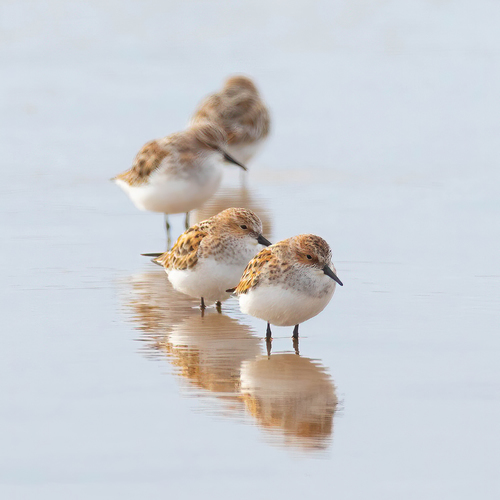 Little Stint
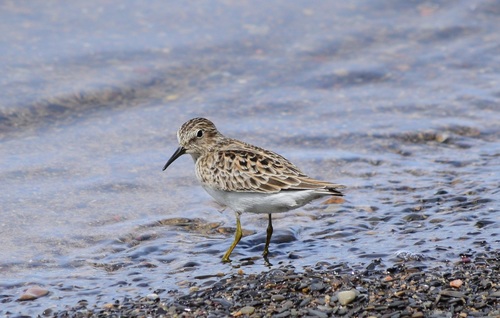 Least Sandpiper
In short
The most reliable field mark between Little Stint and Least Sandpiper is leg color: Little Stint always shows black legs, while Least Sandpiper has yellow-green legs, visible even at a distance or in flight. Juvenile plumages differ: Little Stint juveniles have pale crown stripes and a pinkish breast, while Least Sandpiper juveniles are more rufous above with white mantle stripes. Bill structure and primary projection also help—Little Stint has a finer-tipped bill and longer primary projection. Both are tiny, active shorebirds, but careful attention to legs, bill, and juvenile upperpart pattern will separate them in most field conditions.
Identification tips
- Leg color: Little Stint always has black legs; Least Sandpiper has yellow-green legs. This is the most consistent and visible field mark in all ages and seasons. Even in poor light, check for any hint of yellow or green on the legs for Least.
- Bill structure: Little Stint's bill is fine-tipped and straight, giving a delicate look. Least Sandpiper's bill is short, thin, and slightly decurved. Bill shape is best judged at close range or in photos.
- Primary projection: Little Stint shows a longer primary projection beyond the tertials, giving a more attenuated rear end. Least Sandpiper's projection is shorter, making it look more compact and short-necked.
- Juvenile upperparts: Juvenile Little Stint has pale crown stripes and a pinkish breast, with a neat, scaly look. Juvenile Least Sandpiper is brighter rufous above with bold white mantle stripes, often appearing more patterned and warm-toned.
- Breast and throat: Breeding Little Stint shows an orange wash on the breast and a white throat; Least Sandpiper is streaked brown above with a white belly and lacks the orange wash.
- Supercilium and crown: Least Sandpiper (all ages) shows a distinct pale line above the eye and a dark crown, especially in juveniles and breeding adults. Little Stint's crown is less contrasting, especially in non-breeding plumage.
- Back pattern: Breeding Little Stint shows a strong white 'V' on the back, visible in fresh plumage. Least Sandpiper lacks this mark.
- Leg length and jizz: Little Stint often looks longer-legged and more attenuated, especially when feeding quickly. Least Sandpiper is more compact and crouched.
- Movement: Little Stint is noted for especially quick, darting movements; Least Sandpiper is active but may appear more methodical.
- Winter plumage: Both become greyer above, but leg color and bill structure remain reliable. Juvenile marks fade, so focus on structure and legs.
- Flight views: No distinctive upperwing or tail pattern is noted for either species in the sources, so rely on structure and leg color if visible.
- Voice: Little Stint gives a sharp 'stit' call; Least Sandpiper's call is not described here, so do not rely on vocalization for separation.
- Range and context: In Europe, Little Stint is expected; Least Sandpiper is a rare vagrant. In North America, Least Sandpiper is common, Little Stint is a vagrant. Always consider the likelihood of occurrence.
- Pitfalls: Mud or lighting can obscure leg color, and some Least Sandpipers may show duller legs, but never truly black. Juvenile Little Stint's pale crown stripes can be subtle; check for the pinkish breast and overall neater look.
- Flock composition: Little Stint often joins large mixed flocks with Dunlin and other stints, especially in Eurasia. Least Sandpiper may be found in smaller groups or with other 'peeps' in the Americas.
Size
Both species are among the smallest shorebirds, with Little Stint averaging about 25.5g in body mass [wikidata], and Least Sandpiper ranging from 19–30g [wikipedia]. In practice, size difference is subtle and unreliable in the field, especially when not seen side-by-side. Both are noticeably smaller than most other waders, but size alone will not reliably separate these two.
Plumage
Juvenile Little Stints show pale crown stripes and a pinkish breast, with a generally cleaner, more delicate look above. Juvenile Least Sandpipers are brighter and more rufous above, with prominent white mantle stripes. Adult breeding Little Stints have an orange wash to the breast, a white throat, and a strong white 'V' on the back, while Least Sandpipers in breeding plumage are brown above with dark streaks, a light supercilium, and a dark crown. In winter, both species become greyer above, but Least Sandpiper retains yellow-green legs and a short, thin bill, while Little Stint keeps its black legs and fine-tipped bill. In all plumages, leg color is a key distinction.
Behaviour
Both species are active feeders, picking at mudflats for small invertebrates. Little Stint is noted for especially quick movements. Both can be found in mixed flocks with other small waders, but Little Stint is more likely to be seen in large, dense flocks in its wintering range. Behavior alone is not a strong separator, but the Little Stint may appear slightly more frenetic.
Habitat
Little Stint breeds in arctic Europe and Asia and winters in Africa and South Asia, while Least Sandpiper breeds in northern North America and winters in the southern US, Central and South America. In the Western Palearctic, Least Sandpiper is a rare vagrant, while Little Stint is regular. Both use muddy edges of pools and coastal mudflats on migration and winter. Habitat is only diagnostic in context of known range and vagrancy.
Voice
Little Stint gives a sharp 'stit' call. No distinctive vocalization is noted for Least Sandpiper in the provided sources, and voice is not a primary separator in the field between these two.