

Kleine strandloper vs Kleinste strandloper
Calidris minuta versus Calidris minutilla
Speel een quiz met Kleine strandloper en Kleinste strandloper
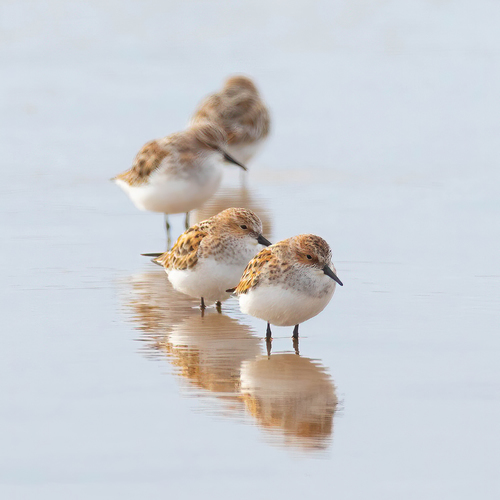 Kleine strandloper
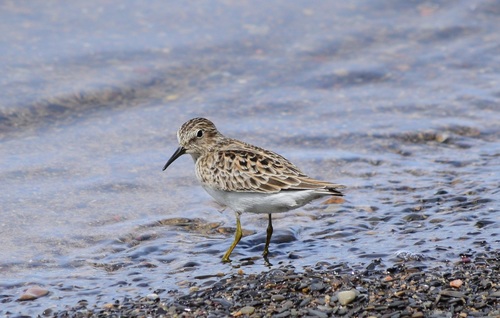 Kleinste strandloper
Kort gezegd
Het meest betrouwbare veldkenmerk tussen Kleine strandloper en Kleinste strandloper is de kleur van de poten: Kleine strandloper heeft altijd zwarte poten, terwijl Kleinste strandloper gele-groene poten heeft, zichtbaar zelfs op afstand of in de vlucht. Juveniele verenkleed verschilt: Juveniele Kleine strandlopers hebben bleke kroonstrepen en een roze borst, terwijl juveniele Kleinste strandlopers boven meer roestkleurig zijn met witte mantelstrepen. De structuur van de snavel en de primaire projectie helpen ook—Kleine strandloper heeft een fijntipige snavel en een langere primaire projectie. Beide zijn kleine, actieve strandlopers, maar aandacht voor poten, snavel en het patroon van het bovenlichaam van juvenielen zal ze in de meeste veldomstandigheden van elkaar scheiden.
Herkenningstips
- Kleur van de poten: Kleine strandloper heeft altijd zwarte poten; Kleinste strandloper heeft gele-groene poten. Dit is het meest consistente en zichtbare veldkenmerk in alle leeftijden en seizoenen. Zelfs bij slecht licht, controleer op enige hint van geel of groen op de poten voor Kleinste.
- Structuur van de snavel: De snavel van de Kleine strandloper is fijntipig en recht, wat een delicate uitstraling geeft. De snavel van de Kleinste strandloper is kort, dun en iets gebogen. De vorm van de snavel is het beste te beoordelen van dichtbij of op foto's.
- Primaire projectie: Kleine strandloper toont een langere primaire projectie voorbij de tertials, wat een meer versmald achterste geeft. De projectie van de Kleinste strandloper is korter, waardoor hij compacter en met een kortere nek lijkt.
- Juveniele bovenkant: Juveniele Kleine strandloper heeft bleke kroonstrepen en een roze borst, met een nette, schubachtige uitstraling. Juveniele Kleinste strandloper is helderder roestkleurig boven met gedurfde witte mantelstrepen, die vaak meer gepattern en warm van toon lijken.
- Borst en keel: Broedende Kleine strandloper toont een oranje was op de borst en een witte keel; Kleinste strandloper is bruin gestreept boven met een witte buik en mist de oranje was.
- Supercilium en kroon: Kleinste strandloper (alle leeftijden) toont een duidelijke bleke lijn boven het oog en een donkere kroon, vooral bij juvenielen en broedende volwassenen. De kroon van de Kleine strandloper is minder contrasterend, vooral in niet-broedende verenkleed.
- Patroon op de rug: Broedende Kleine strandloper toont een sterke witte 'V' op de rug, zichtbaar in verse verenkleed. Kleinste strandloper mist dit kenmerk.
- Lengte van de poten en jizz: Kleine strandloper lijkt vaak langerbenig en meer versmald, vooral wanneer hij snel voedt. Kleinste strandloper is compacter en gedoken.
- Beweging: Kleine strandloper staat bekend om zijn bijzonder snelle, dartelende bewegingen; Kleinste strandloper is actief maar kan methodischer lijken.
- Winterverenkleed: Beide worden grijzer boven, maar de kleur van de poten en de structuur van de snavel blijven betrouwbaar. Juveniele kenmerken vervagen, dus focus op structuur en poten.
- Vluchtzicht: Geen onderscheidend bovenvleugel- of staartpatroon is opgemerkt voor beide soorten in de bronnen, dus vertrouw op structuur en kleur van de poten als deze zichtbaar zijn.
- Stem: Kleine strandloper geeft een scherpe 'stit' roep; de roep van de Kleinste strandloper wordt hier niet beschreven, dus vertrouw niet op vocalisatie voor scheiding.
- Verspreiding en context: In Europa wordt Kleine strandloper verwacht; Kleinste strandloper is een zeldzame dwaalgast. In Noord-Amerika is Kleinste strandloper algemeen, Kleine strandloper is een dwaalgast. Overweeg altijd de waarschijnlijkheid van voorkomen.
- Valstrikken: Modder of verlichting kan de kleur van de poten verdoezelen, en sommige Kleinste strandlopers kunnen doffere poten vertonen, maar nooit echt zwart. De bleke kroonstrepen van juveniele Kleine strandloper kunnen subtiel zijn; controleer op de roze borst en de algehele nettere uitstraling.
- Samenstelling van de groep: Kleine strandloper voegt zich vaak bij grote gemengde groepen met Bonte strandlopers en andere strandlopers, vooral in Eurazië. Kleinste strandloper kan worden gevonden in kleinere groepen of met andere 'peeps' in de Amerika's.
Grootte
Both species are among the smallest shorebirds, with Kleine strandloper averaging about 25.5g in body mass [wikidata], and Kleinste strandloper ranging from 19–30g [wikipedia]. In practice, size difference is subtle and unreliable in the field, especially when not seen side-by-side. Both are noticeably smaller than most other waders, but size alone will not reliably separate these two.
Verenkleed
Juvenile Little Stints show pale crown stripes and a pinkish breast, with a generally cleaner, more delicate look above. Juvenile Least Sandpipers are brighter and more rufous above, with prominent white mantle stripes. Adult breeding Little Stints have an orange wash to the breast, a white throat, and a strong white 'V' on the back, while Least Sandpipers in breeding plumage are brown above with dark streaks, a light supercilium, and a dark crown. In winter, both species become greyer above, but Kleinste strandloper retains yellow-green legs and a short, thin bill, while Kleine strandloper keeps its black legs and fine-tipped bill. In all plumages, leg color is a key distinction.
Gedrag
Beide soorten zijn actieve voeders, die op modderige platen kleine ongewervelden oppikken. Kleine strandloper staat bekend om zijn bijzonder snelle bewegingen. Beide kunnen worden gevonden in gemengde groepen met andere kleine waders, maar Kleine strandloper is waarschijnlijker te zien in grote, dichte groepen in zijn overwinteringsgebied. Gedrag alleen is geen sterke scheider, maar de Kleine strandloper kan iets frenetic lijken.
Habitat
Kleine strandloper broedt in het arctische Europa en Azië en overwintert in Afrika en Zuid-Azië, terwijl Kleinste strandloper broedt in het noorden van Noord-Amerika en overwintert in het zuiden van de VS, Midden- en Zuid-Amerika. In het West-Palearctisch gebied is Kleinste strandloper een zeldzame dwaalgast, terwijl Kleine strandloper regelmatig voorkomt. Beide gebruiken modderige randen van poelen en kustmodderplaten tijdens migratie en overwintering. Habitat is alleen diagnostisch in de context van bekende verspreiding en dwaalgastigheid.
Geluid
Kleine strandloper geeft een scherpe 'stit' roep. Geen onderscheidende vocalisatie is opgemerkt voor Kleinste strandloper in de verstrekte bronnen, en de stem is geen primaire scheider in het veld tussen deze twee.
Kleine strandloper · Kleinste strandloper · Mijn lastige vogels