

Little Pied Cormorant vs Pitt Island Shag
Microcarbo melanoleucos versus Phalacrocorax featherstoni
Play a quiz with Little Pied Cormorant and Pitt Island Shag
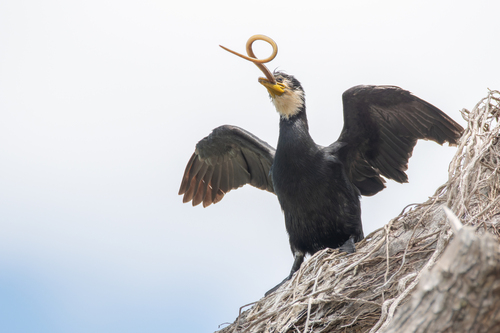 Little Pied Cormorant
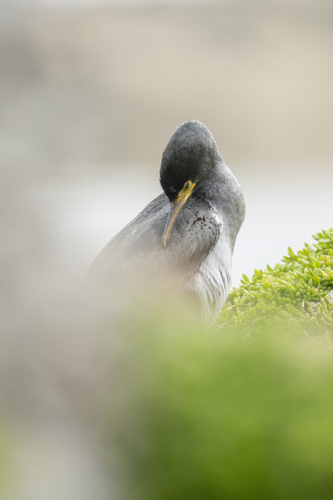 Pitt Island Shag
In short
The most reliable field mark for separating Little Pied Cormorant from Pitt Island Shag is the strong black-and-white contrast of the Little Pied Cormorant’s pied morph, with crisp white underparts and face, versus the Pitt Island Shag’s much more uniform dark body with a gray chest and neck. Structure also helps: Little Pied Cormorant is noticeably smaller, with a shorter yellow bill and longer tail, while Pitt Island Shag is larger, slimmer, and has yellow facial skin and feet. In New Zealand, beware the melanistic (mostly black) Little Pied Cormorant, which can look superficially similar to Pitt Island Shag, but still shows white on the throat and upper neck. Habitat and range are also key: Pitt Island Shag is strictly coastal and endemic to Pitt Island, while Little Pied Cormorant is widespread and found on both inland and coastal waters.
Identification tips
- Pied vs. Uniform Plumage (Adults): Little Pied Cormorant (pied morph) shows sharp black upperparts and white underparts, face, and thighs—very different from the Pitt Island Shag’s mostly dark body with only a gray chest and neck. This is the easiest separation in adults.
- Melanistic Little Pied Cormorant: In New Zealand, melanistic Little Pied Cormorants can look mostly black, but always retain white on the throat and upper neck. Pitt Island Shag never shows this white throat patch; its gray is more diffuse and limited to the chest/neck.
- Facial Skin and Feet: Pitt Island Shag has yellow facial skin around the eyes and yellow feet, while Little Pied Cormorant has yellow on the bill and bare skin but black feet. If you see yellow feet, it’s Pitt Island Shag.
- Bill Structure: Little Pied Cormorant has a noticeably shorter, stubbier yellow bill (about 3 cm), while Pitt Island Shag’s bill is longer and slimmer in proportion to its head.
- Tail Length: Little Pied Cormorant has a relatively long tail for its size, which can be obvious when perched or in flight. Pitt Island Shag’s tail is shorter relative to its body.
- Size and Build: Pitt Island Shag is larger and slimmer, with a more elongated appearance. Little Pied Cormorant is smaller and more compact, often looking ‘chunkier’.
- Habitat Context: If seen on an inland lake, river, or estuary, it is almost certainly Little Pied Cormorant. Pitt Island Shag is strictly coastal and only found around Pitt Island.
- Geographic Range: Pitt Island Shag is endemic to Pitt Island; anywhere else in New Zealand or Australia, a similar bird is almost certainly Little Pied Cormorant.
- Group Size: Little Pied Cormorant is often solitary or in small loose groups, while Pitt Island Shag is usually seen in small breeding groups or singly at sea.
- Immature Birds: Young Little Pied Cormorants are duller, with brownish-black upperparts and paler underparts (if pied); Pitt Island Shag immatures are not described in detail but are likely dark overall. Focus on facial skin and throat color for separation.
- Crest: Little Pied Cormorant may show a small black crest, especially in breeding season; Pitt Island Shag does not have a crest.
- Bare Parts Color: Little Pied Cormorant’s bill and facial skin are yellow, but feet are black. Pitt Island Shag has yellow around the eyes and yellow feet—check feet color if visible.
- Flight Jizz: Little Pied Cormorant in flight appears compact with a long tail and short bill; Pitt Island Shag looks longer and slimmer.
- Voice: Little Pied Cormorant may give a low coo during courtship, but both species are generally silent and not reliably separated by voice.
- Pitfalls: The main confusion is with melanistic Little Pied Cormorants in New Zealand, which can look dark like Pitt Island Shag. Always check for the white throat and yellow feet to confirm ID.
Size
Little Pied Cormorant is smaller (56–58 cm in length) and more compact, with a relatively short bill and longer tail for its size. Pitt Island Shag is larger (about 63 cm in length), heavier (650–1300 g), and has a slimmer, more elongated build. The difference in size and proportions is most apparent when the two are seen side by side, but even singly, the Little Pied Cormorant’s short bill and longer tail stand out compared to the Pitt Island Shag’s more balanced, slender look.
Plumage
For adults, Little Pied Cormorant in its pied morph is sharply black above and white below, with a white face and thighs—this is the most straightforward plumage difference. The melanistic morph (mainly in New Zealand) is all black except for the sides of the head, chin, throat, and upper neck, which remain white; intermediate forms exist. Pitt Island Shag is dark overall, with a black and navy head, back, wings, and tail, but a light gray chest and neck. The yellow facial skin and yellow feet are unique to Pitt Island Shag. Immature Little Pied Cormorants are duller, with brownish-black upperparts and paler underparts if pied, while Pitt Island Shag juveniles are not described in detail but are likely similar to adults in overall dark tones. No distinctive juvenile upperwing patterns are described for either species, so separation relies on overall color contrast and facial/foot color.
Behaviour
Little Pied Cormorant is often seen alone, diving for food in shallow water, and is a solitary feeder. It is frequently observed on inland lakes, rivers, and estuaries, as well as coastal areas. Pitt Island Shag is typically found in small groups at breeding sites or singly within 18 km of Pitt Island, foraging at sea. Both species perch on rocks or trees near water, but Little Pied Cormorant is more likely to be seen away from the coast and is more adaptable in habitat use.
Habitat
Habitat is a strong separator: Little Pied Cormorant is widespread across New Zealand, Australia, and much of Australasia, using both coastal and inland waters (lakes, rivers, estuaries). Pitt Island Shag is strictly coastal and endemic to Pitt Island, found only on rocky shores and open seas nearby. If you are away from Pitt Island or not on a rocky coast, Pitt Island Shag can be ruled out.
Voice
Little Pied Cormorant gives a low cooing sound during courtship. No vocalization is described for Pitt Island Shag, and neither species is particularly vocal or likely to be separated by call in the field.